AI in Monitoring and Evaluation: From Chatbots to Data-Connected Assistants
AI is moving beyond writing and summarizing. Discover what changes when an AI assistant can reason over real M&E data through controlled tools instead of unrestricted database access.

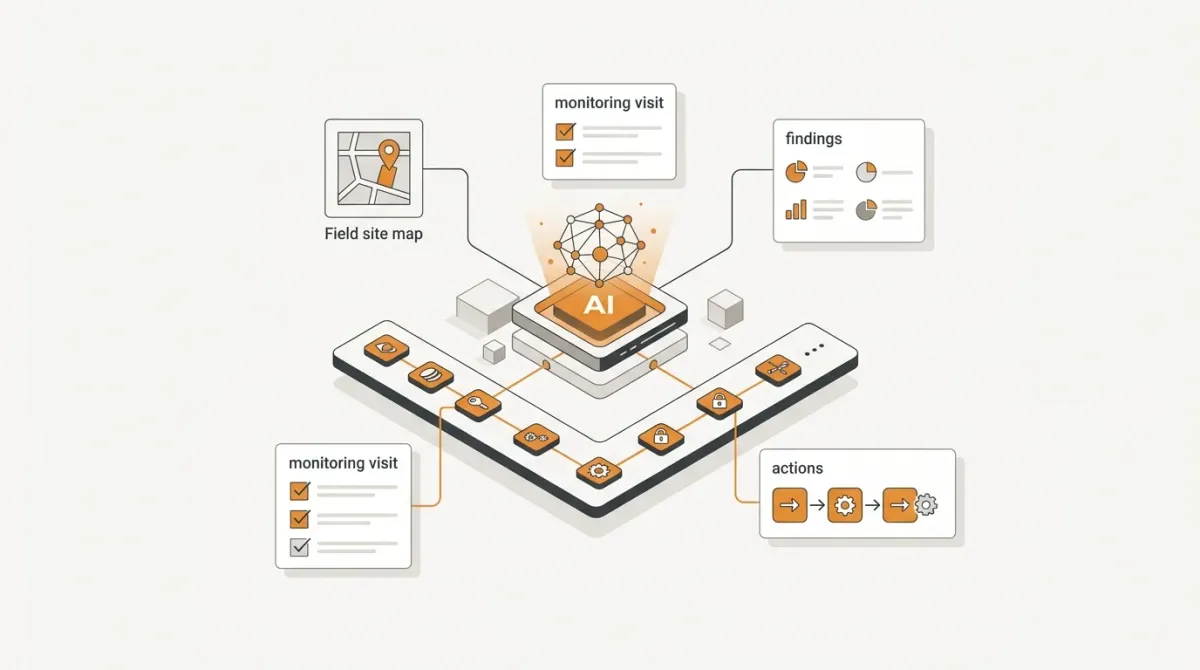
Artificial intelligence is becoming increasingly common in Monitoring, Evaluation and Learning (MEL).
Many organizations have already experimented with AI chatbots to summarize documents, draft reports, explain concepts, or help staff write emails and narratives. These applications can be useful, but they represent only one part of what AI can do for monitoring and evaluation.
The more important shift is from AI that generates answers from a conversation to AI that can reason over an organization's operational data.
For MEL teams, that distinction matters.
A chatbot can tell you what a monitoring indicator means. A data-connected assistant can help you examine what actually happened across the visits, findings, and actions recorded by your organization.
The chatbot model
The simplest way to use AI is to open a chat interface and ask a question.
You provide a prompt, perhaps paste some information into the conversation, and the model generates a response.
For example:
What are common reasons for low immunization coverage?
A modern language model can provide a useful answer based on its training and the information included in the conversation.
But the question is not really about your organization's monitoring data.
The model does not necessarily know:
- which facilities were visited;
- what was observed during those visits;
- which findings were recorded;
- which corrective actions were created;
- whether those actions were completed;
- or whether the same issue has appeared repeatedly.
The AI can reason about the subject, but it is not necessarily reasoning about your operations.
That is the limitation of a conventional chatbot in an M&E environment.
From asking about M&E to asking about your M&E
Now consider a different question:
Which facilities have had repeated stock-management findings during the last three monitoring visits, and which of those findings still have unresolved corrective actions?
This is a fundamentally different type of question.
Answering it requires access to operational information.
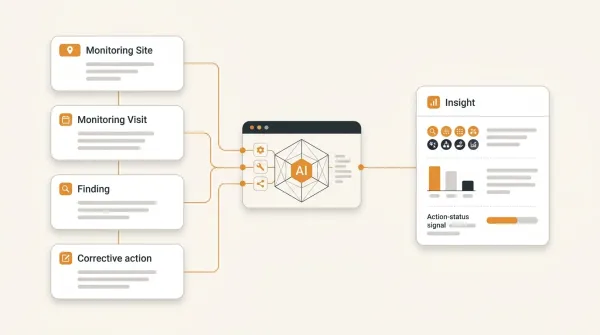
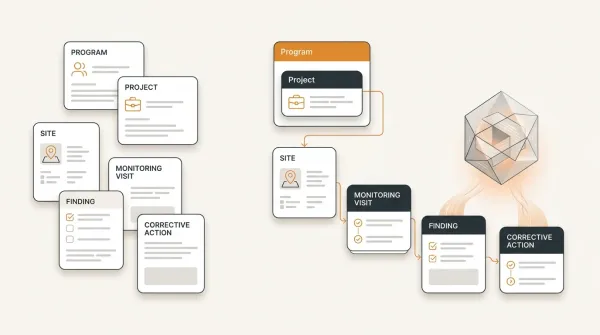
The system needs to understand the organization's monitoring structure and retrieve relevant records. It may need to connect visits to sites, examine findings associated with those visits, inspect corrective actions, and determine their current status.
The AI is no longer simply generating a response about M&E.
It is reasoning over M&E data.
This is where the idea of a data-connected AI assistant becomes important.
What makes an AI assistant data-connected?
A data-connected assistant has access to structured information and tools that allow it to retrieve relevant data when answering a question.
Instead of expecting the user to copy information into the chat, the assistant can work with the organization's existing operational system.
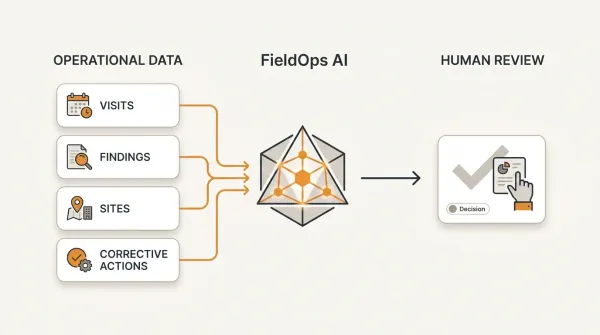
In FieldOps, for example, monitoring information can include:
- programs and projects;
- monitoring sites;
- visits;
- monitoring findings;
- corrective actions;
- action statuses;
- monitoring templates;
- and other operational information.
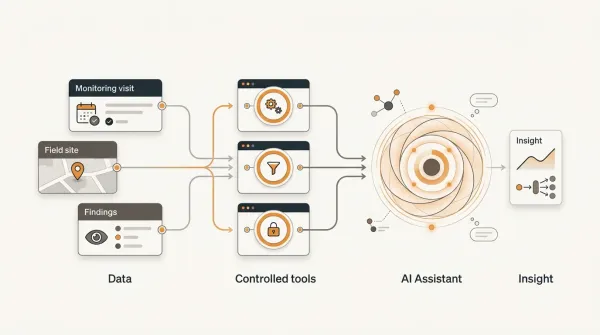
The assistant can use tools to retrieve the information it needs and then use an AI model to reason over the retrieved results.
This creates a different interaction model.
Instead of:
User → Prompt → AI → Answer
the workflow becomes closer to:
User → Question → AI → Data retrieval → Reasoning → Answer
The distinction is subtle from the user's perspective.
They still type a question into a chat interface.
But what happens behind that interface is very different.
Why this matters for monitoring and evaluation
M&E teams already have large amounts of operational information.
The challenge is often not the absence of data.
The challenge is turning that data into something people can understand and act on.
A monitoring system may contain hundreds or thousands of visits. Each visit may contain multiple findings. Each finding may result in one or more actions.
Over time, patterns can become difficult to see.
A program manager might know that several sites have been monitored recently, but identifying recurring issues across those sites may require filtering reports, exporting spreadsheets, reviewing findings and comparing action statuses.
A data-connected assistant can provide another way to interact with that information.
Instead of starting with a report or dashboard, the user can start with a question.
For example:
Which issues are appearing most frequently across our recent monitoring visits?
Or:
Show me sites where findings have increased across the last three visits.
Or:
Which corrective actions have remained open for more than 30 days?
These questions are not necessarily answered by a single database field.
They require the system to bring together multiple pieces of information and then reason over them.
That is where AI becomes particularly interesting for M&E.
The AI does not replace the data system
It is important to understand what a data-connected assistant is—and what it is not.
The AI model should not become the organization's database.
The underlying monitoring system remains the source of operational data.
The AI sits on top of that system and provides a more natural way to explore it.
This is an important architectural distinction.
A model can be extremely capable at understanding language, but it should not be expected to remember the organization's latest monitoring records from its training data.
The operational system knows what has actually been recorded.
The AI provides the reasoning and language interface.
This separation also makes it possible to change the underlying AI provider without having to rebuild the organization's monitoring system.
Multiple AI providers, one monitoring environment
Another interesting aspect of this approach is that the AI model itself does not have to be permanently tied to the application.
Different organizations may have different preferences around AI providers, pricing, availability, privacy requirements, or model capabilities.
A provider-neutral architecture allows an application such as FieldOps to connect to different models while maintaining the same operational data and tools.
The question can remain the same.
The data can remain the same.
The tools can remain the same.
What changes is the model doing the reasoning.
This makes it possible to compare how different models handle the same operational question without changing the underlying monitoring environment.
That is particularly useful when evaluating AI for real-world M&E work.
The important part is not just the model
When discussing AI, it is easy to focus entirely on which model is being used.
Is it Gemini?
OpenAI?
Claude?
DeepSeek?
Mistral?
The model matters, but it is only one component of the system.
For an M&E application, another question may be even more important:
What information and tools can the model access?
A powerful model without access to the organization's operational data may provide a sophisticated generic answer.
A data-connected assistant can potentially provide a much more context-specific answer because it can retrieve the information required for the question.
This changes the role of the AI model.
It becomes less like a standalone chatbot and more like a reasoning layer on top of an operational information system.
From reports to questions
Traditional M&E workflows often revolve around predefined reports.
Someone creates a dashboard.
Someone exports data.
Someone prepares a monthly report.
Someone reviews the findings.
Someone identifies actions.
These workflows remain important.
But AI introduces another possible interface:
the question.
A program manager does not necessarily need to know which report contains the answer.
They can ask the question directly.
For example:
Which sites have the highest number of unresolved findings?
The assistant can determine what information is needed, retrieve the relevant records, and present the result in natural language.
The user can then ask a follow-up question:
What are the common issues at those sites?
And then:
Which of those issues already have corrective actions?
And then:
Which actions are overdue?
The interaction begins to resemble a conversation, but the conversation is grounded in operational data.
That is an important distinction between a chatbot and a data-connected assistant.
Natural language becomes another interface to the database
For decades, interacting with structured data has generally required users to understand forms, filters, reports, queries, dashboards, or spreadsheets.
AI makes it possible to add natural language as another interface.
The user does not necessarily need to know how the underlying tables are structured.
They can describe what they want to know.
The assistant translates the question into the appropriate data retrieval operations, receives the results, and reasons over them.
For example, a user might ask:
How many monitoring visits were conducted in the last quarter?
That may require retrieving visits within a date range.
A more complex question might require several operations:
Which sites were visited more than twice but still have unresolved findings?
The assistant may need to retrieve visits, group them by site, inspect findings, and examine action statuses before constructing the response.
This is where tool-enabled AI becomes particularly useful.
The role of tools
Giving an AI assistant access to tools does not mean giving it unrestricted access to everything in an application.
Tools can be deliberately designed around specific operations.
For example, an assistant might have tools for retrieving:
- programs;
- projects;
- sites;
- visits;
- findings;
- corrective actions;
- and aggregated monitoring information.
The model decides which tools are relevant to the user's question.
The application controls what those tools can access and return.
This provides an important layer between the language model and the underlying data.
The model does not need to know how the database is implemented.
It needs to understand what information a tool can provide.
The application remains responsible for authorization, data access and business rules.
Read-only AI can still be powerful
An AI assistant does not need to modify data to provide significant value.
In fact, a read-only assistant can be particularly useful as an initial implementation.
It can answer questions, identify patterns, summarize monitoring information, and help users explore operational data without changing the underlying records.
This creates a useful separation:
The monitoring system records what happened.
The AI helps users understand what has been recorded.
That distinction is especially important in environments where monitoring records may form part of an organization's formal evidence and reporting processes.
The difference between information retrieval and reasoning
There is also an important distinction between simply retrieving data and reasoning over it.
Suppose an assistant retrieves a list of sites and their latest visit statuses.
That is information retrieval.
Now consider a question such as:
Which sites appear to require additional follow-up based on repeated findings and unresolved actions?
The answer may not exist as a single stored field.
The assistant has to examine multiple pieces of information and make connections between them.
This is where the language model's reasoning capabilities become relevant.
The database provides the evidence.
The model helps interpret the evidence in relation to the user's question.
Keeping the human in the loop
A data-connected AI assistant should not remove the M&E professional from the process.
The goal is not for AI to become the final authority on program performance.
Instead, it can reduce the effort required to find and interpret information.
A program manager can ask a question, inspect the answer, review the underlying records, and decide what action is appropriate.
An M&E specialist can use the assistant to explore patterns before conducting a deeper analysis.
A field team can use it to understand outstanding actions without manually searching through multiple records.
The human remains responsible for interpretation and decisions.
AI simply changes how quickly the relevant information can be reached.
The beginning of a different M&E workflow
The move from chatbots to data-connected assistants represents a broader change in how organizations can interact with their operational data.
The traditional model is often:
Collect → Store → Report → Review
A data-connected AI layer can add another path:
Collect → Store → Ask → Retrieve → Reason → Understand
This does not make dashboards, reports, spreadsheets, or conventional analysis obsolete.
Instead, it gives users another way to reach the information already inside their systems.
For organizations managing complex programs across multiple locations, projects and monitoring cycles, that additional interface can become increasingly valuable.
The most interesting question about AI in M&E may therefore not be:
Which chatbot should we use?
It may be:
What could an AI assistant understand if it could securely reason over the operational data we already collect?
That is the shift from AI as a chatbot to AI as a data-connected assistant.
Move beyond data collection
FieldOps helps NGOs manage field visits, monitoring templates, findings, corrective actions, dashboards and donor reporting in one operational intelligence platform.
Learn more about FieldOps