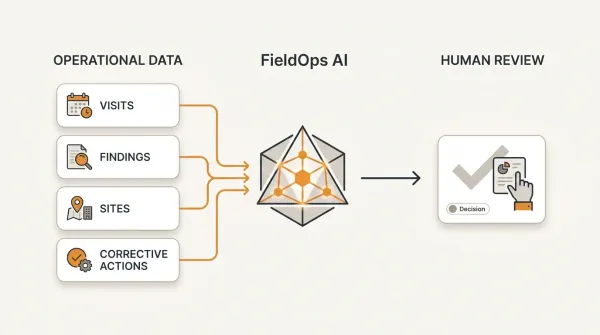
AI-Ready M&E Data: Why Data Quality Matters Before the AI
AI can only reason as well as the information it can access. For monitoring and evaluation teams, becoming AI-ready is less about buying another AI tool and more about having structured, consistent, contextual and trustworthy operational data.
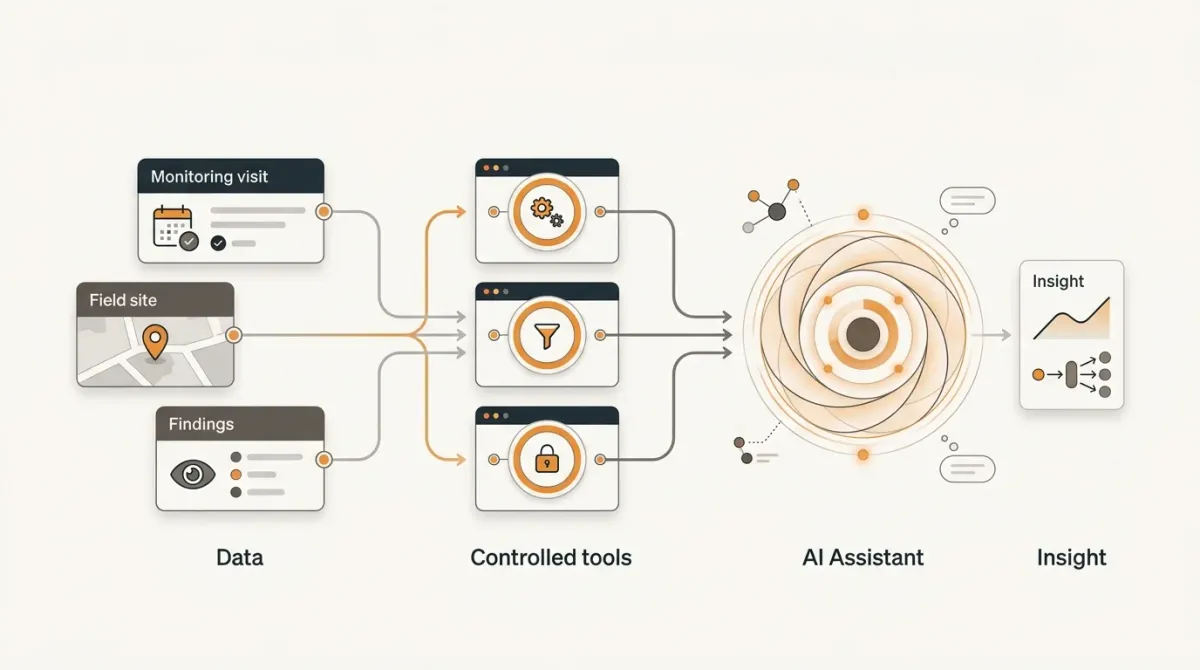
AI is becoming increasingly capable of working with organizational data.
It can summarize large collections of information, identify patterns, compare records, answer questions and help teams make sense of complex evidence.
But there is an important question that organizations often overlook:
Is the data ready for AI?
For monitoring and evaluation teams, this question may matter more than which AI model they choose.
A sophisticated AI assistant connected to inconsistent, incomplete or poorly structured monitoring data can still produce an answer. The problem is that a convincing answer is not necessarily a reliable one.
The foundation of useful AI in M&E is therefore not the AI model alone.
It is the quality and structure of the data behind it.
What does AI-ready M&E data mean?
AI-ready data does not mean that an organization needs to redesign all of its systems for artificial intelligence.
It means that the information an AI system needs to answer questions is available in a form that can be retrieved, interpreted and connected reliably.
For a monitoring system, that might include:
- programs and projects;
- monitoring sites;
- visits;
- indicators;
- findings;
- corrective actions;
- action statuses;
- dates;
- responsible users;
- geographic information;
- and other contextual information.
The important part is not simply having these fields.
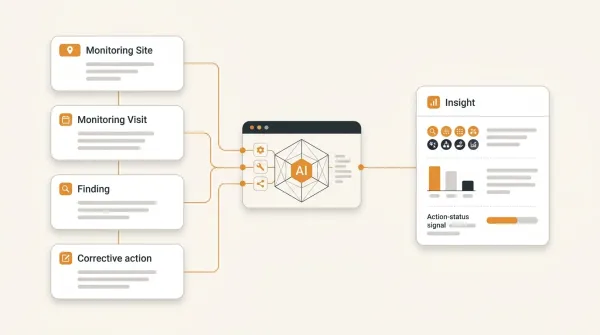
The relationships between them matter too.
A finding should be associated with the visit where it was recorded.
A visit should be associated with a site.
A site should belong to the appropriate program or project.
A corrective action should be traceable to the finding it addresses.
When these relationships are preserved, an AI assistant has much more useful context to work with.
AI does not fix bad monitoring data
One of the most persistent misconceptions about AI is that it can somehow overcome poor data quality.
It cannot.
Suppose a monitoring database contains inconsistent site names:
- Kapsabet Sub-County Hospital
- Kapsabet SCH
- Kapsabet Hospital
- Kapsabet Sub County Hosp.
A human who knows the program may recognize that these records refer to the same location.
An AI system may sometimes infer the relationship, but inference should not be confused with reliable data management.
The same problem becomes more serious when the inconsistency affects dates, indicators, findings, action statuses or other information used to determine program performance.
AI can help identify inconsistencies.
It should not be expected to silently correct them and then treat its assumptions as facts.
Good AI starts with good data practices.
Structure matters more than many organizations realize
Monitoring information is often collected through forms, spreadsheets, mobile applications and other digital tools.
The resulting data may look structured because it exists in rows and columns.
But structure has a deeper meaning.
Consider a monitoring visit.
A visit might have:
- a date;
- a site;
- a monitoring officer;
- a status;
- several findings;
- several corrective actions;
- and responses to dozens of monitoring questions.
These are not necessarily one flat record.
They represent related pieces of information.
If the system preserves those relationships, an AI assistant can ask questions across them.
For example:
Which sites had findings during their last two visits and still have unresolved actions?
That question requires more than searching for a phrase.
The system needs to connect visits, sites, findings and actions.
This is why data architecture becomes increasingly important as organizations begin connecting AI to operational systems.
Context is part of data quality
Data quality is not only about whether a value is technically valid.
Context matters.
Consider the finding:
Stock records were incomplete.
On its own, this tells us very little.
Where was the finding recorded?
When?
During which visit?
For which program?
Was it repeated?
Was an action created?
Who was responsible for the action?
Was the action completed?
A data-connected system can preserve these relationships.
That context gives AI something meaningful to reason about.
Without it, the model may be able to summarize the sentence, but it cannot reliably understand the operational significance of the finding.
For M&E, context is part of the evidence.
Consistency makes analysis possible
Another important characteristic of AI-ready data is consistency.
Imagine that one monitoring officer records a finding as:
Poor stock management
Another records:
Stock management issue
Another writes:
Inadequate inventory practices
And another enters:
Stock cards not properly maintained
These observations may represent the same underlying issue, or they may represent different issues.
A human M&E specialist may be able to interpret them using contextual knowledge.
A system has a harder problem.
This does not mean every finding must be forced into a rigid predefined category.
It means organizations should think carefully about where standardization is useful.
Controlled values can be valuable for fields such as:
- finding categories;
- action statuses;
- visit statuses;
- site types;
- geographic locations;
- program areas;
- indicator types.
Free-text fields still have an important role, particularly for detailed observations.
The combination of structured fields and descriptive text often provides better information than either approach alone.
Completeness matters too
An AI assistant can only reason over information that exists and is accessible to it.
If corrective actions are tracked outside the monitoring system, an assistant connected only to monitoring visits may not be able to determine whether findings have actually been addressed.
If site information is stored separately, the assistant may lack geographic or organizational context.
If historical visits were never migrated, an AI assistant cannot reliably describe long-term trends from records it cannot access.
This leads to an important principle:
AI cannot reason over evidence that the system does not contain.
Before introducing AI, organizations should therefore ask what information is available, where it lives, how complete it is, and whether the relevant relationships are preserved.
Historical data can be especially valuable
AI becomes more useful when it can work with history rather than isolated records.
A single monitoring visit can tell you what happened on one occasion.
A series of visits can reveal patterns.
For example:
Which findings have appeared repeatedly at this site over the last six months?
That question requires historical data.
The assistant needs to examine multiple visits and compare their findings.
Another question might be:
Which corrective actions have remained open across multiple monitoring cycles?
Again, the answer depends on historical records and relationships between events.
This is one reason organizations should think beyond the latest report when preparing their data for AI.
Historical monitoring information can become an important source of operational context.
Data freshness matters
There is another dimension that is easy to overlook: freshness.
An AI assistant answering a question about current operational performance should ideally have access to current information.
If the underlying dataset was last synchronized three months ago, an answer about current outstanding actions may already be outdated.
This does not mean every AI system needs real-time data.
The appropriate refresh frequency depends on the use case.
A quarterly evaluation may not require minute-by-minute synchronization.
A program manager checking overdue corrective actions may benefit from much more current information.
The important thing is to understand the relationship between the question being asked and the freshness of the data available to the assistant.
Data quality is not just a technical issue
M&E data quality is often treated as the responsibility of data teams.
But AI makes data quality an organizational issue.
If field officers record information inconsistently, the problem eventually affects analysis.
If program teams do not close corrective actions, the system cannot accurately represent action completion.
If users create duplicate sites, historical trends can become fragmented.
If monitoring templates change without versioning, comparisons across time may become difficult.
AI makes these issues more visible because users can ask questions that cross many parts of the system.
The quality of the answer may expose the quality of the underlying information.
That can be uncomfortable, but it can also be useful.
AI can become another layer of data quality assurance
There is a positive side to this.
AI does not only consume data.
It can also help organizations examine their data.
For example, an AI-assisted workflow could help identify:
- unusual values;
- missing information;
- inconsistent terminology;
- repeated findings;
- unresolved actions;
- duplicate records;
- unexpected changes in patterns;
- or questions that cannot be answered because required information is missing.
The AI should not automatically decide that every anomaly is an error.
An unusual value may be completely legitimate.
Instead, AI can help surface areas that deserve human review.
This turns the relationship around.
Rather than thinking of AI only as a system that answers questions about data, organizations can also use AI to ask better questions about the quality of their data.
The importance of traceability
For M&E, a useful AI answer should not exist in isolation.
Users need to be able to understand where the answer came from.
Suppose an assistant says:
Five sites have unresolved findings related to stock management.
A useful system should make it possible to investigate that statement.
Which five sites?
Which visits?
Which findings?
Which actions?
What are their current statuses?
Traceability helps users distinguish between an answer that is grounded in operational records and a generic statement generated by a language model.
It also supports the human review process that remains essential in M&E.
The goal is not simply to produce an answer.
The goal is to produce an answer that can be understood and checked.
The model is only one part of the system
This is why choosing an AI model should not be the first step in an organization's AI strategy.
Teams often begin by asking:
Should we use OpenAI, Gemini, Claude, DeepSeek or another model?
That is a reasonable question, but it comes later.
First, organizations need to understand:
- What questions do users need to answer?
- What data is required to answer those questions?
- Where is that data stored?
- Is it structured consistently?
- Are the relationships between records preserved?
- How current is the information?
- Who is authorized to access it?
- How can answers be traced back to source records?
Once those foundations are understood, model selection becomes much more meaningful.
Different models can then be evaluated using the same operational questions and the same underlying information.
A practical AI-readiness checklist for M&E teams
Organizations considering data-connected AI can start with a relatively simple assessment.
1. Identify the questions
Do not start with the technology.
Start with the questions M&E teams actually want answered.
Examples include:
Which sites have recurring findings?
Which corrective actions are overdue?
What issues are appearing most frequently?
How have findings changed over time?
The questions help determine what data the system needs.
2. Map the required data
For each question, identify the records required to answer it.
A question about overdue actions may require findings, actions, dates, responsible users and action statuses.
A question about site performance may require sites, visits, findings and historical records.
3. Check relationships
Make sure the system knows how records relate to each other.
Visits should connect to sites.
Findings should connect to visits.
Actions should connect to findings.
Without these relationships, sophisticated questions become much harder to answer reliably.
4. Review consistency
Look for duplicate records, inconsistent names, missing categories and unclear statuses.
Not every field needs to be standardized.
But the fields used for analysis should have clear definitions.
5. Check freshness
Understand how often data is updated and whether that matches the questions users want to ask.
6. Plan for traceability
Users should be able to move from an AI-generated insight back to the underlying monitoring records where appropriate.
7. Keep human review
AI-generated analysis should support M&E professionals rather than replace their contextual judgment.
AI readiness is really information readiness
The most important lesson is that AI adoption in M&E is not primarily a race to acquire the newest model.
It is an information challenge.
Organizations that have fragmented, poorly connected or inconsistently maintained monitoring information may struggle to get reliable value from even highly capable AI systems.
Organizations with structured operational data, clear relationships, strong data governance and well-defined evidence requirements have a stronger foundation for building useful AI capabilities.
This does not mean their data has to be perfect.
Few real-world M&E systems are.
It means the organization understands what its data represents, where its limitations are, and how the information can be responsibly used.
The future of AI in M&E starts with the data you already have
The most valuable AI application for an M&E team may not be another standalone chatbot.
It may be an assistant that can understand the organization's existing monitoring information and help staff explore it through natural language.
But that capability depends on something that existed long before generative AI:
good information management.
AI can make it easier to ask questions.
It can make analysis more accessible.
It can help surface patterns that are difficult to see manually.
But the evidence still has to come from somewhere.
For M&E teams, becoming AI-ready therefore starts with a deceptively simple question:
Can your monitoring system reliably explain what happened, where it happened, when it happened, what was found, and what happened next?
If the answer is yes, AI has something meaningful to work with.
If the answer is no, improving the data foundation may be the most important AI investment to make first.
Move beyond data collection
FieldOps helps NGOs manage field visits, monitoring templates, findings, corrective actions, dashboards and donor reporting in one operational intelligence platform.
Learn more about FieldOps