Why Context Matters: Making AI Useful for Monitoring and Evaluation
An AI model can understand language, but understanding an M&E question requires more than language. It requires context. Here is why connecting programs, projects, sites, visits, findings and corrective actions can make AI far more useful for monitoring and evaluation teams.
Artificial intelligence is very good at understanding language.
It can interpret questions, summarize information, identify relationships and generate explanations in seconds.
But there is a significant difference between understanding a sentence and understanding the context behind it.
That difference matters enormously in Monitoring and Evaluation.
Consider a simple finding:
Stock records were incomplete.
A language model can understand what that sentence means.
But an M&E professional may immediately ask several additional questions:
Which site?
Which program?
Which project?
When was the finding recorded?
Was this the first time the issue was observed?
Was it also identified during the previous visit?
Was a corrective action created?
Who was responsible?
Has the action been completed?
Without that context, the finding is just a sentence.
With the context, it becomes operational information.
This is one of the reasons context is so important when building AI systems for M&E.
A monitoring record is rarely useful on its own
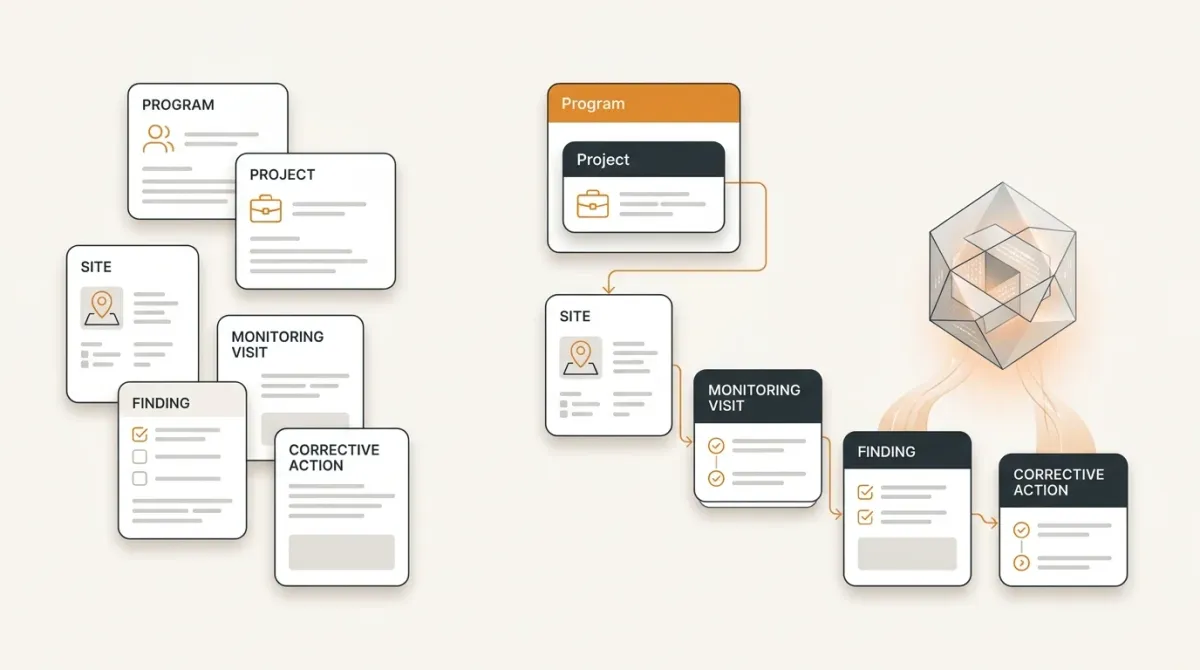
Operational data is usually connected.
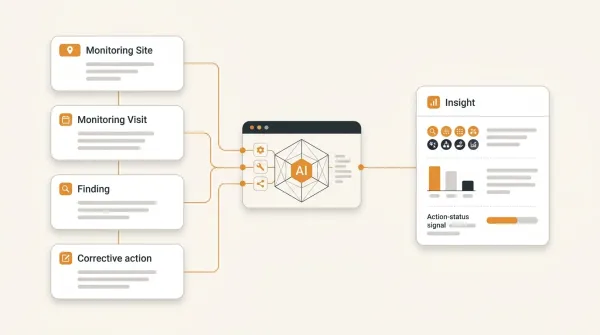
A monitoring visit belongs to a site.
A site belongs to a project or program.
A visit can produce multiple findings.
A finding can result in one or more corrective actions.
An action can have an owner, a deadline and a status.
These relationships are not merely technical database relationships.
They are the context that gives the information meaning.
Consider these two statements:
12 findings were recorded.
And:
12 findings were recorded across four sites during the latest monitoring cycle, with eight associated corrective actions still open.
The second statement is more useful because it contains context.
The difference is not necessarily the language model.
The difference is the information available to the system.
Context changes the question AI can answer
A generic AI chatbot can answer a question such as:
What are common causes of poor stock management?
That can be useful.
But a data-connected M&E assistant can potentially answer a very different question:
What stock-management issues have been repeatedly identified across our monitored sites?
The first question requires general knowledge.
The second requires organizational knowledge.
It requires access to the organization's monitoring records and the relationships between those records.
This is where AI becomes much more relevant to day-to-day M&E work.
The value is no longer simply that the AI knows about monitoring and evaluation.
It is that the AI can understand what is happening in this particular program.
Context starts with the program
One of the strengths of a structured monitoring system is that information does not exist in isolation.
A program provides an important layer of context.
For example, an organization might have several programs operating in different locations, each with different objectives, indicators and monitoring requirements.
A question such as:
Which sites have unresolved findings?
may not be sufficiently specific.
But:
Which sites in the immunization program have unresolved findings from the last monitoring cycle?
provides a much clearer scope.
The AI needs to understand the program context before it can correctly interpret the question and retrieve the relevant information.
This is why program-level context is important when designing AI capabilities for operational systems.
Projects provide another layer
Programs can contain multiple projects.
Projects may have different implementation periods, geographic coverage, partners or monitoring requirements.
A finding recorded at a site is therefore not necessarily meaningful without knowing which project it belongs to.
Suppose the same facility is involved in two different projects.
A question about performance at that facility may require the AI to distinguish between the two projects.
Without that distinction, an answer could combine information that should be analyzed separately.
A context-aware system can preserve those boundaries.
That makes questions more precise and reduces the risk of treating unrelated operational information as if it belonged together.
Sites turn abstract data into field reality
M&E is ultimately about what is happening in real places.
A site provides another critical layer of context.
A monitoring system may contain information about hospitals, health centers, schools, community programs, offices or other implementation locations.
Knowing the site allows the system to connect observations to a real operational environment.
For example:
Which sites have recurring findings?
is a question about patterns across locations.
A useful answer requires more than counting findings.
The system needs to know which findings belong to which sites and how those sites relate to the relevant program or project.
This is where structured site information becomes valuable.
Visits provide the time dimension
Monitoring is not static.
The same site can be visited multiple times.
That means a monitoring finding should be understood in relation to when it was observed.
Consider a finding recorded during one visit.
On its own, it tells us that an issue existed at that point in time.
But if the same issue appears during three consecutive visits, the interpretation changes.
The question becomes:
Is this a recurring issue?
That requires historical context.
The AI needs to understand the sequence of monitoring events rather than treating every finding as an independent record.
This is one reason historical monitoring data can be particularly valuable for AI-assisted analysis.
Findings provide the evidence
Findings are often where monitoring observations become actionable information.
They describe what was observed during a visit.
But even findings benefit from their surrounding context.
For example:
Staff did not consistently maintain stock cards.
is more useful when associated with:
- the specific site;
- the monitoring visit;
- the program;
- the project;
- the finding category;
- previous observations;
- and any corrective action that followed.
This allows an AI assistant to reason about the finding rather than simply summarize its wording.
It can potentially help users distinguish between isolated observations and recurring patterns.
Corrective actions complete the story
There is another important relationship in M&E:
finding → action
A monitoring system should not only capture what went wrong.
It should also capture what happens next.
A finding without an action may require follow-up.
An action that remains open may represent an unresolved issue.
An action that has been completed may indicate that the organization has responded.
This creates a much richer operational picture.
Consider the difference between:
Five sites had stock-management findings.
and:
Five sites had stock-management findings, and three still have unresolved corrective actions.
The second statement connects observation with response.
That is operational intelligence.
Context allows AI to move beyond summaries
Summarization is one of the most obvious uses of generative AI.
Give a model a collection of records and ask it to summarize them.
But an M&E assistant can potentially do more.
It can help users ask questions about relationships and patterns.
For example:
Which findings are recurring?
Which sites have the highest number of unresolved findings?
Which corrective actions are overdue?
Are the same issues appearing across multiple projects?
Which findings have resulted in actions that remain open?
These questions require the AI to work with connected information.
The value comes from combining retrieval with reasoning.
The importance of operational context
This is where FieldOps' approach to monitoring data becomes particularly relevant.
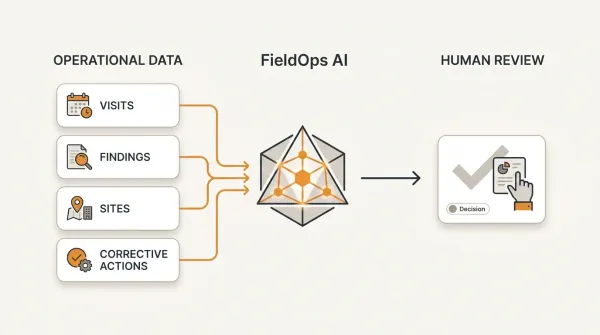
FieldOps is designed around the operational chain of programs, projects, sites, monitoring visits, findings and actions.
That structure is useful independently of AI.
It helps organizations organize their monitoring operations.
But it also creates a foundation for AI-assisted exploration.
When an AI assistant can work with those relationships, it does not have to treat every piece of information as an isolated piece of text.
It can work with the operational structure behind the information.
That distinction is important.
AI does not become useful for M&E simply because a chatbot has been placed on top of a database.
The underlying system needs to provide meaningful context.
Context also improves follow-up questions
One of the most useful characteristics of a data-connected assistant is the ability to continue a line of inquiry.
Imagine starting with:
Which sites have the most unresolved findings?
The assistant identifies several sites.
The user can then ask:
What are the common findings at those sites?
Then:
Which of those findings have remained unresolved across multiple visits?
Then:
Which corrective actions are currently overdue?
Each question builds on the previous context.
This is different from generating a series of unrelated AI prompts.
The conversation becomes an exploration of the organization's operational information.
The assistant can help the user move from a broad question toward a more specific understanding of what is happening.
Context reduces unnecessary manual analysis
Without an AI assistant, answering these questions may require several steps.
An M&E professional might need to:
- Open the monitoring system.
- Filter visits.
- Identify relevant sites.
- Review findings.
- Check action statuses.
- Export information.
- Compare records.
- Prepare a summary.
None of these activities are inherently problematic.
They are simply time-consuming.
A data-connected assistant can provide another route.
The user can begin with the question rather than with the mechanics of retrieving the data.
The system can handle the retrieval and present the relevant information in a form that is easier to explore.
The M&E professional can then spend more time interpreting the evidence and deciding what it means.
Context does not mean giving AI everything
There is also an important architectural principle here.
A useful AI assistant does not need unrestricted access to an organization's entire database.
In fact, unrestricted access is neither necessary nor desirable.
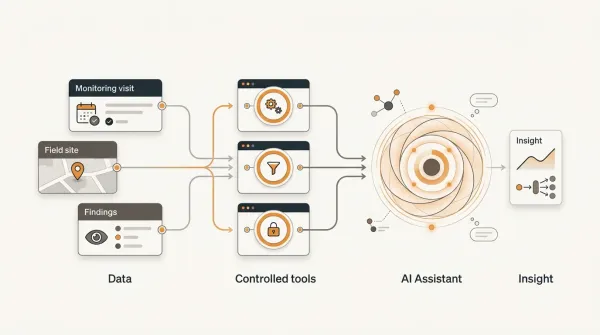
The application can expose specific tools that allow the assistant to retrieve the information needed for legitimate questions.
For example, the assistant may have controlled capabilities for retrieving sites, visits, findings and corrective actions.
The application remains responsible for authorization and access rules.
The AI receives the information it needs to answer the question within the boundaries defined by the system.
This creates a more controlled relationship between AI and organizational data.
The same model can produce different answers in different contexts
This is an important point when evaluating AI systems.
Imagine asking two organizations the same question:
Which sites require follow-up?
The language model could be identical.
The question could be identical.
But the answers should be different because the underlying operational data is different.
That is exactly what we would expect from a useful organizational AI assistant.
The value is not in producing a generic answer that could apply to anyone.
The value is in producing an answer grounded in the organization's own context.
This is why connecting AI to operational data can be more significant than simply adding a more sophisticated chatbot.
Context also makes AI more useful across roles
Different people within an organization may ask very different questions about the same monitoring data.
A field officer might ask:
What actions are still open at my sites?
A program manager might ask:
Which sites have recurring findings?
An M&E specialist might ask:
What patterns are emerging across recent monitoring cycles?
A senior manager might ask:
Which operational issues appear to be recurring across the program?
The underlying data may be the same.
The questions are different.
A data-connected assistant can provide a natural interface for each user without requiring everyone to understand the underlying database or reporting structure.
This can make operational information more accessible across an organization.
Context is also about knowing what the data does not say
A good AI assistant should not only use context to produce answers.
It should recognize when the available context is insufficient.
Suppose a user asks:
Why did performance decline at this site?
The monitoring system may contain visits and findings, but not information about staffing changes, funding interruptions, supply deliveries or external events.
The AI should not invent those explanations.
It can describe what the monitoring data shows and identify information that would be needed to investigate further.
This is an important principle for responsible AI in M&E:
The absence of evidence should not become an invented explanation.
Better context, better questions
There is another benefit to connecting AI with structured operational information.
It changes the kinds of questions users can ask.
Instead of asking only:
Summarize our latest monitoring report.
users can begin asking:
What changed?
What is recurring?
What remains unresolved?
Which sites need attention?
Which actions are overdue?
Where are similar issues appearing?
These are operational questions.
They connect monitoring evidence to follow-up and decision-making.
That is where AI can become much more relevant to the daily work of M&E teams.
FieldOps and the context layer
FieldOps is built around a simple operational idea:
Capture once. Use everywhere.
Monitoring information should not need to be repeatedly copied into separate spreadsheets, reports and systems before it becomes useful.
The same operational information can support monitoring workflows, dashboards, reporting and, increasingly, AI-assisted exploration.
When programs, projects, sites, visits, findings and actions are connected, the organization has more than a collection of records.
It has an operational context.
That context is what allows an AI assistant to move beyond generic knowledge and begin working with the realities of a particular program.
AI is only as useful as the context surrounding it
The future of AI in M&E is unlikely to be defined only by increasingly capable language models.
It will also be defined by how effectively those models can interact with the information systems organizations already use.
A powerful model can explain what a corrective action is.
A context-aware assistant can help identify which corrective actions remain open.
A generic chatbot can explain what a monitoring finding means.
A data-connected assistant can help identify recurring findings across monitored sites.
The difference is context.
For M&E teams, that may be one of the most important considerations when evaluating AI.
The question is not simply:
How intelligent is the model?
It is also:
How much of the operational context can the system reliably understand?
That is where structured monitoring data, connected records and carefully designed AI tools become particularly important.
And it is where AI starts moving from a general-purpose chatbot toward something much more useful: an assistant that understands the operational world in which the organization works.
Move beyond data collection
FieldOps helps NGOs manage field visits, monitoring templates, findings, corrective actions, dashboards and donor reporting in one operational intelligence platform.
Learn more about FieldOps