What Can an AI Assistant Actually Do With Monitoring Data?
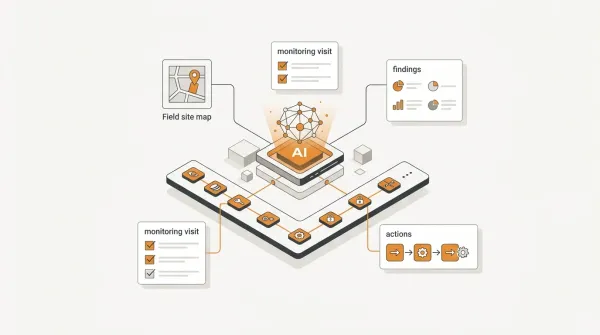
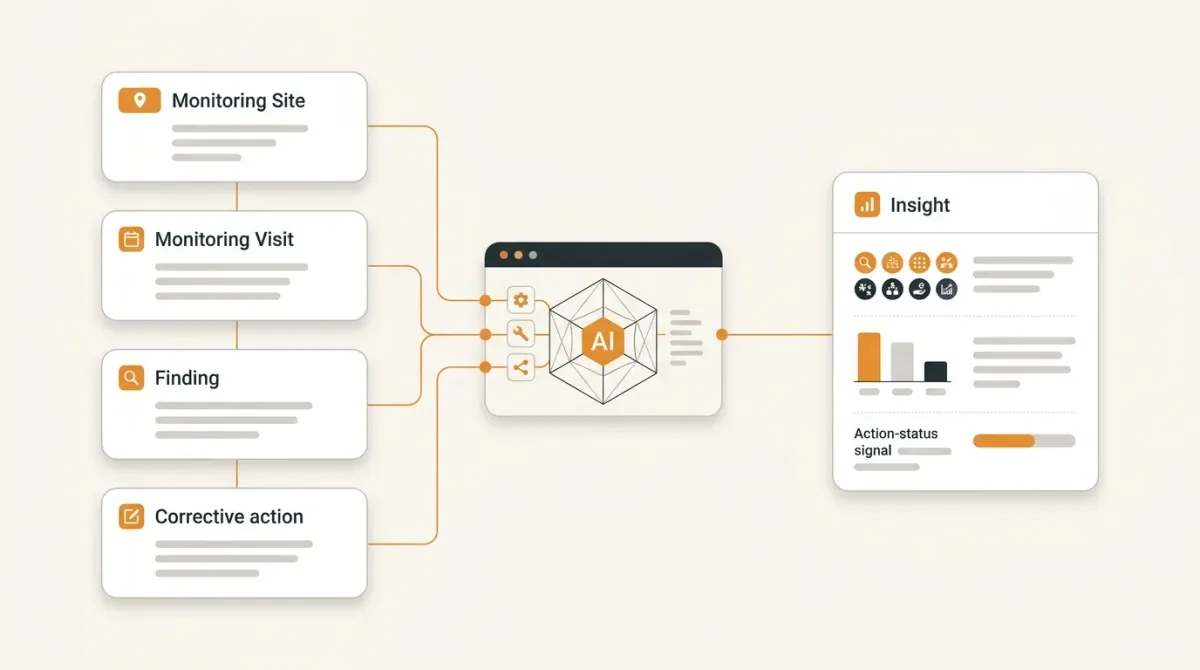
An AI assistant connected to a monitoring system can do more than summarize reports. It can help M&E teams explore visits, sites, findings and corrective actions, identify recurring patterns, and answer operational questions using the organization's own data.

An AI assistant can write an email.
It can summarize a document.
It can explain an M&E concept.
It can help draft a report.
All of these are useful applications of generative AI.
But what happens when the AI assistant can actually work with an organization's monitoring data?
That changes the question from:
"What can AI tell me about monitoring and evaluation?"
to:
"What can AI help me understand about our monitoring data?"
This is where a data-connected AI assistant becomes particularly interesting for M&E teams.
Instead of asking users to manually copy monitoring information into a chatbot, the assistant can work with structured operational information and help users explore it through natural language.
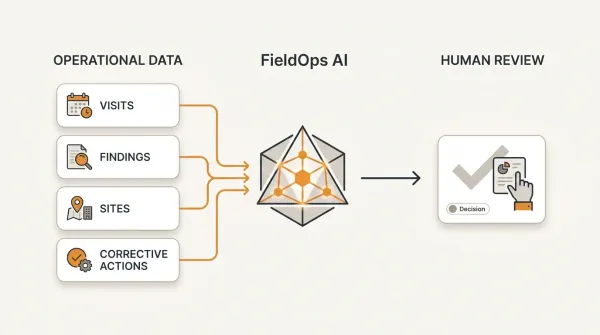
In FieldOps, that means questions can be grounded in information such as programs, projects, sites, monitoring visits, findings and corrective actions.
The result is not simply another chatbot.
It is another way to interact with the organization's operational information.
Start with the questions M&E teams already ask
M&E professionals already have questions.
The challenge is often getting to the answer efficiently.
A program manager may want to know:
Which sites have the most unresolved findings?
An M&E officer might ask:
What issues are appearing repeatedly across recent visits?
A field officer might ask:
Which corrective actions are still open at my sites?
A program lead could ask:
Have the same findings been appearing across multiple monitoring cycles?
These are not questions about what M&E means.
They are questions about what is happening inside a specific program.
That distinction is important.
A generic AI model can explain the concept of an unresolved finding.
A data-connected assistant can potentially identify the unresolved findings that actually exist in the organization's monitoring records.
The assistant starts with operational data
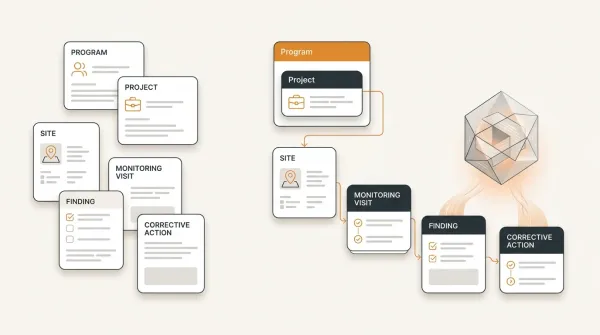
Consider a simple FieldOps monitoring structure.
A program contains projects.
Projects contain sites.
Sites are visited by monitoring teams.
Visits produce findings.
Findings can result in corrective actions.
Each of these records provides information.
But the real value comes from their relationships.
For example:
Program → Project → Site → Visit → Finding → Corrective Action
An AI assistant can use those relationships to understand a question in context.
Suppose a user asks:
Which sites have recurring findings?
The assistant cannot answer that reliably by looking at a single finding.
It needs to look across visits, group information by site, examine findings over time and determine whether similar issues have appeared repeatedly.
That is a reasoning task built on structured operational data.
Finding recurring problems
One of the most useful questions an M&E team can ask is:
What keeps happening?
A single finding may represent an isolated problem.
A finding appearing during several monitoring visits may indicate something different.
For example, imagine that a site is visited three times.
During the first visit, the monitoring team records an issue with stock documentation.
During the second visit, a similar issue is recorded.
During the third visit, the issue appears again.
The important information is not simply that three findings exist.
The pattern is that the issue has persisted across monitoring cycles.
An AI assistant can help users explore these patterns.
It can potentially move from individual records toward questions such as:
Which findings have appeared repeatedly at this site?
Or:
Which findings are recurring across multiple sites?
That can save an M&E professional from manually comparing individual visit records.
Moving from findings to actions
Monitoring does not end when a finding is recorded.
In many cases, a finding should lead to a corrective action.
This creates another useful relationship for AI-assisted analysis.
Consider the question:
Which findings from the latest monitoring cycle still require follow-up?
The answer requires more than identifying findings.
The system needs to understand which findings have associated actions and the current state of those actions.
A more specific question might be:
Which corrective actions related to findings from the latest monitoring cycle are still open?
Now the assistant has to connect:
Visit → Finding → Corrective Action → Status
This is exactly the kind of question that becomes possible when operational records are connected.
From "what happened?" to "what remains unresolved?"
Traditional monitoring reports often focus heavily on what happened during a monitoring period.
An AI assistant can also help users explore what has not yet been resolved.
For example:
Which sites have unresolved findings?
Then:
Which of those findings have been open the longest?
Then:
Which sites have multiple unresolved actions?
Each question narrows the investigation.
The user does not necessarily need to build a new report for every question.
They can continue exploring the information conversationally.
This does not eliminate formal reporting.
It provides another way to investigate the operational data before, during or after reporting.
Comparing sites
Another practical use is comparing monitoring information across sites.
A user might ask:
Which sites recorded the highest number of findings during the last monitoring cycle?
The assistant may need to retrieve visits, associate them with sites, count findings and compare the results.
The next question might be:
What were the most common findings at those sites?
That requires another layer of analysis.
The assistant can use the result of the first question as context for the next one and continue exploring the underlying data.
This can be particularly useful when a program manager wants to move from a broad observation to a more specific investigation.
Looking across multiple visits
M&E data becomes much more valuable when viewed over time.
Consider a question such as:
How has the number of findings at this site changed over the last five visits?
The assistant needs historical context.
It has to identify the relevant visits, order them chronologically, examine the associated findings and summarize the pattern.
The answer is not stored as a single sentence in the database.
It has to be constructed from multiple records.
This is where the combination of structured data and AI reasoning becomes useful.
Understanding the difference between frequency and persistence
There is another distinction that can be important.
A finding occurring frequently is not necessarily the same as a finding that persists.
Suppose one issue appears in ten different sites during one monitoring cycle.
That could indicate a widespread problem.
Another issue might appear at only one site but across six consecutive visits.
That could indicate a persistent site-level problem.
Those are different operational patterns.
An AI assistant can help users ask questions that distinguish between them:
Which findings are widespread across sites?
and:
Which findings are persistent at individual sites?
The underlying monitoring data provides the evidence.
The assistant provides a natural-language way to explore the relationships.
Looking across projects
The same principle applies at a larger scale.
An organization may operate several projects.
A manager might ask:
Are similar findings appearing across different projects?
This requires the assistant to understand project boundaries while also identifying common patterns.
It should not simply combine every record in the organization.
It needs to understand the organizational context of the question.
That is one reason structured relationships between programs, projects, sites and visits are so important.
Asking questions without knowing the report
One of the practical advantages of an AI interface is that users do not necessarily have to know where the answer lives.
In a conventional reporting environment, the user may need to know:
- which dashboard to open;
- which report to run;
- which filters to apply;
- which date range to select;
- which fields to compare.
With an AI assistant, the user can begin with the question.
For example:
Show me sites with repeated findings in the last three monitoring visits.
The system can determine what information is required and retrieve it through its available tools.
The user does not have to translate the question into database terminology.
That is an important shift in how people interact with operational information.
AI can help with investigation, not just answers
The most useful interaction may not be a single question and answer.
It may be a chain of investigation.
For example:
Which sites have the most findings?
The assistant identifies the sites.
The user asks:
What are the common issues at those sites?
The assistant examines the findings.
The user asks:
Which of those issues have appeared more than once?
The assistant looks across historical visits.
The user asks:
Which corrective actions were created for those findings?
The assistant connects the findings to actions.
The user asks:
Which actions are still open?
The assistant examines their statuses.
The conversation has now moved from a broad question about monitoring performance to a specific set of unresolved operational issues.
That is a much more useful application of conversational AI than simply asking it to summarize a report.
FieldOps provides the operational foundation
This is where the structure of FieldOps becomes important.
FieldOps is designed around the operational lifecycle of monitoring information.
Organizations can work with programs, projects, sites, visits, findings and corrective actions as connected operational records.
That structure is useful for ordinary monitoring workflows.
It also provides the context needed for an AI assistant to work with operational questions.
The AI does not have to invent a picture of how the organization operates.
It can work with the structure already represented in the system.
This is an important distinction.
The AI is not replacing the monitoring system.
It is using the monitoring system as a source of operational context.
The AI does not need unrestricted database access
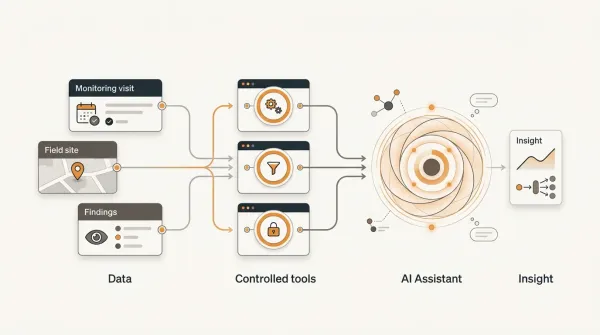
A useful AI assistant should not simply be given unrestricted access to an organization's database.
Instead, the application can expose controlled tools that allow the assistant to retrieve specific types of information.
For example, the assistant may be able to retrieve information about sites, visits, findings or corrective actions.
The application remains responsible for authorization and access controls.
This means the AI can reason over information without becoming the system of record itself.
The underlying monitoring application remains responsible for storing and managing the organization's data.
The AI becomes a reasoning and interaction layer on top of it.
The answer should remain grounded in the records
There is an important difference between generating a plausible answer and generating a useful operational answer.
Suppose the assistant says:
Several sites are experiencing recurring stock-management problems.
That sounds reasonable.
But an M&E professional needs to know:
Which sites?
Which visits?
Which findings?
How many times did the issue occur?
Were corrective actions created?
Are those actions still open?
A data-connected assistant should make it possible to trace an answer back to the underlying operational information.
That helps users validate what the AI is saying.
It also reinforces an important principle for AI in M&E:
The AI should help users understand the evidence, not replace the evidence.
AI can surface questions that dashboards do not anticipate
Dashboards are extremely useful when the questions are known in advance.
But organizations cannot predict every question a program manager will ask.
A dashboard might show:
- total visits;
- findings by category;
- action completion;
- site coverage;
- monitoring trends.
But a manager may suddenly ask:
Which sites had the same finding during their last two visits and still have an open action?
That is a very specific question.
It may not have its own dashboard widget.
Creating a new report every time such a question arises is inefficient.
A data-connected assistant provides another option.
The user can ask the question directly.
AI can make operational information more accessible
M&E systems often contain valuable information that not everyone knows how to query.
An experienced data analyst may know exactly which filters and reports to use.
A program manager may understand the program extremely well but may not know the underlying database structure.
A field officer may know their sites intimately but may not have time to work through multiple reports.
Natural language can provide a bridge between these users and the operational information they need.
Instead of requiring every user to become an expert in the reporting system, the assistant can provide a conversational interface to the information.
This is where "Capture once. Use everywhere." becomes important
FieldOps' underlying philosophy is simple:
Capture once. Use everywhere.
Information collected during monitoring should be useful beyond the moment it is entered.
The same visit can contribute to reporting.
The same finding can contribute to follow-up.
The same corrective action can contribute to action tracking.
And the same operational information can provide context for AI-assisted questions.
This is one of the reasons connected operational data matters.
The value of a monitoring record increases when it can be used in multiple parts of the organization's workflow without requiring repeated manual data entry.
AI does not replace the M&E professional
There is an important boundary here.
An AI assistant can help identify patterns.
It can retrieve information.
It can summarize findings.
It can connect related records.
It can help users explore questions.
But the M&E professional still provides the programmatic interpretation.
Suppose the AI identifies recurring stock-management findings.
The M&E professional may know that a supply-chain disruption occurred during the same period.
Or that a policy changed.
Or that a particular intervention had just started.
The monitoring data may not contain all of that contextual knowledge.
AI can help surface the pattern.
The human still needs to determine what the pattern means and what should happen next.
That is a more useful model for AI adoption than treating the assistant as an autonomous decision-maker.
The real opportunity is operational intelligence
The most interesting capability of a data-connected AI assistant is not that it can produce fluent sentences.
Modern AI models are already very good at language.
The more important capability is helping people move from operational records to understanding.
A monitoring system can tell you that a finding exists.
An AI assistant can help you ask:
Is this finding recurring?
The system can tell you that an action is open.
The assistant can help you ask:
How long has it remained open, and where else are similar actions unresolved?
The system can store visits.
The assistant can help you ask:
What has changed across the last several visits?
This is the difference between data storage and operational intelligence.
A practical way to think about AI in M&E
A useful mental model is:
Data provides the evidence.
Tools provide controlled access to the evidence.
AI provides the reasoning interface.
M&E professionals provide the judgment.
Each part has a role.
The monitoring system records what happened.
The tools retrieve relevant information.
The AI helps users explore relationships and patterns.
The human decides what those findings mean for the program.
This division of responsibility makes AI much more useful—and much more grounded.
The questions are already there
Organizations do not need to invent artificial use cases for AI.
M&E teams already ask questions every day.
What happened?
Where did it happen?
Is it recurring?
What changed?
What remains unresolved?
Which sites need follow-up?
Which actions are overdue?
Are similar problems appearing elsewhere?
The opportunity is to make those questions easier to ask against the organization's existing monitoring information.
That is what makes a data-connected AI assistant different from a generic chatbot.
It does not simply know about Monitoring and Evaluation.
It can help users explore their Monitoring and Evaluation data.
For FieldOps, that is the more important direction for AI.
The goal is not simply to add a chatbot to a monitoring platform.
It is to make the operational information an organization has already collected easier to understand, investigate and use.
Move beyond data collection
FieldOps helps NGOs manage field visits, monitoring templates, findings, corrective actions, dashboards and donor reporting in one operational intelligence platform.
Learn more about FieldOps