Beyond Data Collection: Why NGOs Need Operational Intelligence
Most NGO technology focuses on collecting data. FieldOps argues that the next step is operational intelligence: turning field data into action, accountability and better programme decisions.

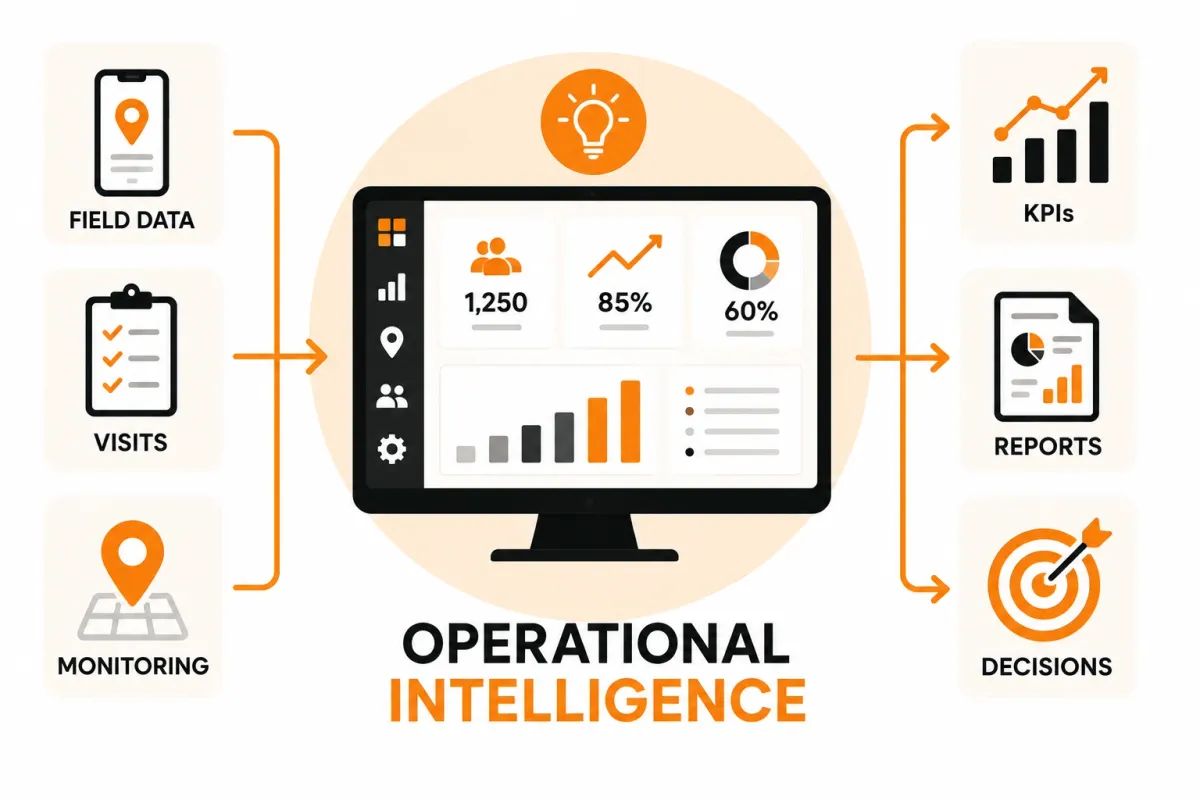
Summary: NGOs have made major progress in digital data collection, but many still struggle to turn field data into timely decisions. This article explains why operational intelligence is the next step beyond forms, spreadsheets and dashboards.
Key Takeaways
- Data collection is important, but it is only the beginning of programme management.
- Many NGOs already have the data they need, but it is scattered across forms, spreadsheets, dashboards, emails and WhatsApp.
- Operational intelligence connects field visits, findings, actions, indicators and reporting into one management view.
- Dashboards help teams see what is happening. Operational intelligence helps them decide what to do next.
- FieldOps is designed as an operational intelligence layer for NGOs, not just another mobile data collection tool.
It is 4:47 p.m. on a Friday
A donor emails asking for the status of outstanding corrective actions across 42 health facilities.
The programme manager knows the data exists.
Some of it is in KoboToolbox. Some of it is in Excel. Some of it is in WhatsApp messages from field supervisors. Some updates were mentioned in a weekly review call. A dashboard was exported three days ago, but nobody is completely sure whether it reflects the latest field visits.
By Monday morning, the report will be ready.
Unfortunately, the situation on the ground will already have changed.
This is not a data collection problem.
It is an operational intelligence problem.
The last decade was about collecting data
Digital data collection changed the way development programmes operate.
Instead of carrying paper forms from the field to the office, teams can now collect data using mobile devices. They can capture GPS coordinates, take photos, apply validation rules, and submit information from remote locations.
Tools such as KoboToolbox and ODK have been especially important for humanitarian, development, research and public sector work. They made mobile data collection more accessible and helped thousands of organisations move away from paper-based processes.
This progress should not be dismissed. It solved a real problem.
What digital data collection improved
| Before digital forms | After digital forms |
|---|---|
| Paper forms moved slowly from field to office | Data can be submitted directly from the field |
| Manual data entry introduced errors | Validation rules reduce common mistakes |
| GPS and photo evidence were difficult to manage | Location and media evidence can be captured with submissions |
| Reports were delayed by physical workflows | Data can be exported and analysed faster |
| Field visibility was limited | Managers can see more of what teams are collecting |
But digital data collection is only one part of programme management.
A submitted form does not automatically create follow-up. A completed survey does not automatically resolve a field issue. A dashboard does not automatically tell a manager what action to take. An Excel export does not automatically create accountability.
FieldOps principle: Collecting data is the beginning of programme management, not the end of it.
Data collection is not the same as programme management
This distinction matters because many organisations still treat data collection as if it were the centre of digital transformation.
They ask:
- Which form tool should we use?
- How do we collect data offline?
- How do we export submissions?
- How do we build a dashboard?
These are important questions, but they are not enough.
A programme manager is not only responsible for collecting information. They are responsible for keeping implementation moving.
They need to know whether planned visits are happening. They need to know whether field findings are being addressed. They need to know whether teams are following up on issues. They need to know whether project activities are producing the expected signals. They need to know whether leadership can trust the information being reported.
That requires more than a form.
It requires an operational system.
In practice
A field officer visits a health facility and records that essential commodities are missing.
A traditional data collection tool captures the observation.
An operational intelligence system goes further:
- The finding is recorded against the facility.
- A corrective action is assigned.
- A responsible person is identified.
- A due date is tracked.
- Supervisors can see whether the issue is still open.
- Leadership can identify whether the same problem is recurring across facilities.
The data point becomes part of an operational workflow.
The hidden gap after submission
In many organisations, the weakest part of monitoring is not what happens before submission. It is what happens after submission.
Field teams collect data. Then the organisation enters a grey zone.
Findings are discussed in meetings. Actions are assigned informally. Follow-ups are recorded in emails. Some updates remain in WhatsApp. Reports are prepared manually. When staff change roles, institutional memory disappears. When donors ask for evidence, teams scramble to reconstruct what happened.
What the gap looks like
| The organisation has | But still struggles with |
|---|---|
| Mobile forms | Follow-up after submission |
| Dashboards | Action ownership |
| Excel reports | Version control |
| WhatsApp updates | Institutional memory |
| Field observations | Corrective action tracking |
| Indicator data | Real-time management decisions |
This gap is costly.
It affects service delivery. It slows corrective action. It weakens accountability. It increases reporting pressure. It makes teams reactive instead of proactive.
The organisation may appear digitally mature because it uses mobile forms and dashboards. But operationally, it may still depend on manual coordination.
This is why operational intelligence matters.
What operational intelligence means for NGOs
Operational intelligence is the ability to see, understand and act on what is happening across programmes, projects, sites, teams and field activities.
It connects data collection with implementation management.
In practical terms, operational intelligence helps an organisation answer questions such as:
- What is happening in the field right now?
- Which activities are on track?
- Which sites need attention?
- Which field visits are overdue?
- Which findings have not been resolved?
- Which teams need support?
- Which risks are emerging?
- Which decisions should be made today?
This is different from traditional reporting.
Reporting often looks backwards. It explains what happened during a period. Operational intelligence supports action while implementation is still happening.
A report may say that 76 percent of planned visits were completed last quarter.
Operational intelligence asks:
- Which 24 percent were missed?
- Why were they missed?
- Who is responsible for follow-up?
- Which programme areas are affected?
- What should be done this week?
That shift from reporting to action is the heart of operational intelligence.
Data collection tells you what happened. Operational intelligence helps you decide what to do next.
Why dashboards alone are not enough
Dashboards are valuable. They help teams visualise trends, compare indicators, and communicate results quickly.
But dashboards have limits.
A dashboard can show that a site scored poorly during a monitoring visit. It may show that an indicator is below target. It may show that a district has fewer completed visits than expected.
But unless the dashboard is connected to an operational workflow, it may not answer the most important question:
What happens next?
Dashboards vs operational intelligence
| Dashboards help teams see | Operational intelligence helps teams act |
|---|---|
| Number of visits completed | Which visits are overdue and why |
| Indicator performance | Which actions are needed to improve performance |
| Facility scores | Which findings are unresolved |
| Geographic distribution | Which locations need supervision |
| Monthly trends | Which decisions should be made now |
Dashboards help people see.
Operational intelligence helps people act.
An NGO does not improve a programme simply by looking at a chart. It improves a programme when the right person sees the right issue, takes responsibility, follows up, and closes the loop.
The problem with disconnected tools
Most NGOs do not rely on one system. They rely on a stack of tools.
A typical programme might use:
- KoboToolbox or ODK for mobile data collection
- Excel for cleaning, tracking and reporting
- Power BI or Tableau for dashboards
- Email for approvals
- WhatsApp for field updates
- Shared folders for documents
- Manual templates for donor reports
- Separate systems for finance, HR or procurement
Each tool may be useful on its own.
The problem is that the operational workflow is spread across all of them.
When information is scattered, programme managers spend too much time reconciling versions of the truth. They ask staff for updates. They compare spreadsheets. They check whether the dashboard is current. They follow up manually. They prepare reports from multiple sources.
Common signs of a disconnected operations stack
- Teams export data frequently but still struggle to make decisions.
- Field findings are not consistently followed up.
- Programme managers depend on manual status updates.
- Different teams maintain different versions of the truth.
- Reporting takes too long.
- Dashboards do not explain what action is needed.
- It is difficult to track visits, findings and actions together.
- Leadership lacks a clear view of field implementation.
Disconnected tools do not only slow teams down.
They make accountability harder.
What FieldOps is trying to solve
FieldOps was built around a simple belief:
Collecting data is the beginning of programme management, not the end of it.
The goal is not to replace every tool NGOs already use. In many cases, organisations have good reasons to keep using tools such as KoboToolbox, ODK Central, Excel, Power BI or Tableau.
The problem is not that these tools are useless.
The problem is that they usually solve separate parts of the operational puzzle.
FieldOps is designed to connect the pieces.
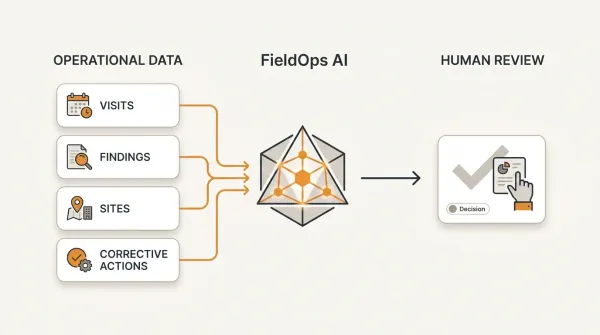
It brings together field visit management, monitoring templates, indicators, field data, findings, actions, dashboards, imports, integrations and reporting workflows into a more coherent operational layer.
Instead of asking, "Where is the latest spreadsheet?", a programme manager can ask, "What needs attention today?"
That is a very different way of working.
How FieldOps is different from traditional data collection tools
Many tools start with the form.
FieldOps starts with the operation.
That difference shapes the platform.
Two different ways of working
| Form-first workflow | Operations-first workflow |
|---|---|
| Create a form | Define programmes, projects and sites |
| Collect submissions | Plan and record field visits |
| Export data | Use monitoring templates and indicators |
| Analyse results | Track findings and corrective actions |
| Prepare reports | Connect dashboards, BI and donor reporting |
Both workflows involve data.
But one is centred on submissions.
The other is centred on managing field operations.
That is the core distinction.
When a form tool is enough
It is important to be honest about this.
Not every organisation needs a platform like FieldOps.
If an organisation is running a short survey, conducting a one-time assessment, or collecting research data for a limited project, a form-based tool may be enough.
For example, KoboToolbox or ODK may be the right fit when the main goal is:
- Designing digital forms
- Collecting survey responses
- Working offline
- Exporting submissions
- Running rapid assessments
These tools are excellent for many data collection use cases.
But organisations often reach a point where the challenge becomes broader.
They are no longer asking only, "How do we collect data?"
They are asking:
- How do we manage recurring field visits?
- How do we standardise monitoring across programmes?
- How do we follow up on findings?
- How do we track actions across sites?
- How do we combine Kobo, ODK and Excel data?
- How do we give leadership real-time visibility?
- How do we prepare donor reports without manual chaos?
- How do we maintain accountability as we scale?
That is when operational intelligence becomes necessary.
Operational intelligence in practice
Imagine a regional programme manager opening FieldOps on Monday morning.
Instead of asking five people for updates, they immediately see:
- Field visits completed last week
- Visits scheduled for the current week
- Sites that have not been visited recently
- Findings raised by field teams
- Corrective actions assigned to staff
- Overdue actions
- Indicator trends by programme or site
- GPS-linked field activity
- Dashboard summaries for leadership
- Data imported from Excel or integrated from KoboToolbox and ODK Central
This does not eliminate management judgement.
It improves it.
The manager still decides what matters. But they decide with better visibility.
That is the real value of operational intelligence. It reduces the distance between field reality and management action.
Why this matters for donor reporting
Donor reporting is often treated as a separate activity. In many organisations, it becomes a stressful process at the end of the month, quarter or project period.
Teams gather data, request updates, clean spreadsheets, verify figures, prepare narratives and respond to follow-up questions.
The pressure is not only about producing a report. It is about proving that the organisation understands its own implementation.
Operational intelligence makes reporting easier because it improves the operational discipline behind the report.
When visits, findings, actions, indicators and dashboards are managed consistently, reporting becomes less of a rescue mission.
The organisation can show:
- What was planned
- What was done
- What was found
- What action was taken
- What changed over time
- Who was responsible
- What evidence supports the report
This strengthens accountability.
It also builds confidence with donors, boards, government partners and communities.
Why this matters for learning
Monitoring and Evaluation is not only about accountability. It is also about learning.
Development work happens in complex environments. Plans change. Risks emerge. Communities respond in unexpected ways. What works in one location may fail in another.
Operational intelligence supports learning because it helps teams notice patterns earlier.
If a problem appears across several field visits, it should not wait until the next quarterly review. If an intervention is working unusually well in one site, teams should be able to study and replicate it. If field teams repeatedly report the same bottleneck, management should see it clearly.
Learning depends on visibility.
And visibility depends on connected operational information.
Why this matters for leadership
Leadership teams need more than activity counts.
They need confidence.
They need to know whether programmes are moving, whether risks are being managed, whether teams are following through, and whether reported results reflect field reality.
In many organisations, senior leaders receive information too late or in too much detail. They either get polished reports after the fact or raw data that requires interpretation.
Operational intelligence gives leadership a middle layer.
It converts field activity into management insight.
For example:
- A director does not need to inspect every field form.
- They need to know which programme areas are off track.
- They need to know which issues are unresolved.
- They need to know where decisions are required.
- They need to know whether the organisation is learning and adapting.
This is what separates reporting from intelligence.
Reporting informs.
Intelligence guides.
The future of NGO technology
The next phase of NGO digital transformation will not be defined by who collects the most data.
It will be defined by who helps organisations act on the data they already collect.
That future will likely include:
- Better integration between field data systems
- Stronger workflow management
- More real-time operational dashboards
- Better use of GIS and GPS data
- More structured findings and action tracking
- Direct integration with BI tools
- Stronger audit trails
- More adaptive programme management
- Better collaboration between M&E, programme and leadership teams
This does not mean every organisation needs a complex enterprise system.
It means the centre of gravity is shifting.
Digital transformation is moving beyond forms and dashboards into operational management.
That is the space FieldOps is built for.
What makes FieldOps different
FieldOps is not trying to be another standalone survey tool.
It is designed as an operational intelligence platform for NGOs and development organisations.
That means it focuses on the full programme operations lifecycle:
| Operational area | How FieldOps supports it |
|---|---|
| Programmes, projects and sites | Organises work around real implementation structures |
| Field visits | Helps teams manage recurring monitoring activity |
| Monitoring templates and indicators | Standardises what is collected and reviewed |
| KoboToolbox and ODK Central | Connects existing field data sources |
| Excel imports | Helps teams bring historical and offline data into one system |
| Findings and corrective actions | Turns observations into follow-up |
| GIS and GPS field data | Adds location context to field operations |
| Dashboards and BI | Supports Power BI, Tableau and BI API workflows |
| Donor reporting | Makes reporting easier by improving operational structure |
| Role-based access and audit trails | Supports accountability and controlled access |
But the features are not the main point.
The main point is the operating model.
FieldOps is built around the idea that field data should not sit separately from field action. Monitoring should not sit separately from programme management. Dashboards should not sit separately from accountability. Reporting should not sit separately from daily operations.
A better system connects them.
The FieldOps point of view
FieldOps exists because we believe NGOs need better operational visibility.
Not more disconnected tools.
Not more manual spreadsheets.
Not dashboards that look impressive but do not drive action.
Better visibility means programme teams can see what is happening, understand what needs attention, and act before problems become reporting failures.
It means field visits are not just recorded; they are managed.
It means findings are not just documented; they are followed up.
It means indicators are not just reported; they are connected to operational decisions.
It means leadership does not wait for the end of the quarter to discover implementation gaps.
This is the shift from data collection to operational intelligence.
Frequently Asked Questions
What is operational intelligence for NGOs?
Operational intelligence for NGOs is the ability to see, understand and act on what is happening across programmes, projects, field visits, sites, findings, actions and indicators. It helps teams move beyond collecting data to making timely operational decisions.
How is operational intelligence different from data collection?
Data collection records information from the field. Operational intelligence connects that information to decisions, workflows, accountability and follow-up actions.
Do NGOs still need tools like KoboToolbox and ODK?
Yes. KoboToolbox and ODK are valuable tools for mobile data collection. FieldOps is designed to complement such tools by helping organisations manage the wider operational workflow around visits, findings, indicators, dashboards and reporting.
Why are dashboards not enough for NGO programme management?
Dashboards help teams visualise information, but they do not always manage accountability. Operational teams also need to know who is responsible for follow-up, which actions are overdue and what decisions should be made next.
When does an NGO need operational intelligence?
An NGO may need operational intelligence when it manages multiple projects, field teams, sites, donors or reporting requirements and can no longer rely on disconnected spreadsheets, form exports, emails and WhatsApp updates.
How Modern Operational Intelligence Platforms Solve This
Collecting data has never been the final goal of Monitoring and Evaluation.
The real objective is helping organisations make better operational decisions while programmes are still being implemented.
Modern Operational Intelligence platforms achieve this by connecting the activities that traditionally exist in separate systems.
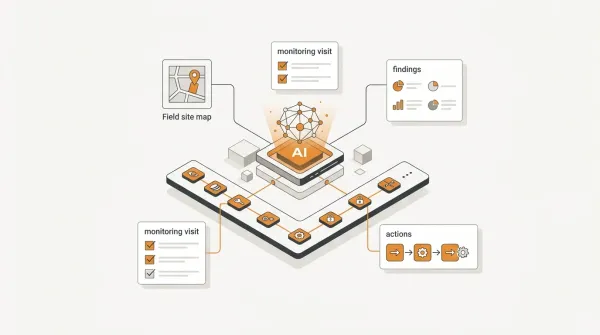
Instead of treating field visits, monitoring templates, findings, corrective actions, dashboards and reporting as independent processes, they bring them together into one continuous operational workflow.
This architecture is built around a few important principles.
Connect Operational Workflows
Planning, field visits, reviews, findings, corrective actions and reporting should form one operational lifecycle instead of existing as isolated activities.
When workflows are connected, operational information moves naturally from field teams to programme managers and leadership without relying on manual coordination.
Create One Trusted Operational Model
Development programmes often use KoboToolbox, ODK Central, Excel, Power BI and many other systems.
Modern Operational Intelligence platforms do not replace every tool.
They standardise operational information so that dashboards, reports and KPIs all use consistent definitions regardless of where the data originated.
Capture Once. Use Everywhere.
Operational information should only need to be collected once.
The same trusted information should then support dashboards, donor reporting, executive reporting, Power BI, Tableau and organisational learning.
Reducing duplicate data entry improves both efficiency and confidence in reported results.
Design for Continuous Learning
Operational Intelligence is not only about understanding today's programme performance.
It is about recognising recurring findings, improving corrective actions, identifying emerging risks and helping organisations learn continuously instead of waiting for quarterly or annual reviews.
How FieldOps Implements These Principles
FieldOps was designed as an Operational Intelligence platform rather than another standalone data collection tool.
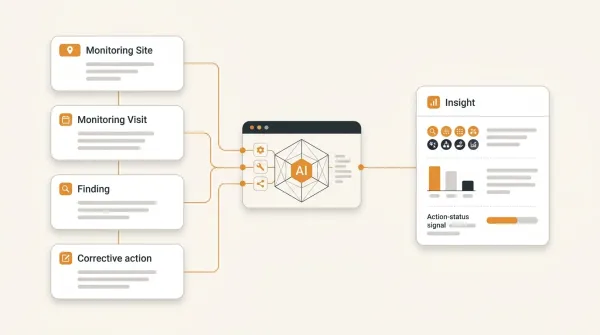
Instead of replacing systems that organisations already depend on, FieldOps connects field visits, monitoring templates, indicators, findings, corrective actions, dashboards and enterprise reporting into one governed operational model.
Information collected from the field becomes part of a structured operational workflow.
Visits become reviewed operational records.
Reviews generate findings.
Findings generate corrective actions.
Corrective actions contribute to dashboards, donor reporting and organisational learning.
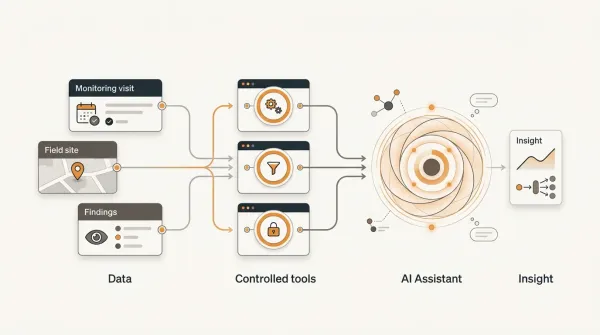
FieldOps also supports integrations with KoboToolbox, ODK Central, structured Excel imports, Microsoft Power BI, Tableau and a secure BI API, allowing organisations to reuse trusted operational information across reporting and analytics without creating multiple versions of the truth.
The objective is simple.
Capture operational information once.
Govern it consistently.
Use it everywhere.
Final thoughts
Data collection will always matter.
NGOs still need reliable forms, accurate submissions, strong validation and high-quality monitoring data.
But collecting data is not the finish line.
It is the starting point.
The organisations that perform best will not be the ones that simply collect more information. They will be the ones that turn information into timely decisions, structured follow-up and better programme execution.
That is why NGOs need operational intelligence.
And that is why FieldOps exists.
Move beyond data collection
FieldOps helps NGOs manage field visits, monitoring templates, findings, corrective actions, dashboards and donor reporting in one operational intelligence platform.
Learn more about FieldOps