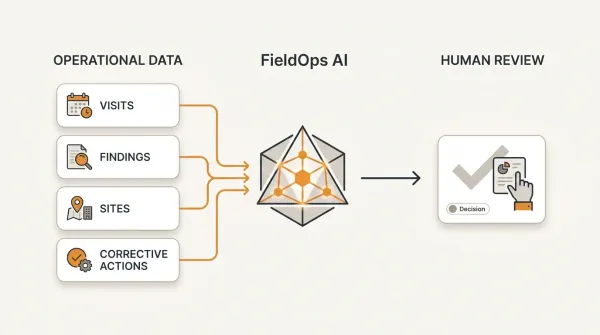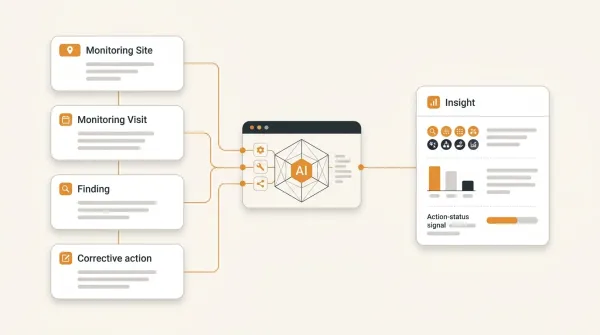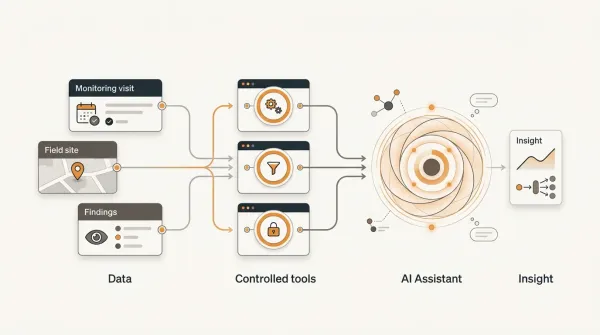
Corrective Action Tracking Software: Turning Monitoring Findings Into Measurable Improvement
Learn how corrective action tracking software helps NGOs, governments and development programmes turn monitoring findings into measurable improvements through ownership, verification, dashboards and operational accountability.

A monitoring finding has little value if nobody is responsible for fixing it. Corrective action tracking transforms observations into measurable improvements by ensuring every issue has an owner, a deadline, evidence of completion and independent verification.
Key Takeaways
- Corrective actions are operational workflows, not administrative checklists.
- Ownership, deadlines and verification are essential for accountability.
- Spreadsheets become difficult to manage as corrective actions increase.
- Modern corrective action tracking software should support the entire lifecycle from finding to closure.
- Operational Intelligence helps organisations identify patterns, reduce recurring issues and improve programme performance.
Search for "corrective action tracking software" and you'll find solutions built for manufacturing, quality assurance and compliance.
Many of those platforms are powerful.
But development programmes, NGOs and government agencies face a different challenge.
Their corrective actions often begin with a field visit.
A monitoring officer identifies a problem.
A supervisor reviews the evidence.
A programme manager assigns responsibility.
Weeks later, someone must verify that the problem has actually been resolved.
That isn't simply task management.
It's operational accountability.
Corrective actions are where monitoring becomes programme improvement.
Why Spreadsheets Eventually Fail
For a small programme with a handful of corrective actions each month, a spreadsheet may be sufficient.
As programmes grow, however, the process becomes increasingly difficult to manage.
Imagine an organisation tracking more than 400 corrective actions across multiple projects.
Different programme managers maintain separate spreadsheets.
Email reminders are sent manually.
Evidence is stored in shared folders.
Leadership asks simple questions:
- Which actions are overdue?
- Which high-risk findings remain unresolved?
- Which programmes have the largest backlog?
- Which corrective actions still require verification?
Answering those questions often requires hours of manual reconciliation.
The problem isn't the spreadsheet itself.
The problem is that spreadsheets were never designed to coordinate complex operational workflows.
What Corrective Action Tracking Software Should Do
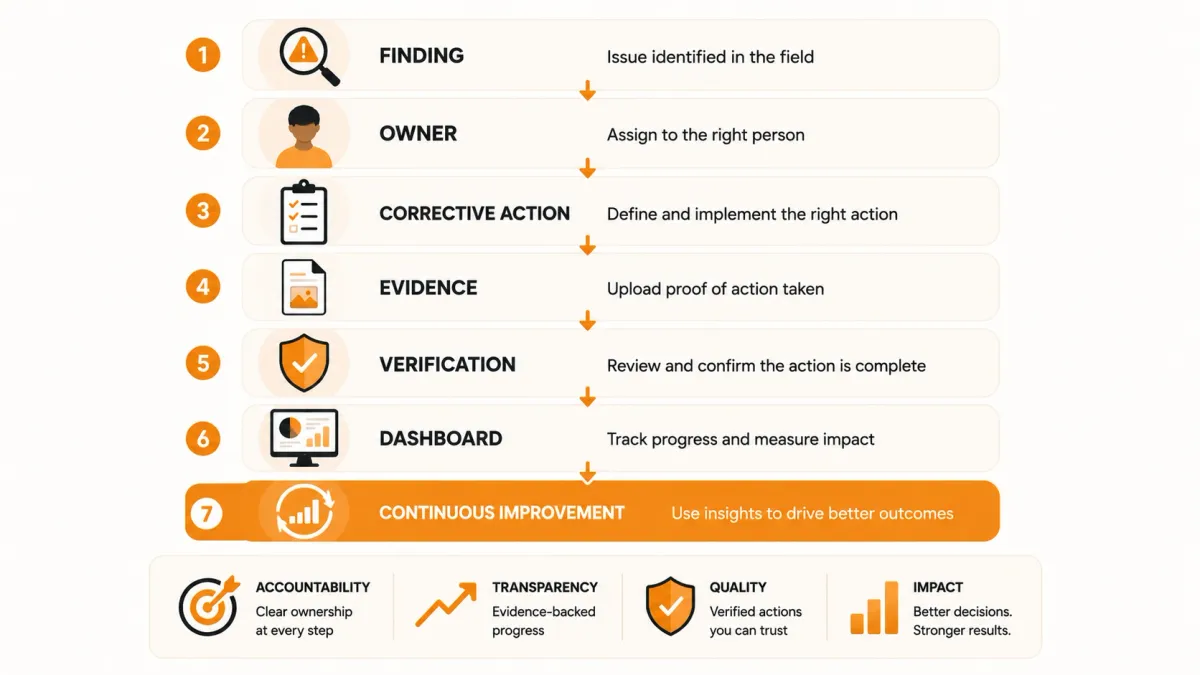
A mature corrective action process follows a structured lifecycle.
Finding
   ↓
Assign Owner
   ↓
Due Date
   ↓
Implementation
   ↓
Evidence Submitted
   ↓
Review
   ↓
Verification
   ↓
Closure
   ↓
Reporting & Learning
Each stage strengthens accountability.
The objective is not merely to record that an action exists.
The objective is to demonstrate that the original problem has been resolved and verified.
Operational Tracking vs Administrative Tracking
Many organisations record only the status of an action.
Operational tracking goes further.
| Administrative Tracking | Operational Tracking |
|---|---|
| Status updated | Problem resolved |
| Completion date | Evidence reviewed |
| Task closed | Independent verification completed |
| Simple checklist | Organisational learning captured |
Operational tracking focuses on outcomes rather than activity.
Real-World Examples
Corrective actions look different across sectors, but the underlying workflow is remarkably consistent.
Education
A school monitoring visit identifies missing attendance registers and incomplete lesson plans.
The corrective action is assigned to the head teacher with a due date. Evidence is uploaded, reviewed and verified before the finding is closed.
Health
A supervision visit discovers expired medicines and incomplete patient records.
Corrective actions are assigned to the facility manager, while a district supervisor verifies implementation during the next visit.
Agriculture
Extension officers identify irrigation failures affecting demonstration plots.
The engineering team receives the corrective action, photographs are uploaded after repairs and a follow-up visit confirms the issue has been resolved.
Infrastructure
Inspectors discover defects in a newly completed water project.
Rather than simply recording the defect, corrective actions are prioritised, assigned to the contractor and tracked until verification.
Humanitarian Response
Rapid assessments identify gaps in shelter distribution.
Corrective actions are assigned immediately, progress is monitored daily and leadership dashboards highlight overdue actions requiring escalation.
Across every sector, the objective is the same:
Identify → Assign → Implement → Verify → Learn.
Common Mistakes in Corrective Action Management
Corrective action processes usually fail because of weak governance rather than unwilling teams.
Common mistakes include:
- Assigning actions to departments instead of named individuals.
- Closing actions without supporting evidence.
- Treating implementation as verification.
- Tracking actions across multiple spreadsheets.
- Losing historical updates in email threads.
- Failing to prioritise high-risk findings.
- No executive visibility into overdue actions.
A corrective action should not be considered complete simply because someone says it is complete. Verification provides the confidence that the original problem has genuinely been resolved.
How Modern Operational Intelligence Platforms Solve This
Corrective action management should be designed as an operational workflow rather than a list of tasks.
Principle 1: Every Finding Becomes an Operational Object
A finding should trigger a managed workflow with ownership, priority, deadlines and reporting—not become another row in a spreadsheet.
How FieldOps implements this
FieldOps links findings directly to operational actions so every issue can progress through a structured lifecycle with status, ownership and reporting.
Principle 2: Ownership Must Be Explicit
Teams do not complete corrective actions.
People do.
Every action should have one accountable owner.
How FieldOps implements this
Each action in FieldOps can be assigned to a responsible individual, prioritised, given due dates and monitored through status updates and notifications.
Principle 3: Verification Is Different From Completion
Completing an activity is not the same as proving that the underlying issue has been resolved.
Modern systems separate implementation from verification.
How FieldOps implements this
FieldOps supports action updates, supporting evidence and independent verification before actions are considered closed, preserving an auditable history of progress.
Principle 4: Actions Become Organisational Intelligence
Corrective actions should not disappear once closed.
Over time they reveal recurring risks, training needs and systemic weaknesses.
How FieldOps implements this
FieldOps aggregates action status, priorities, overdue items and historical trends into operational dashboards, helping leadership identify recurring issues and monitor organisational performance rather than isolated tasks.
A Corrective Action Software Evaluation Checklist
Before selecting a corrective action management solution, evaluate whether it supports operational accountability rather than simply recording tasks.
Workflow
Can the system:
- Create actions directly from monitoring findings?
- Assign one accountable owner?
- Set priorities and due dates?
- Record progress through status updates?
- Attach supporting evidence?
- Separate implementation from verification?
Visibility
Can managers immediately see:
- Overdue corrective actions?
- High-priority actions?
- Actions awaiting verification?
- Repeat findings across projects?
- Organisational trends over time?
Governance
Does the platform provide:
- A complete audit history?
- Role-based permissions?
- Notifications and reminders?
- Dashboards for leadership?
- Consistent reporting across programmes?
If several of these capabilities are missing, your organisation may still be managing corrective actions administratively rather than operationally.
The objective is not to close tasks. The objective is to solve problems and demonstrate that they have been solved.
Our Recommendation
For small teams managing only a few actions each month, a simple tracker may be sufficient.
As programmes expand across multiple projects, regions and implementing partners, choose a platform that can:
- connect findings to corrective actions
- enforce accountability through ownership
- support evidence and verification
- surface overdue and high-risk actions
- provide organisation-wide dashboards
- preserve a complete operational history
The strongest solutions treat corrective actions as part of the field operations lifecycle rather than as isolated tasks.
Final Thoughts
Every monitoring visit represents an opportunity to improve programme delivery.
That opportunity is lost when findings remain unresolved or corrective actions disappear into spreadsheets and email threads.
Effective corrective action management creates accountability, encourages continuous learning and gives leadership confidence that operational issues are being addressed—not simply documented.
Monitoring succeeds when evidence leads to action, action leads to verification and verification leads to lasting improvement.
Move beyond data collection
FieldOps helps NGOs manage field visits, monitoring templates, findings, corrective actions, dashboards and donor reporting in one operational intelligence platform.
Learn more about FieldOps