Donor Reporting Software: How to Reduce Reporting Time While Improving Data Quality
Discover how modern donor reporting software helps NGOs and development programmes reduce reporting time, improve data quality and produce trusted donor reports through better operational processes.

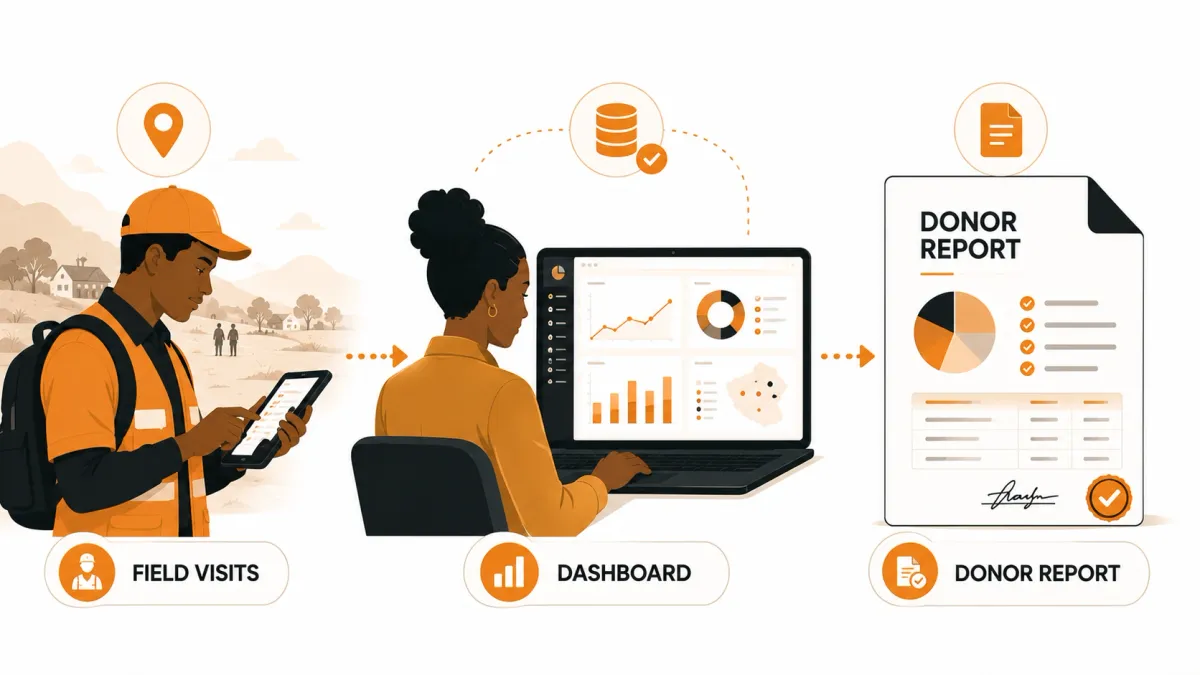
The best donor reports are not created during reporting week. They are created every day through disciplined operational processes, consistent data collection, transparent approvals and trustworthy operational records.
Donor Reporting Software: How to Reduce Reporting Time While Improving Data Quality
Key Takeaways
- Donor reporting begins long before a report is written.
- Manual reporting usually reflects operational fragmentation, not a reporting problem.
- A single operational data model improves both reporting speed and accuracy.
- Good donor reporting software supports governance, auditability and consistent KPIs.
- Operational Intelligence transforms reporting from a manual exercise into a continuous capability.
Every programme team knows the pressure of donor reporting.
A reporting deadline approaches.
Spreadsheets begin circulating.
Indicator owners are asked for updates.
Different versions of the same report appear in email threads.
Charts are copied from previous reports.
Numbers are checked, rechecked and questioned again.
By the time the report is submitted, the team has spent days—or even weeks—consolidating information instead of improving programme delivery.
Many organisations assume this is simply part of donor reporting.
It isn't.
It is usually a symptom of fragmented operational processes.
Reporting rarely becomes difficult because people don't know how to write reports. It becomes difficult because operational information is scattered across multiple systems, spreadsheets and email conversations.
Why Donor Reporting Takes Too Long
Most reporting delays begin with a familiar pattern.
Programme data lives in one system.
Financial information lives in another.
Monitoring indicators are updated in spreadsheets.
Corrective actions are tracked separately.
Leadership dashboards rely on manual exports.
When reporting time arrives, someone must combine all of this information into one coherent narrative.
That process introduces:
- duplicated effort
- inconsistent KPI calculations
- version confusion
- manual validation
- delayed approvals
- increased risk of reporting errors
The reporting process becomes a project in its own right.
Reporting Problems Start Much Earlier
The biggest reporting mistake organisations make is treating reporting as a standalone activity.
In reality, every donor report reflects the quality of operational processes that happened beforehand.
Good reporting starts with:
- clear planning
- consistent field data collection
- structured review workflows
- transparent approvals
- findings management
- corrective action tracking
- governed KPI definitions
When those operational foundations are strong, reporting becomes largely an exercise in communicating trusted information rather than rebuilding it from scratch.
Good reporting is the outcome of good operations—not the substitute for them.
How Modern Operational Intelligence Platforms Solve This
The strongest reporting platforms do not begin with report templates.
They begin with trustworthy operational processes.
Modern Operational Intelligence platforms are designed so that reporting becomes the natural outcome of well-governed field operations rather than a separate administrative exercise.
Principle 1: Capture Once, Use Everywhere
Every piece of operational information should be collected once and reused across dashboards, reports, analytics and donor submissions.
Repeated data entry increases errors and wastes valuable staff time.
How FieldOps Implements This
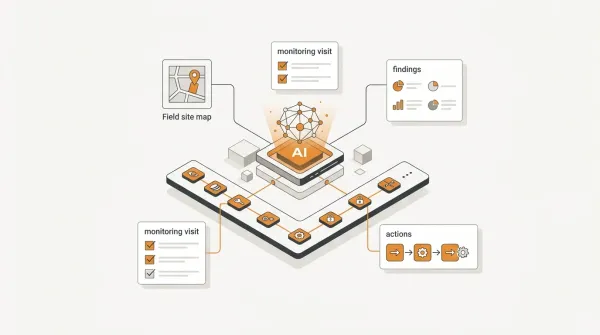
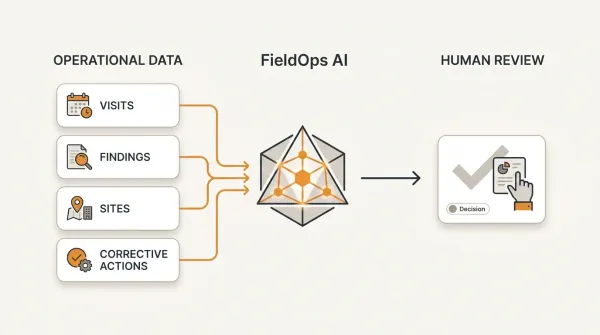
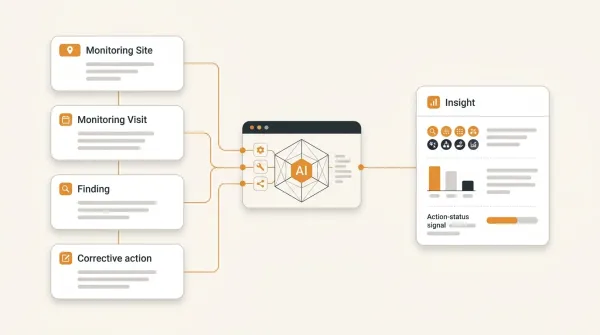
FieldOps captures operational data through monitoring visits, findings and corrective actions, then reuses that trusted information across dashboards, exports, analytics and donor reporting workflows without requiring teams to recreate the same information.
Principle 2: Operational Workflows Create Reporting
Reliable reports begin with reliable operations.
Planning, field visits, reviews, approvals, findings and corrective actions should all contribute to the final report automatically.
How FieldOps Implements This
FieldOps connects the complete field operations lifecycle so that reporting reflects validated operational records instead of manually consolidated spreadsheets.
Principle 3: Govern KPI Definitions Centrally
If every programme calculates indicators differently, no report can be fully trusted.
Modern platforms define KPIs once and make those definitions available everywhere.
How FieldOps Implements This
FieldOps maintains governed KPI definitions and exposes consistent metrics across operational dashboards, executive reporting and external analytics platforms.
Principle 4: Reporting Should Scale Without Slowing Operations
As programmes expand, reporting should remain responsive without affecting day-to-day operational work.
This requires separating analytical workloads from operational transactions.
How FieldOps Implements This
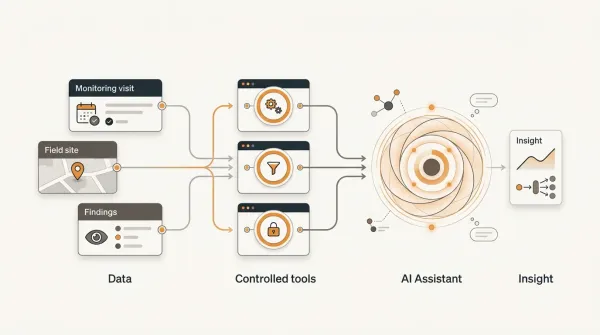
FieldOps provides analytics-optimised reporting datasets and a secure BI API that integrate with Microsoft Power BI, Tableau and Excel. Executive reports can analyse millions of operational records while field teams continue working without reporting queries slowing the application.
A Donor Reporting Software Evaluation Checklist
Before selecting a reporting platform, ask:
Operational Readiness
- Can every reported number be traced back to its original source?
- Are reviews and approvals part of the reporting workflow?
- Are findings and corrective actions reflected in reporting?
Data Governance
- Is there one definition for every KPI?
- Can previous reporting periods be reconstructed?
- Is version history preserved?
Reporting Architecture
- Can the platform integrate with existing tools?
- Does it support enterprise BI platforms such as Power BI and Tableau?
- Can dashboards and donor reports use the same trusted operational data?
- Will reporting remain fast as data volumes grow?
The best reporting platform is not the one that creates reports the fastest. It is the one that makes every reported number trustworthy.
Final Thoughts
Donor reporting should never become a frantic exercise that begins a few weeks before a submission deadline.
By that stage, the most important work should already be complete.
Field visits should have been conducted.
Evidence should have been reviewed.
Findings should have been identified.
Corrective actions should already be underway.
Indicators should already be governed.
Dashboards should already reflect programme performance.
The report simply communicates the operational story that has been unfolding throughout implementation.
Organisations that consistently produce high-quality donor reports are rarely those with the largest reporting teams.
They are the organisations that invest in disciplined operational processes, trusted data, transparent governance and continuous operational visibility.
Reporting then becomes a by-product of good programme management instead of a stressful quarterly project.
As development programmes grow in scale and complexity, reporting platforms alone are no longer enough.
Organisations need operational systems that connect planning, field execution, reviews, findings, corrective actions, dashboards and enterprise reporting into one governed operational workflow.
That is the foundation of Operational Intelligence.
The best donor reports aren't created because people work harder at reporting time.
They are created because reliable operational information was captured once, governed consistently and trusted throughout the entire programme lifecycle.
Move beyond data collection
FieldOps helps NGOs manage field visits, monitoring templates, findings, corrective actions, dashboards and donor reporting in one operational intelligence platform.
Learn more about FieldOps