The Complete Field Operations Lifecycle: From Planning to Corrective Action
Field operations extend far beyond data collection. Discover how leading organisations connect planning, field visits, findings, corrective actions, reporting and continuous learning into one operational lifecycle that improves programme delivery and decision-making

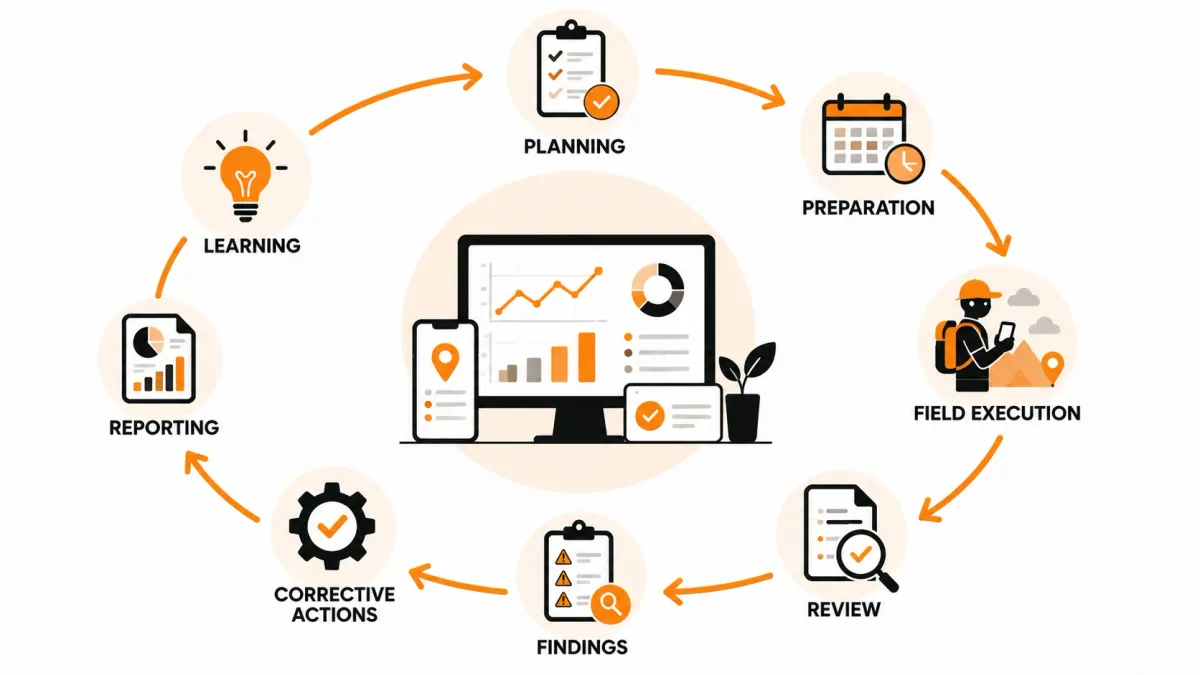
Field operations don't begin when someone arrives at a project site with a tablet or clipboard. They begin much earlier—with planning, preparation and clear operational processes. Organisations that understand this distinction consistently deliver better programmes because they treat monitoring as a continuous management cycle rather than a series of disconnected activities.
Key Takeaways
- Effective field operations begin with planning, not data collection.
- Monitoring is only one stage within a broader operational lifecycle.
- Findings should always lead to corrective actions.
- Dashboards are valuable only when they support decisions.
- Continuous learning strengthens future programmes.
- Operational Intelligence connects every stage of the lifecycle into a single workflow.
Whether you're managing a donor-funded agriculture programme, supervising infrastructure projects, coordinating humanitarian activities or monitoring health interventions, one challenge is almost universal.
Getting reliable information from the field isn't enough.
The real challenge is ensuring that information leads to better operational decisions.
Many organisations have invested heavily in digital data collection over the past decade.
Paper forms have become mobile applications.
GPS coordinates are captured automatically.
Photographs are uploaded instantly.
Dashboards update in near real time.
Yet despite these technological advances, many programme teams continue to experience familiar frustrations.
- Field visits are delayed.
- Monitoring reports arrive too late.
- The same findings appear quarter after quarter.
- Corrective actions are tracked in spreadsheets that few people update.
- Management meetings spend more time discussing what happened than deciding what to do next.
The problem usually isn't a lack of information.
It's that every stage of field operations is managed separately.
Planning happens in one system.
Monitoring happens in another.
Reporting is produced somewhere else.
Follow-up actions are often live in email, spreadsheets or meeting minutes.
Collecting better data won't solve disconnected workflows. Organisations need a way to connect planning, field execution, findings, corrective actions and reporting into a single operational lifecycle.
Looking Beyond the Field Visit
Ask someone to describe field monitoring and they'll probably picture a field officer interviewing beneficiaries, inspecting construction work or completing a digital questionnaire.
Those activities are certainly important.
But they represent only one moment in a much larger process.
Long before the first field visit takes place, decisions have already been made that will influence the quality of every observation collected.
- Programme objectives have been defined.
- Indicators have been selected.
- Monitoring templates have been designed.
- Field teams have been assigned.
- Travel has been approved.
- Sites have been prioritised.
- Equipment has been prepared.
If any of these activities are poorly managed, even the most capable field officer will struggle to produce reliable information.
That's why high-performing organisations don't think about monitoring as a single event.
They think about it as a continuous operational lifecycle.
The Eight Stages of Modern Field Operations
Rather than treating monitoring as a single activity, leading organisations manage field operations as a continuous lifecycle.
| Stage | Purpose | Typical Outputs |
|---|---|---|
| Planning | Define objectives and priorities | Monitoring plans, schedules |
| Preparation | Prepare teams and logistics | Assigned visits, updated templates |
| Field Execution | Collect evidence | Responses, GPS, photos, notes |
| Review | Verify quality | Approved or returned visits |
| Findings | Identify issues | Risks, observations, recommendations |
| Corrective Actions | Resolve issues | Assigned tasks and deadlines |
| Reporting | Support decisions | Dashboards, management reports |
| Learning | Improve future programmes | Better processes and guidance |
Each stage depends on the quality of the one before it.
Weak planning creates inconsistent field visits.
Weak review reduces confidence in reports.
Weak follow-up allows the same issues to recur.
When organisations strengthen every stage instead of focusing only on data collection, monitoring becomes a management discipline rather than a reporting exercise.
Stage 1: Planning Sets the Direction
Planning rarely receives the same attention as dashboards or mobile applications.
Yet it is arguably the most important stage in the entire lifecycle.
Good planning answers critical questions before anyone leaves the office.
- What are we trying to learn?
- Which indicators require verification?
- Which locations should be prioritised?
- Who should conduct the visit?
- What evidence should be collected?
- What risks deserve additional attention?
Answering these questions consistently creates a shared understanding across programme teams.
Without that consistency, different field officers may interpret monitoring requirements differently, making it difficult to compare results across projects or reporting periods.
In Practice
Imagine a national education programme monitoring classroom conditions.
One supervisor records the number of desks available.
Another records only damaged desks.
A third includes comments from teachers but no photographs.
A fourth uploads photographs without written observations.
Each visit contains useful information.
Together, however, they create a reporting challenge because the teams were never working to the same operational standard.
This isn't a data collection problem.
It's a planning problem.
Operational excellence isn't created during the field visit. It's created through the planning decisions that shape every visit before it begins.
Characteristics of Effective Planning
| Characteristic | Benefit |
|---|---|
| Standard monitoring templates | Consistent evidence collection |
| Clearly defined indicators | Comparable reporting |
| Scheduled field visits | Better operational coverage |
| Assigned responsibilities | Clear accountability |
| Risk-based prioritisation | Efficient use of resources |
| Defined review procedures | Improved data quality |
Planning isn't about creating unnecessary administration.
It's about establishing enough structure that every field visit contributes to a coherent operational picture instead of becoming an isolated activity.
Planning naturally leads into preparation.
The next stage determines whether field teams arrive ready to gather meaningful evidence—or spend valuable time solving avoidable operational problems.
Stage 2: Preparation Creates Consistency
A well-planned field visit can still fail if preparation is rushed.
Preparation connects planning with execution. It ensures people, processes and technology are ready before anyone travels to a project site.
Many operational problems begin long before a field team arrives on site.
A missing monitoring template.
An outdated questionnaire.
A tablet that hasn't synchronised.
A vehicle that wasn't booked.
A supervisor who wasn't informed.
Each issue seems minor on its own.
Together, they reduce the quality and consistency of monitoring.
What Preparation Should Include
Preparation is more than logistics.
It is about giving field teams everything they need to succeed.
An effective preparation process usually includes:
- Assigning field officers and supervisors
- Confirming visit objectives
- Selecting the correct monitoring template
- Reviewing previous visit history
- Downloading forms for offline use
- Confirming GPS coordinates
- Checking devices and batteries
- Confirming transport and accommodation where required
- Identifying known operational risks
Preparation doesn't remove uncertainty from field work. It removes avoidable uncertainty.
Preparation Checklist
| Question | Ready? |
|---|---|
| Has the visit been assigned? | ✓ |
| Is the correct monitoring template available? | ✓ |
| Have previous findings been reviewed? | ✓ |
| Are indicators clearly defined? | ✓ |
| Is offline access available if required? | ✓ |
| Are logistics confirmed? | ✓ |
| Has a reviewer been identified? | ✓ |
Stage 3: Field Execution Is Where Planning Meets Reality
Field execution is the stage most people associate with monitoring.
Field officers interview beneficiaries.
Inspect facilities.
Observe activities.
Capture photographs.
Record GPS coordinates.
Complete digital forms.
But collecting information isn't the objective.
Producing reliable evidence for better operational decisions is.
Information Comes From Many Sources
Modern programmes rarely depend on one source of information.
| Source | Typical Purpose |
|---|---|
| Monitoring forms | Structured observations |
| KoboToolbox | Surveys and assessments |
| ODK Central | Mobile data collection |
| Excel | Partner submissions and historical data |
| GPS | Location verification |
| Photographs | Visual evidence |
| Documents | Registers, contracts and supporting records |
| Field observations | Context and qualitative insight |
The challenge isn't gathering information.
It's bringing these different sources together into a coherent operational picture.
Context Matters
Imagine two field visits that record exactly the same responses.
One includes verified GPS, photographs and supervisor approval.
The other contains no supporting evidence and is submitted three weeks late.
The data may appear identical.
The operational confidence is not.
Reliable decisions depend on reliable context—not just reliable data.
Technology has transformed monitoring, but it should support professional judgement rather than replace it.
Experienced field officers often notice issues that no questionnaire can anticipate.
Those observations frequently become the most valuable findings from a visit.
Stage 4: Review Builds Trust
Submitting a field visit should not automatically make it part of official reporting.
Every organisation needs an appropriate review process.
Review improves confidence in operational information before it influences programme decisions.
Typical review activities include:
- Checking completeness
- Verifying photographs
- Confirming GPS locations
- Validating unusual responses
- Requesting clarification
- Approving or returning visits
Why Review Matters
| Without Review | With Review |
|---|---|
| Missing responses remain unnoticed | Missing information is corrected |
| Duplicate visits may be accepted | Duplicate records are identified |
| Weak evidence enters reports | Evidence is verified |
| Reports rely on unchecked data | Reports rely on trusted information |
Maintaining an audit trail also strengthens accountability.
For every visit, organisations should know:
- who created it
- who submitted it
- who reviewed it
- who approved it
- what changed
- when it changed
- why it changed
Once a visit has been reviewed, the next question is no longer "What happened?"
It becomes:
"What did we learn, and what should we do about it?"
Stage 5: Findings Transform Information into Insight
By this stage, the organisation has something valuable.
Not just data.
Verified information.
The next challenge is understanding what that information actually means.
That is the purpose of findings.
A finding is more than an observation.
It identifies an issue, success, trend or risk that deserves attention.
Without structured findings, important issues often disappear inside lengthy reports that are rarely revisited.
Observations vs Findings
| Observation | Finding |
|---|---|
| Fifty farmers attended training. | Attendance was below target because invitations reached two villages late. |
| A classroom has been completed. | The building is complete but does not meet accessibility requirements. |
| Medicines are available. | Current stock levels are unlikely to last until the next delivery cycle. |
| A borehole is operational. | The borehole is working but there is no maintenance committee. |
Observations describe reality.
Findings explain why that reality matters.
Data records events. Findings identify what deserves action.
Prioritising Findings
Not every finding requires the same response.
| Priority | Recommended Action |
|---|---|
| Low | Continue monitoring |
| Medium | Assign a corrective action |
| High | Escalate to programme management |
| Critical | Immediate intervention |
Prioritisation ensures that programme teams focus their time where it will have the greatest impact.
Characteristics of Strong Findings
High-quality findings are:
- evidence based
- specific
- objective
- measurable
- linked to programme objectives
- supported by photographs or documentation where appropriate
Clear findings make later decisions much easier.
Stage 6: Corrective Actions Create Improvement
Many organisations produce excellent monitoring reports.
Far fewer consistently manage what happens afterwards.
As a result, the same recommendations appear quarter after quarter.
The same operational problems continue to affect programme delivery.
Monitoring becomes an exercise in documenting recurring issues rather than solving them.
Monitoring creates awareness. Corrective actions create change.
Closing the Loop
Every significant finding should answer five questions.
| Question | Example |
|---|---|
| What needs to happen? | Repair damaged water pump |
| Who is responsible? | County Water Engineer |
| When should it be completed? | Within 14 days |
| How will success be verified? | Follow-up inspection |
| What evidence is required? | Photographs and completion report |
Nothing should depend on memory.
Everything should be visible and accountable.
Corrective Action Workflow
| Status | Meaning |
|---|---|
| Open | Work has not started |
| In Progress | Work is underway |
| Awaiting Verification | Reported complete but awaiting confirmation |
| Completed | Verified and closed |
| Cancelled | No longer required |
Tracking these stages allows managers to understand not only what has been found, but what has actually been resolved.
In Practice
Imagine a donor-funded agricultural programme operating across three counties.
Routine monitoring identifies several recurring issues:
- irrigation pumps are not receiving scheduled maintenance
- farmer attendance at training sessions is declining
- procurement delays are affecting equipment delivery
- GPS locations for several project sites are inaccurate
Instead of documenting these issues in a quarterly report and moving on, each finding becomes a corrective action.
Engineering teams resolve maintenance issues.
Programme officers investigate declining attendance.
Operations managers address procurement delays.
Field supervisors verify project locations.
One month later, management can clearly see:
- what has been resolved
- what remains outstanding
- who is responsible
- which actions are overdue
- where operational risks remain
The conversation has shifted from reporting problems to managing improvement.
A Simple Decision Framework
| If the finding... | Then... |
|---|---|
| Has minimal operational impact | Record and monitor |
| Affects programme delivery | Assign a corrective action |
| Creates financial or compliance risk | Escalate to management |
| Poses an immediate safety risk | Trigger urgent intervention |
Are You Closing the Loop?
Use this quick assessment.
- □ Every finding has an owner.
- □ Every corrective action has a due date.
- □ Managers can identify overdue actions.
- □ Completed actions require evidence.
- □ Repeat findings are analysed for root causes.
- □ Dashboards include corrective action progress.
If several boxes remain unchecked, your monitoring process may still be ending with reports instead of operational improvement.
The final stages of the lifecycle explain how reporting and organisational learning transform operational information into long-term programme improvement.
Stage 7: Reporting Should Drive Better Decisions
Many organisations treat reporting as the finish line.
The field visits are complete.
The dashboards have been refreshed.
The donor report has been submitted.
The monitoring cycle appears to be over.
In reality, reporting should mark the beginning of decision-making rather than the end of monitoring.
A useful report answers practical questions.
- Are programme activities on track?
- Which locations need additional support?
- Which corrective actions remain overdue?
- What operational risks are emerging?
- Where should managers focus next?
If a report simply presents numbers without helping people decide what to do next, it provides information but not operational insight.
Different Audiences Need Different Reports
| Audience | Primary Need |
|---|---|
| Field Officers | Assigned work and outstanding visits |
| Supervisors | Reviews, approvals and quality issues |
| Programme Managers | Progress, trends and operational risks |
| Executives | Strategic performance indicators |
| Donors | Evidence linked to programme outcomes |
The best dashboard is not the one with the most charts. It's the one that helps someone make the right decision quickly.
Bringing Operational Information Together
Modern programmes rarely depend on a single source of information.
Operational reporting often combines:
- monitoring visits
- monitoring templates
- KoboToolbox surveys
- ODK Central submissions
- Excel imports
- GPS and GIS data
- findings
- corrective actions
- business intelligence dashboards
The goal is not to collect more information.
The goal is to present one coherent operational picture.
Stage 8: Learning Creates Better Programmes
Strong organisations don't just complete projects.
They improve because of them.
Every monitoring cycle should strengthen the next one.
Questions become clearer.
Templates improve.
Training evolves.
Recurring issues are prevented instead of repeatedly documented.
Learning transforms monitoring from a compliance exercise into a strategic capability.
In Practice
A programme conducts more than 2,000 field visits every year.
Supervisors repeatedly notice that field photographs are inconsistent.
Instead of reminding field officers after every review, the organisation improves the system itself.
It updates:
- monitoring templates
- reviewer guidance
- onboarding materials
- training sessions
- quality standards
Within months, photograph quality improves across every programme.
The organisation hasn't simply corrected individual mistakes.
It has improved the process that produced those mistakes.
Operational Intelligence Maturity Model
Organisations generally evolve through recognisable stages.
| Level | Characteristics |
|---|---|
| Level 1 — Reactive | Paper forms and disconnected spreadsheets |
| Level 2 — Digital Collection | Mobile forms replace paper but workflows remain fragmented |
| Level 3 — Managed Operations | Standard templates, structured reviews and consistent processes |
| Level 4 — Operational Intelligence | Findings, corrective actions and reporting are connected |
| Level 5 — Continuous Improvement | Operational insight continuously improves programmes |
Digitising data collection is an important milestone.
It is not the destination.
Operational maturity comes from connecting the entire lifecycle.
Self-Assessment
How mature is your operational process?
- □ Field visits follow a standard planning process.
- □ Monitoring templates are consistent.
- □ Every visit is reviewed.
- □ Findings are tracked separately from observations.
- □ Corrective actions have owners and deadlines.
- □ Managers can identify overdue actions.
- □ Dashboards combine multiple operational data sources.
- □ Lessons learned improve future monitoring.
The more statements you can confidently tick, the stronger your operational processes are likely to be.
Final Thoughts
Field operations are not isolated activities.
Planning influences preparation.
Preparation shapes field execution.
Field execution produces findings.
Findings generate corrective actions.
Corrective actions improve reporting.
Reporting drives learning.
Learning strengthens future planning.
When organisations manage these stages as a connected lifecycle, monitoring becomes much more than collecting information.
It becomes a continuous process for improving programme delivery.
That is the essence of Operational Intelligence.
Move beyond data collection
FieldOps helps NGOs manage field visits, monitoring templates, findings, corrective actions, dashboards and donor reporting in one operational intelligence platform.
Learn more about FieldOps