From Findings to Follow-Up How AI Can Connect Corrective Actions to Monitoring Results
A monitoring finding is only part of the story. When findings, corrective actions and follow-up visits are connected, AI can help M&E teams understand what happened after an issue was identified, whether actions were followed through, and whether problems reappeared in later monitoring.
A monitoring finding is rarely the end of the story.
When a field team identifies a problem, the next question is usually what happened after it was recorded.
Was a corrective action created?
Who was responsible?
Was it completed?
Was the finding checked again during a later visit?
Did the issue return?
For M&E teams, understanding this chain can require moving between findings, corrective actions, monitoring visits, and follow-up records.
When those records are connected, an AI assistant can help users explore the full story rather than looking at each record in isolation.
A finding without follow-up is only part of the picture
Imagine a monitoring visit identifies this finding:
"Required stock documentation was incomplete."
That is useful evidence.
But an M&E professional will usually have more questions.
- Was an action created?
- What was the action?
- Who was responsible?
- Was it completed?
- When was it completed?
- Was the issue checked during the next visit?
- Did the finding appear again?
The finding tells you what was observed.
The corrective action tells you what was supposed to happen next.
The follow-up visit can tell you what happened afterward.
Together, they provide a much more complete monitoring story.
Connecting the chain
Conceptually, the relationship looks like this:
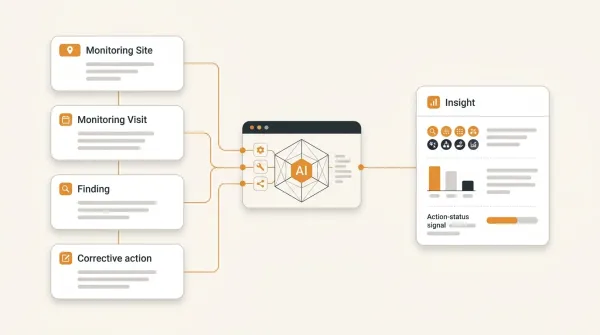
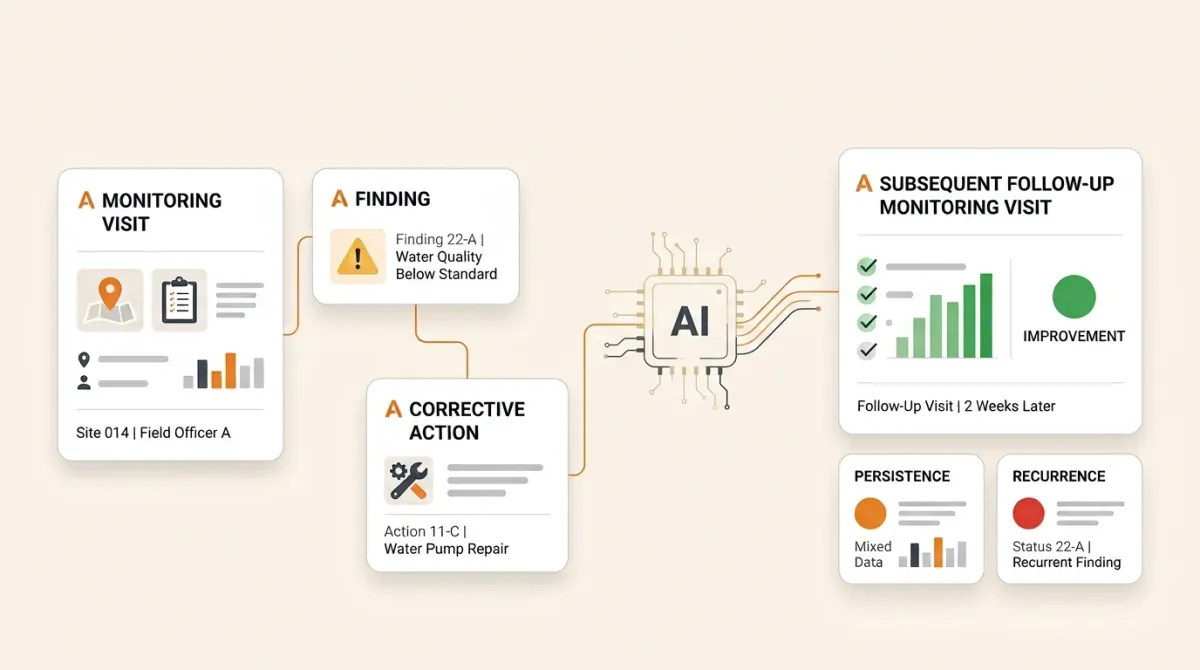
Monitoring Visit → Finding → Corrective Action → Follow-up → Subsequent Finding
Each part provides different information.
The visit provides the monitoring context.
The finding provides the observed issue.
The corrective action records the response.
The follow-up provides evidence about what happened afterward.
The subsequent visit provides another opportunity to determine whether the issue persisted, improved, or was resolved.
This chain is particularly useful when an M&E professional is trying to understand not just what problems were identified, but how those problems were handled.
The difference between recording an action and resolving a finding
These are not necessarily the same thing.
Suppose a finding is recorded during a monitoring visit and a corrective action is created.
The action might later be marked as completed.
That tells you the action was recorded as completed.
It does not automatically prove that the underlying problem was resolved.
A later monitoring visit may provide stronger evidence.
For example:
Visit 1
Finding: Required documentation is incomplete.
Action: Update the documentation process.
Status: Open.
Visit 2
Action: Marked as completed.
Finding: Documentation is still incomplete.
Now the monitoring history contains an important distinction.
The corrective action was recorded as completed, but the related finding appeared again.
That is exactly the kind of relationship that can be difficult to see when records are reviewed independently.
AI can help connect the records
An AI assistant can help answer questions that require several related records.
For example:
"Show me findings that had corrective actions marked complete but appeared again in a later monitoring visit."
That question is not asking the AI to summarize a single visit.
It requires the assistant to:
- Retrieve findings.
- Identify related corrective actions.
- Examine their statuses.
- Look at subsequent monitoring visits.
- Determine whether related findings appeared again.
- Present the evidence in a useful sequence.
This is where connecting AI to operational data becomes more interesting than simply asking a general-purpose model to summarize text.
The model is not expected to remember the monitoring history.
The system retrieves the relevant records.
The AI reasons over what it receives.
The timeline matters
Consider a simplified example.
January
A monitoring visit identifies incomplete beneficiary records.
January
A corrective action is created to improve record maintenance.
February
The action is marked completed.
March
A follow-up monitoring visit identifies the same documentation problem.
A simple report might show:
Corrective action: Completed
But the timeline tells a different story:
Finding identified → action created → action completed → finding observed again
That sequence is much more useful for investigation.
An M&E professional might then ask:
"Why did this finding reappear after the corrective action was completed?"
At that point, the assistant should distinguish between what the records demonstrate and what they do not.
It can show that the finding reappeared.
It may be able to show the action that was completed.
But unless the monitoring data contains evidence explaining the recurrence, it should not invent a reason.
The AI should preserve the distinction between evidence and interpretation
This distinction becomes particularly important when AI is analyzing corrective actions.
Suppose the records show:
- Finding: incomplete reporting records
- Action: staff refresher training
- Action status: completed
- Later finding: incomplete reporting records
The assistant can reasonably describe the sequence.
It can say that the issue was documented again after the action was recorded as completed.
But it should not conclude:
"The training was ineffective."
That is an interpretation that may require additional evidence.
Perhaps the training occurred but the wrong staff attended.
Perhaps the problem was caused by a system issue.
Perhaps the later finding concerned a different reporting period.
Perhaps the records are incomplete.
The AI should help the user investigate these possibilities rather than presenting an unsupported explanation as fact.
Corrective actions create another dimension of M&E data
Findings describe problems.
Corrective actions describe responses.
That makes actions particularly valuable when analyzing monitoring performance.
An M&E team might want to ask:
"How many findings currently have no corrective action?"
Or:
"Which corrective actions remain open?"
Or:
"Which sites have repeated findings associated with overdue actions?"
Or:
"Which findings have reappeared after their corrective actions were completed?"
These questions require the system to understand relationships between different types of operational records.
They cannot be answered reliably by looking at findings alone.
AI can help investigate unresolved findings
Imagine a programme manager asking:
"Which findings have remained unresolved across multiple monitoring visits?"
The assistant could retrieve the relevant visits and findings and organize the information by site or project.
The result might reveal a pattern such as:
Site A
Finding first recorded in Visit 1 → still present in Visit 2 → still present in Visit 3.
Site B
Finding first recorded in Visit 2 → corrective action created → resolved by Visit 3.
Site C
Finding first recorded in Visit 1 → action completed → finding appears again in Visit 4.
The value is not simply the summary.
The value is the ability to move from the summary back into the operational evidence.
The M&E professional can then investigate individual records rather than manually searching through every visit.
It can also work in the other direction
The same relationship can be explored starting from corrective actions.
For example:
"Which corrective actions are still open?"
The assistant can identify the actions and then provide their related findings, sites, projects, and monitoring visits.
A follow-up question could be:
"Which of those actions are linked to findings that have appeared more than once?"
The user has moved from actions to findings to monitoring history through a conversation.
That is a different experience from navigating a series of separate screens and reports.
Programme managers can ask higher-level questions
Once the underlying relationships are available, questions can move from individual records to programme-level patterns.
For example:
"Which types of findings are generating the most corrective actions?"
Or:
"Which sites have the highest number of unresolved findings?"
Or:
"Which projects have findings that continue across monitoring cycles?"
These questions can help users investigate operational patterns.
But the quality of the answer still depends on the quality and completeness of the underlying records.
If findings are inconsistently categorized, if actions are not linked to findings, or if historical visits are missing, the assistant cannot reliably reconstruct the complete picture.
AI does not remove the need for good monitoring data.
It makes the quality of that data more visible.
The structure of the operational system matters
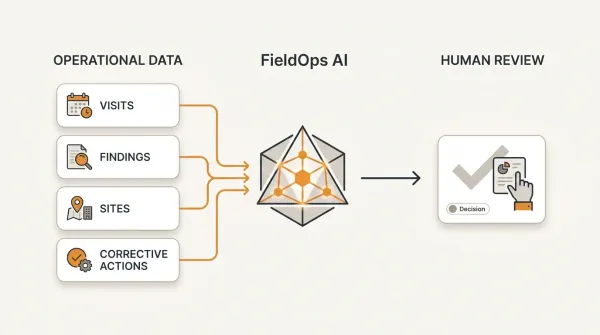
This is why FieldOps is designed around connected operational records.
A monitoring visit is not just a text document.
It belongs to a site.
The site belongs to a project.
The project belongs to a programme.
The visit contains findings.
Findings can have corrective actions.
Later visits can provide follow-up evidence.
That structure creates a path through the monitoring history.
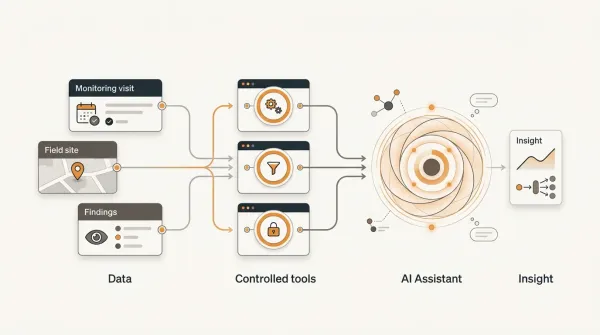
The AI assistant can use controlled tools to retrieve the relevant parts of that structure.
It does not need unrestricted access to the database.
It needs carefully defined ways to retrieve the information required to answer the user's question.
The AI is not the source of truth
This distinction is important.
If FieldOps AI says that a finding appeared during three monitoring visits, the underlying visits remain the source of that information.
The assistant is helping the user navigate and reason over those records.
If the user wants to verify the answer, the relevant operational records should remain available for inspection.
This creates a useful separation:
FieldOps records the evidence.
FieldOps AI helps users explore the evidence.
The M&E professional interprets the evidence and decides what to do.
That separation becomes especially important when the analysis concerns corrective actions and accountability.
Read-only analysis reduces unnecessary risk
FieldOps AI is designed as a read-only assistant.
It can retrieve findings and corrective actions.
It can compare monitoring visits.
It can identify relationships and patterns.
It can explain the information returned by the system.
But it does not independently modify the underlying records.
That means an M&E professional can ask:
"Which corrective actions are overdue?"
without giving the AI permission to change the status of those actions.
The assistant can help with investigation without becoming the system responsible for the operational record.
From findings to the full monitoring story
A finding tells you what was observed.
A corrective action tells you what response was recorded.
A follow-up visit provides another opportunity to examine what happened.
Connecting these records makes it possible to explore the complete sequence.
Instead of asking only:
"What findings were recorded?"
M&E teams can ask:
"What happened after those findings were recorded?"
That is a much more operational question.
It moves the focus from identifying problems to understanding their lifecycle.
And that is where connected monitoring data becomes particularly valuable for AI.
The system captures the evidence.
The AI helps connect the records.
The M&E professional decides what the evidence means and what should happen next.
Capture once. Use everywhere.
Move beyond data collection
FieldOps helps NGOs manage field visits, monitoring templates, findings, corrective actions, dashboards and donor reporting in one operational intelligence platform.
Learn more about FieldOps