From Monitoring Finding to Corrective Action: How AI Can Connect the Story
A monitoring finding is rarely the end of the story. It can lead to a corrective action, follow-up visit and eventually verification. Here is how a data-connected AI assistant can help M&E teams trace that journey across connected operational records.
A monitoring finding is rarely the end of the story.
A field officer records an observation.
The observation becomes a finding.
The finding may lead to a corrective action.
That action may be assigned, followed up and eventually verified.
When those records remain connected, they tell a much larger operational story.
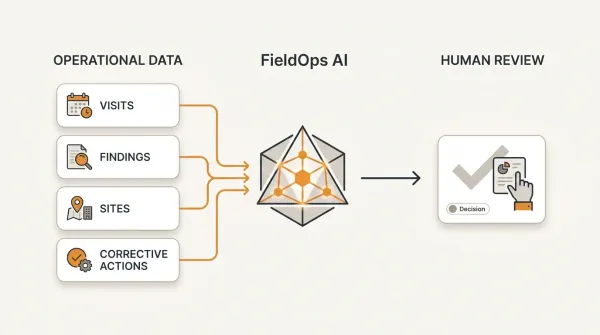
This is another area where a data-connected AI assistant can be useful.
Instead of looking at a finding as an isolated record, the assistant can help an M&E professional trace what happened before and after it.
For example:
What corrective action was created for this finding?
Then:
Is that action still open?
And later:
Was the issue recorded again during a subsequent monitoring visit?
These questions move beyond the finding itself.
They follow the operational lifecycle around it.
A finding is the beginning of a workflow
Consider a monitoring visit where an M&E officer records:
Stock records were incomplete.
That observation may require follow-up.
A corrective action could then be created:
Update stock records and reconcile the physical stock with the available documentation.
The action may be assigned to someone responsible for addressing the issue.
Later, another visit may take place.
The monitoring team may then record:
Stock records updated and documentation available.
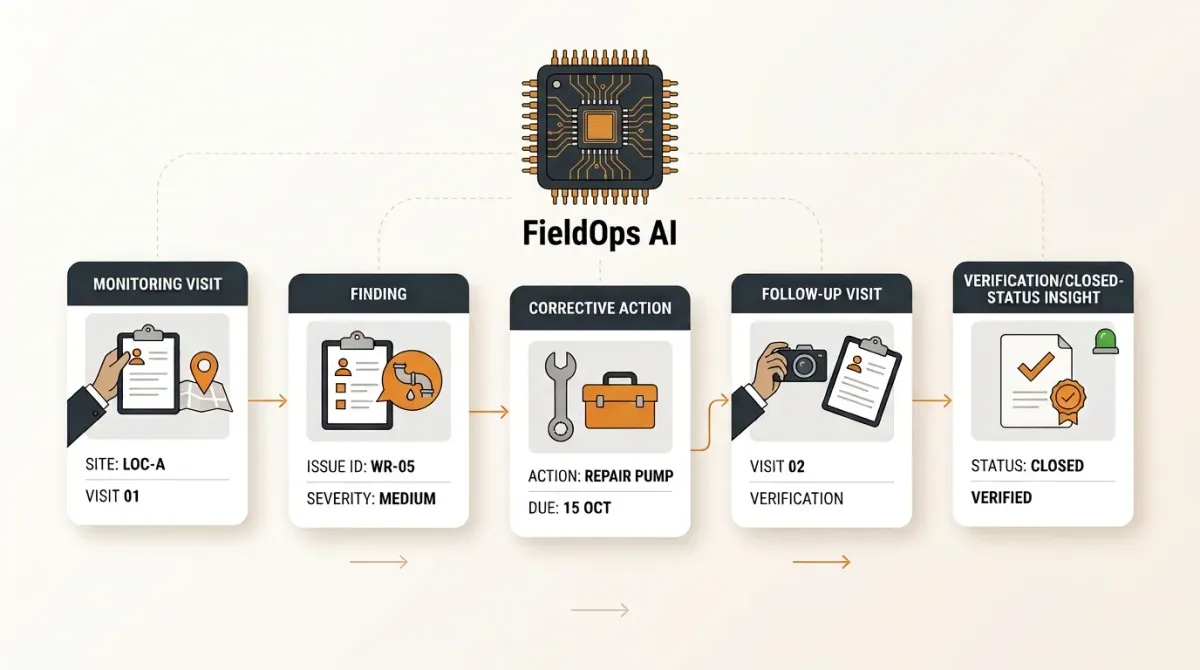
Now there is a sequence:
Visit → Finding → Corrective Action → Follow-up Visit → New Finding
The value is not in any individual record.
The value is in the relationship between them.
The question M&E teams actually want to answer
An M&E professional may not simply want to know:
What findings were recorded?
They may want to know:
What happened after the finding was recorded?
That question is much more operational.
It requires the system to connect multiple records.
The assistant needs to understand which visit produced the finding, which corrective action was associated with it and whether subsequent monitoring provided evidence about the issue.
This is where structured operational data becomes particularly important.
From finding to action
Suppose a user asks:
Show me the corrective actions associated with findings from the latest monitoring visit.
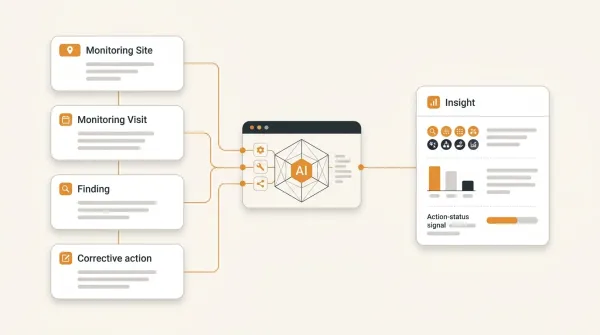
The assistant needs to connect the visit to its findings and then connect those findings to their corrective actions.
The information might look conceptually like this:
Monitoring Visit
↓
Finding
↓
Corrective Action
The user did not need to open each record individually.
The assistant can help bring the related information together.
That is one of the practical differences between an AI assistant connected to operational data and a generic chatbot.
Then comes the next question
Finding the corrective action is useful.
But the M&E professional may immediately ask:
Which of those actions are still open?
Now the assistant needs to examine action status.
The investigation becomes:
Finding → Corrective Action → Status
A program manager might then ask:
Which sites have the largest number of unresolved actions?
Now site context becomes important.
The assistant has moved from one finding to a broader operational question.
The monitoring cycle continues
The real value becomes clearer when another monitoring visit occurs.
Suppose the original finding was:
Stock documentation incomplete.
A corrective action was created.
Several weeks later, the site is visited again.
The follow-up visit records:
Stock documentation has been updated.
Now the organization has evidence that the issue was addressed.
But consider the alternative.
The follow-up visit records:
Stock documentation remains incomplete.
The corrective action may have been marked complete, but the issue has appeared again.
That creates a much more interesting question:
Why did the finding recur after the corrective action was completed?
The AI should not invent the reason.
But it can help identify the evidence needed to investigate the situation.
This is why the relationship matters
If the records are disconnected, the M&E professional may need to manually search for:
- the original visit;
- the original finding;
- the corrective action;
- the action status;
- the next visit;
- the subsequent finding.
When these records are connected, the system already contains the relationships.
The AI can use those relationships to help answer questions across the monitoring lifecycle.
This is one of the ideas behind FieldOps' operational model.
The AI is following the evidence
Consider the question:
What happened to this finding?
A useful answer should be based on the records.
It might identify:
- the visit where the finding was recorded;
- the finding itself;
- the corrective action created from it;
- the current action status;
- subsequent visits involving the same site;
- later findings related to the same issue.
The assistant is effectively reconstructing the operational history.
It is not creating a story.
It is connecting the records that already exist.
That distinction is important.
A corrective action is not proof of resolution
This is another useful distinction.
Creating a corrective action does not necessarily mean that the underlying problem has been resolved.
Likewise, marking an action as completed does not automatically prove that the issue no longer exists.
A later monitoring visit may provide additional evidence.
This creates a useful sequence:
Finding recorded
→
Action created
→
Action completed
→
Follow-up monitoring
→
Issue verified or issue recurs
An AI assistant can help users investigate this sequence.
But the evidence still comes from the monitoring records.
Asking whether the issue returned
Imagine an M&E manager asks:
Which findings appeared again after their corrective actions were completed?
This is a more sophisticated question.
The assistant needs to identify findings, their corrective actions, action completion status and later monitoring records.
It then needs to compare the records over time.
The answer is not stored in one field.
It has to be constructed from several related records.
This is precisely the kind of question where a connected operational model becomes valuable.
Looking at corrective actions across sites
The same approach can work at a larger scale.
A program manager might ask:
Which sites have multiple unresolved corrective actions?
The assistant can connect actions to their sites and examine their statuses.
The next question might be:
What types of findings are associated with those actions?
Now the assistant moves back from actions to findings.
Then:
Are the same findings recurring at these sites?
Now the investigation connects historical visits to the same operational issue.
The user can move between different levels of the monitoring data without manually constructing each report.
From one finding to a program-level pattern
Imagine several sites have the same type of finding.
The organization creates corrective actions at each site.
After subsequent monitoring visits, some sites resolve the issue while others continue to record it.
An M&E professional may then want to understand the difference.
Questions could include:
Which sites resolved the finding?
Which sites continue to report it?
Which corrective actions remain open?
How many monitoring cycles have passed?
Did the finding recur after the action was completed?
These are operational questions.
They require relationships between records rather than a simple text summary.
The AI can help users investigate the timeline
Time is particularly important here.
Consider:
January: Finding recorded.
January: Corrective action created.
February: Action marked completed.
March: Follow-up visit conducted.
March: Similar finding recorded again.
That sequence tells a different story from:
January: Finding recorded.
January: Corrective action created.
February: Action completed.
March: Follow-up visit conducted.
March: No related finding recorded.
The AI can help users explore these timelines.
But the underlying dates and records remain the evidence.
This is where context becomes essential
The phrase:
"The issue was resolved."
cannot be interpreted correctly without context.
Resolved when?
At which site?
Based on which finding?
Which corrective action?
Verified by whom?
During which visit?
An AI assistant needs access to enough context to answer these questions responsibly.
This connects directly to an earlier idea in this series:
AI needs more than language. It needs operational context.
The finding, action and follow-up visit need to remain connected.
FieldOps is structured around these relationships
FieldOps provides a connected operational model for monitoring work.
Programs contain projects.
Projects contain sites.
Monitoring visits are associated with sites.
Visits produce findings.
Findings can lead to corrective actions.
That structure gives the AI something important to work with.
It does not have to infer the entire organizational model from a collection of disconnected documents.
The relationships already exist in the operational system.
The AI can use them to investigate questions.
The assistant does not decide whether an action is successful
There is an important boundary here.
Suppose an AI assistant identifies that a corrective action was marked completed and that a later visit did not record the same finding.
It can report those facts.
It can help summarize the sequence.
But it should not automatically conclude:
The intervention was successful.
There may be other explanations.
Perhaps the issue was not checked during the follow-up visit.
Perhaps the finding was recorded differently.
Perhaps the monitoring scope changed.
Perhaps the data is incomplete.
The M&E professional needs to interpret the evidence.
The AI helps make that evidence easier to inspect.
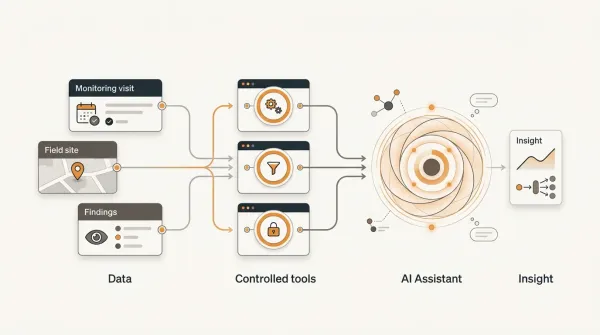
This is another reason FieldOps AI is read-only
The assistant can investigate the lifecycle without modifying it.
It can answer:
What findings were recorded?
What actions were created?
Which actions remain open?
What happened during subsequent visits?
Did similar findings appear again?
But it does not independently rewrite those records.
The monitoring system remains the source of record.
The AI remains an interface for understanding that record.
The human remains responsible for decisions.
A useful investigation can happen conversationally
Imagine an M&E professional starts with:
Which sites have unresolved findings?
The assistant provides the relevant sites.
The user asks:
What are the most common findings at those sites?
The assistant examines the findings.
The user asks:
Which of those findings have corrective actions?
The assistant connects the findings to actions.
The user asks:
Which actions are still open?
The assistant examines their statuses.
The user asks:
Have any of those findings appeared again during later visits?
The assistant looks at subsequent monitoring records.
This is no longer just a question-and-answer interaction.
It is an investigation.
The AI is helping the user navigate the organization's operational history through natural language.
The value is in the connected story
A monitoring platform can contain thousands of individual records.
But M&E professionals rarely care about records in isolation.
They care about what happened.
They care about what was found.
They care about what was done.
They care about whether the issue persisted.
They care about what happened during follow-up.
That is a story contained inside the data.
Visit → Finding → Action → Follow-up → Outcome
When those relationships are preserved, AI can help users explore the story.
From reporting to investigation
Traditional reporting often answers questions that have already been defined.
For example:
- How many visits were conducted?
- How many findings were recorded?
- How many actions are open?
- How many sites were monitored?
These are important questions.
But operational teams often need to go further.
They may want to ask:
Why does this finding keep appearing?
What happened after the corrective action?
Which sites improved?
Which sites still need attention?
Did the issue return after follow-up?
These questions require investigation.
A data-connected AI assistant can provide a natural-language interface for that investigation.
The same data can support different questions
One monitoring visit can support many different questions.
The visit can contribute to:
- coverage reporting;
- finding analysis;
- site performance review;
- corrective-action tracking;
- historical comparisons;
- recurring-finding analysis;
- follow-up investigations.
The organization does not need to capture the information separately for each use case.
This is where the FieldOps principle becomes relevant:
Capture once. Use everywhere.
The value of the monitoring record increases when the same connected information can support multiple operational needs.
What makes this different from document-based AI
A document-based AI system can summarize a monitoring report.
That is useful.
But the operational questions described here may require information from multiple records.
The original finding might be in one visit.
The corrective action might be stored separately.
The follow-up evidence might come from another visit weeks later.
The assistant needs to connect those pieces.
That is fundamentally different from simply uploading a document and asking for a summary.
The AI is working with an operational data model rather than a single block of text.
The broader opportunity
Finding-to-action tracing is only one example of what connected AI can enable.
The same approach can support questions such as:
- Which findings have no corrective actions?
- Which corrective actions have remained open across multiple monitoring cycles?
- Which sites continue to report similar findings?
- Which actions were completed before a follow-up visit?
- Which findings disappeared after follow-up?
- Which findings returned after actions were completed?
- Which projects have the largest number of unresolved actions?
Each question starts with the same underlying principle:
The records need to remain connected.
Once they are connected, AI can help users explore those relationships using natural language.
AI becomes more useful as the operational model becomes richer
This is one of the lessons from building FieldOps AI.
The usefulness of the assistant is not determined only by the language model.
It also depends on what the underlying system knows.
If the system knows the visit but not the site, context is lost.
If it knows the finding but not the corrective action, follow-up becomes harder to trace.
If it knows the action but not its status history, the operational story is incomplete.
AI can reason over information.
But it cannot reconstruct information that the system never captured.
That is why the design of the operational system matters so much.
The goal is not just to answer questions
A good AI assistant should help M&E professionals move from a question to an investigation.
Start with:
What happened?
Move to:
What was found?
Then:
What was done about it?
Then:
Was the action completed?
Then:
What happened afterward?
That is a much richer interaction than simply generating a summary.
It allows the user to follow the operational thread.
And because the assistant is connected to the monitoring data, each step can remain grounded in the organization's records.
From findings to operational intelligence
A finding is a data point.
A corrective action is a response.
A follow-up visit provides additional evidence.
Connected together, they form an operational history.
That history can help M&E teams understand not just what was observed, but what happened afterward.
This is where AI can add another layer of value.
The system captures the evidence.
The assistant helps connect and explore it.
The M&E professional interprets what it means and decides what should happen next.
That is the direction we are taking with FieldOps AI.
Not AI replacing the monitoring workflow.
Not AI making decisions on behalf of the organization.
But AI helping people follow the story already contained in their operational data.
Capture once. Use everywhere.
Move beyond data collection
FieldOps helps NGOs manage field visits, monitoring templates, findings, corrective actions, dashboards and donor reporting in one operational intelligence platform.
Learn more about FieldOps