From Questions to Investigation: How AI Can Help M&E Teams Explore Monitoring Patterns
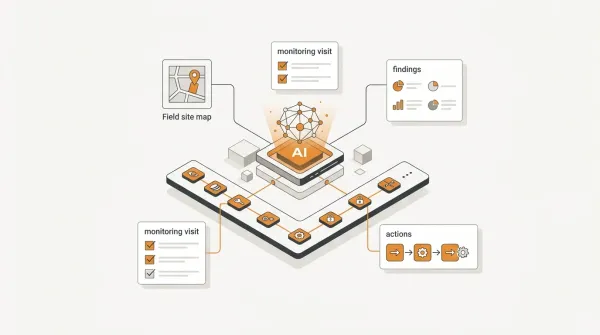
Finding a pattern in monitoring data is only the beginning. AI can help M&E teams follow the evidence, ask increasingly specific questions, connect findings to sites, visits and corrective actions, and investigate what the data actually shows.
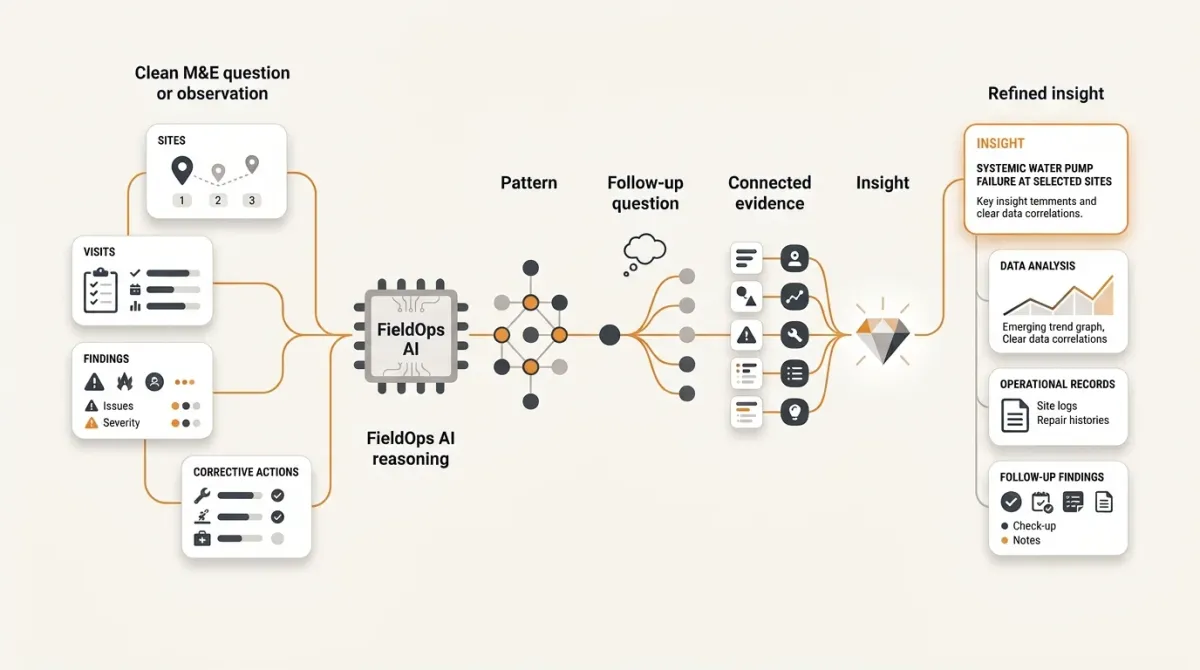
Finding a pattern in monitoring data is only the beginning.
An M&E professional may notice that several sites have recurring findings, that certain corrective actions remain open, or that the same issue appears across multiple monitoring visits.
The next question is usually more important:
Why is this happening?
Answering that question often requires investigation.
The user needs to move between sites, projects, visits, findings and corrective actions. They need to narrow the question, examine the evidence, and ask follow-up questions based on what they discover.
This is where an AI assistant connected to operational monitoring data can become more useful than a system that simply generates one answer.
The value is not only in answering the first question.
It is in helping the user ask the next useful question.
An answer is often the beginning
Consider a programme manager asking:
"Which sites have recurring findings?"
The assistant may identify several sites.
That answer is useful.
But it immediately creates new questions:
"Which findings are recurring?"
Then:
"When did they first appear?"
Then:
"Which projects are those sites part of?"
Then:
"Were corrective actions created?"
Then:
"Are those actions still open?"
Then:
"Did the findings appear again after the actions were completed?"
The user has moved from a broad question to a much more specific investigation.
This is an important distinction.
A traditional report may answer the first question.
A conversational AI assistant can help the user continue exploring the evidence.
Investigation is different from summarization
Summarization usually starts with a known body of information and asks the system to make it shorter or easier to understand.
Investigation is different.
The user starts with a question, discovers something, and then asks another question based on what they found.
For example:
Question 1
"Which sites have recurring documentation findings?"
Discovery
Several sites appear repeatedly.
Question 2
"Which of those sites are part of the same project?"
Discovery
Most of them belong to one project.
Question 3
"When did the issue start appearing in that project?"
Discovery
The findings began appearing during a particular monitoring period.
Question 4
"What corrective actions were recorded?"
Discovery
Several actions were created, with different statuses.
The investigation keeps moving.
The AI is not simply writing a report.
It is helping the user navigate the operational evidence.
The next question depends on the previous answer
This is one of the most interesting properties of conversational analysis.
A user does not always know the complete question at the beginning.
They may only know that something looks unusual.
For example:
"Are there recurring findings across our sites?"
If the answer reveals a pattern, the next question becomes more specific.
"Which sites are affected?"
Then:
"Are those sites concentrated in one project?"
Then:
"What happened during the visits where the finding was recorded?"
Then:
"Were corrective actions followed up?"
The investigation evolves as information is discovered.
This is difficult to replicate with a static report because the path is not known in advance.
Connected data makes follow-up questions possible
For an AI assistant to support this kind of investigation, it needs access to connected operational records.
A question about recurring findings may require information from:
Projects → Sites → Visits → Findings → Corrective Actions
A follow-up question may require the assistant to move in another direction.
For example:
"Which projects contain the affected sites?"
That requires project and site relationships.
Then:
"Which visits recorded the finding?"
That requires the visit relationship.
Then:
"What actions were created?"
That requires the relationship between findings and corrective actions.
The AI does not need to understand every database table directly.
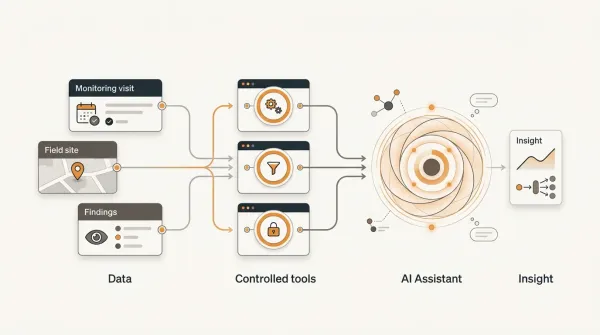
It needs controlled ways to retrieve the relevant operational information.
The investigation can move from broad to specific
A useful way to think about AI-assisted M&E investigation is as a narrowing process.
It might begin with:
Programme
"What are the recurring findings across the programme?"
Then move to:
Project
"Which projects are affected?"
Then:
Site
"Which sites are contributing to the pattern?"
Then:
Visit
"When were these findings recorded?"
Then:
Finding
"What exactly was observed?"
Then:
Corrective action
"What response was recorded?"
Then:
Follow-up
"What happened afterward?"
The user is effectively drilling through the operational structure using natural language.
This can reduce the cost of exploration
Without a conversational interface, the user may need to navigate through multiple reports and filters to perform this investigation.
They may need to:
- Open a project report.
- Filter sites.
- Review monitoring visits.
- Open individual findings.
- Check corrective actions.
- Return to the report.
- Repeat the process for another site.
- Compare the results manually.
The information may all be available.
The difficulty is connecting it efficiently.
An AI assistant can provide another interface to that information.
Instead of navigating each relationship manually, the user can express the investigation in natural language.
But the AI must remain grounded
Conversational investigation introduces an important responsibility.
The assistant should not treat every answer as an established fact.
Suppose the data shows that several sites have the same type of finding.
The assistant can report that pattern.
But the user may then ask:
"What is causing this?"
The available monitoring data may not contain enough information to answer that question.
A responsible assistant should distinguish between:
What the records show
and
What might explain those records.
For example:
"The finding appears across eight sites and three monitoring cycles."
This is an observation based on the available records.
It is different from:
"The issue is caused by inadequate staff training."
That explanation requires evidence that may not be present in the monitoring data.
The assistant should not fill that gap with speculation.
Good investigation includes knowing when to stop
An AI assistant should not always produce an explanation.
Sometimes the correct response is that the available evidence is insufficient.
Suppose the user asks:
"Why did this finding persist?"
The records show that the finding appeared during three visits.
They show that a corrective action was created.
They show that the action was marked completed.
They show that the finding appeared again.
But they contain no evidence explaining why.
The assistant can provide the sequence.
It can identify the recurrence.
It can show the related action.
But it should make clear that the reason for recurrence is not established by the available records.
That is more useful than inventing an answer.
Investigation can expose gaps in the monitoring system
This type of interaction can also reveal problems with the data itself.
Imagine an M&E professional asks:
"Which sites had recurring findings after corrective actions were completed?"
The assistant discovers that several corrective actions cannot be reliably connected to the findings they were intended to address.
That is not simply an AI problem.
It is an operational data problem.
The investigation has exposed a gap in how the monitoring information was captured or structured.
Similarly, the assistant may discover that historical visits are missing, statuses are inconsistent, or findings are recorded with highly variable terminology.
AI-assisted investigation can therefore make data quality issues more visible.
Follow-up questions can connect different dimensions
One of the strengths of this approach is that the user can move between different dimensions of the same problem.
For example:
"Which sites have recurring findings?"
This starts with sites.
Then:
"Which projects contain those sites?"
This moves to projects.
Then:
"Which findings are recurring?"
This moves to findings.
Then:
"What corrective actions were associated with them?"
This moves to actions.
Then:
"Which actions remain open?"
This moves to status.
The underlying records are connected.
The conversation provides a flexible way to move through those relationships.
The investigation can also start from corrective actions
The process does not always need to begin with findings.
An M&E manager could ask:
"Which corrective actions have remained open for the longest?"
The assistant could identify the actions and their associated findings.
The user could then ask:
"Which sites are affected?"
Then:
"Have those sites been monitored since the actions were created?"
Then:
"What did the subsequent visits find?"
The investigation has now moved:
Corrective Action → Finding → Site → Visit → Follow-up Finding
The starting point changed, but the connected operational model still supports the investigation.
This is why context matters
A general-purpose AI model can understand questions such as:
"What does a recurring monitoring finding mean?"
But that is different from answering:
"Which findings have recurred across our sites?"
The second question requires access to the organization's actual monitoring records.
It also requires context.
The assistant needs to understand what belongs to the organization, programme, project and site.
It needs to retrieve the relevant visits.
It needs to connect findings to their associated actions.
It needs to understand the status and timing of those records.
Without that context, the AI can discuss the concept.
With the context, it can investigate the organization's actual data.
FieldOps provides the operational structure
This is one reason the structure of FieldOps matters for AI.
The operational model provides connected records:
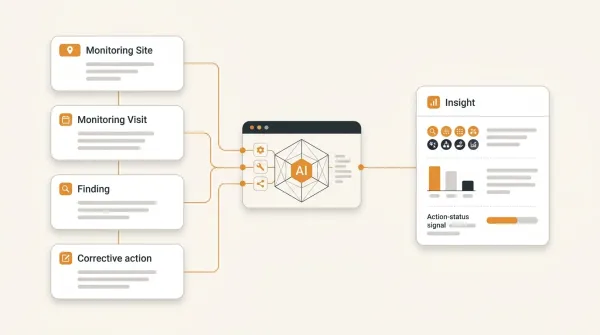
Programs → Projects → Sites → Visits → Findings → Corrective Actions
That structure gives the assistant multiple paths through the monitoring data.
A user can begin with a programme-level question.
They can move to a project.
Then a site.
Then a visit.
Then a finding.
Then a corrective action.
Then a subsequent monitoring result.
The assistant can follow those relationships through controlled tools rather than relying on the model to guess how the records are connected.
The AI should not become the system of record
As the investigation becomes more sophisticated, it is important to maintain a clear separation between analysis and operational records.
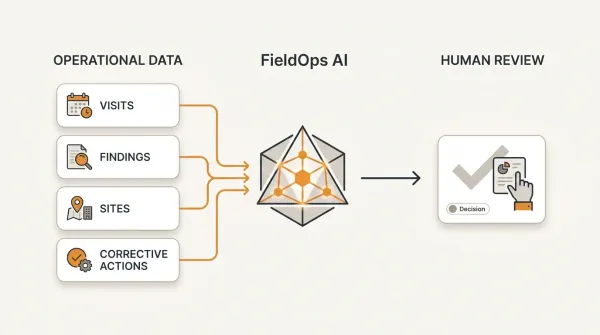
FieldOps AI is designed as a read-only assistant.
It can retrieve information.
It can connect related records.
It can compare monitoring history.
It can identify patterns.
It can explain what the available evidence shows.
But it does not independently modify the visits, findings or corrective actions it is analyzing.
That means the investigation does not alter the underlying evidence.
The operational system remains the source of record.
The human remains part of the investigation
AI can make it easier to explore the data.
It does not remove the need for M&E judgment.
An M&E professional may use the assistant to identify a pattern, investigate its history, and find the relevant records.
They may then decide that the issue requires:
- additional field verification
- discussion with programme staff
- review of implementation records
- further monitoring
- additional evidence
- management attention
The AI can help shorten the path to those questions.
The decision about what the evidence means and what should happen next remains with the people responsible for the programme.
The real value may be the next question
This is an important shift in how AI can be used in M&E.
The goal does not always need to be:
"Give me the answer."
Sometimes the more useful goal is:
"Help me investigate this."
A useful assistant can help users move from:
Question → Evidence → Pattern → Follow-up question → More evidence → Deeper understanding
That process is closer to how experienced M&E professionals already investigate operational issues.
The difference is that AI can provide a natural-language interface to the connected monitoring records.
Instead of manually reconstructing the path through the system, the user can describe what they want to investigate.
From AI answers to AI-assisted investigation
The progression is subtle but important.
A basic AI interaction might be:
"Summarize this monitoring report."
A data-connected assistant can go further:
"Which sites have recurring findings?"
And then further:
"Which of those findings remained unresolved?"
And further still:
"What happened after the corrective actions were recorded?"
Each question builds on the previous discovery.
That is where an AI assistant can become more than a reporting tool.
It becomes an investigation interface for the monitoring system.
The underlying system captures the evidence.
Connected tools make that evidence accessible.
AI helps the user navigate and reason across it.
And the M&E professional decides what the evidence means and what should happen next.
Capture once. Use everywhere.
Move beyond data collection
FieldOps helps NGOs manage field visits, monitoring templates, findings, corrective actions, dashboards and donor reporting in one operational intelligence platform.
Learn more about FieldOps