How AI Can Help M&E Teams See Patterns Across Multiple Sites
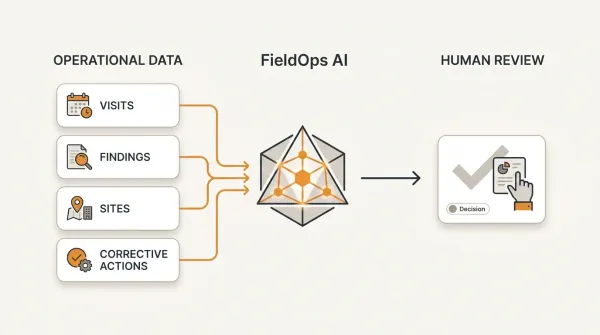
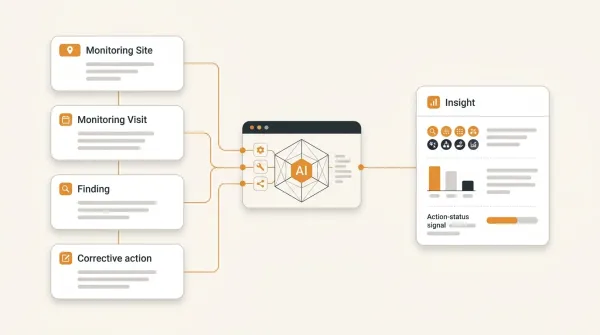
A problem found at one site may be isolated. The same issue appearing across several sites can reveal a much broader monitoring pattern. Here is how connected operational data can help AI assist M&E teams in comparing sites, identifying recurring issues, and investigating programme-wide patterns.
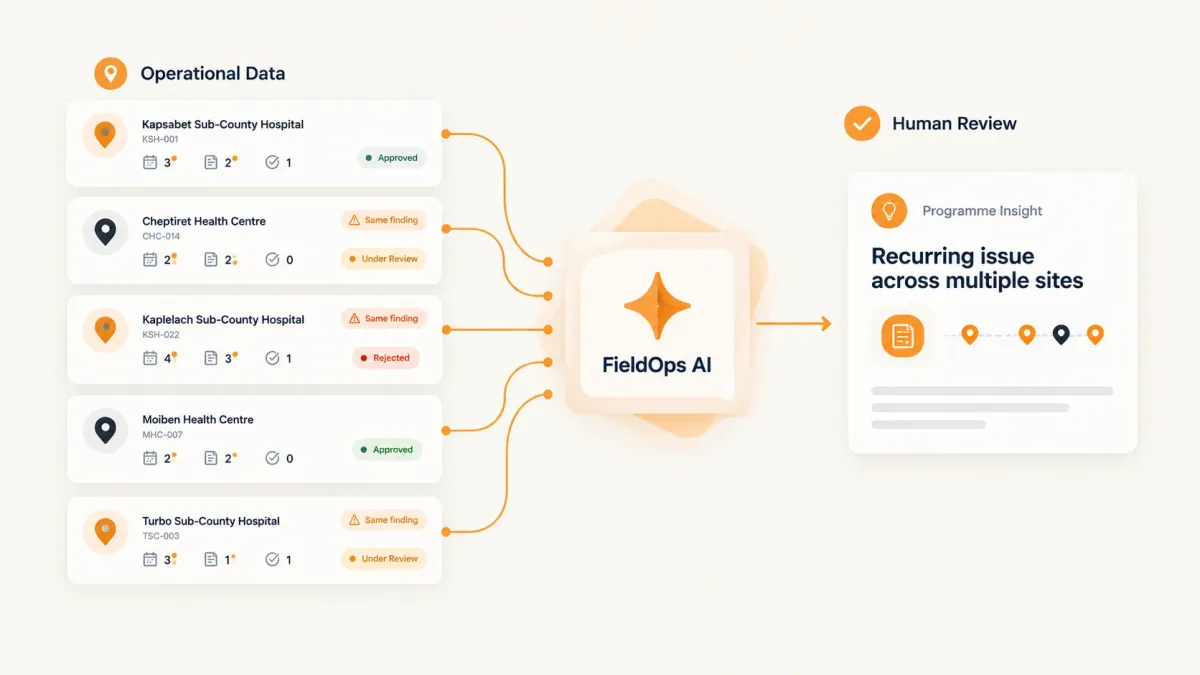
A finding at one site may be an isolated problem.
The same finding appearing across several sites can tell a very different story.
For M&E teams managing programmes across many locations, this distinction matters.
A monitoring system may contain hundreds or thousands of individual visits. Each site may have its own findings, corrective actions and follow-up history.
Looking at those records one site at a time can make it difficult to see patterns that exist across the wider programme.
This is another area where an AI assistant connected to operational monitoring data can be useful.
Instead of asking only what happened at one site, M&E teams can ask what is happening across multiple sites.
A single site can hide a programme-wide pattern
Imagine a programme monitoring several health facilities.
At Site A, a monitoring visit identifies incomplete stock documentation.
At Site B, another visit identifies the same type of issue.
At Site C, the monitoring team records a similar finding.
At Site D, the documentation is complete.
Viewed separately, these may look like individual site-level findings.
Viewed together, they may suggest a pattern worth investigating.
An M&E professional could ask:
"Which sites have had findings related to incomplete stock documentation?"
That question moves the analysis from an individual site to the programme.
The underlying records have not changed.
The question has changed.
Comparing sites is more than counting findings
A simple count can be useful.
For example:
- Site A: 2 findings
- Site B: 7 findings
- Site C: 3 findings
- Site D: 1 finding
But the numbers alone do not tell the whole story.
Site B may have been monitored five times while Site D has only been monitored once.
Site A may have two findings that were resolved quickly.
Site C may have three findings that have persisted across several visits.
This is why meaningful comparison requires context.
AI needs to understand the relationship between sites, visits, findings, actions and time.
Without that context, a comparison can easily become misleading.
AI can help look across the monitoring record
Suppose an M&E professional asks:
"Which sites have had the same type of finding during more than one monitoring visit?"
Answering this question requires more than retrieving a single record.
The assistant needs to:
- Identify the relevant sites.
- Retrieve their monitoring visits.
- Examine the findings recorded during those visits.
- Identify related or repeated issues.
- Consider the timing of those findings.
- Present the pattern in a way the user can investigate.
This is a fundamentally different task from asking an AI model to summarize a report.
The assistant is reasoning over connected operational records.
The same finding can have different meanings across sites
A recurring finding does not necessarily mean the same thing everywhere.
Imagine that several sites have findings related to documentation.
At one site, the issue may have appeared once and been resolved.
At another, it may have appeared during three consecutive visits.
At another, it may have been identified during a single visit but accompanied by a corrective action that remains open.
The finding category may be similar.
The operational context is different.
That context is important when comparing sites.
A useful AI assistant should therefore avoid treating every matching finding as identical evidence.
It should help the user examine the underlying records.
Widespread issues can become easier to investigate
Now imagine that an M&E manager asks:
"What findings are appearing across multiple sites?"
The assistant might identify several recurring categories.
The user could then ask:
"Which of those have appeared across more than one monitoring cycle?"
And then:
"Which sites still have open corrective actions related to those findings?"
The conversation has moved through several levels of analysis:
Programme → Finding pattern → Monitoring history → Corrective action
This is where connected data becomes particularly valuable.
The user does not have to manually reconstruct every relationship before asking the next question.
Isolated problems and widespread problems are different
One of the useful distinctions in multi-site monitoring is between an isolated issue and a broader pattern.
Consider two scenarios.
Scenario 1: Isolated issue
One site records a problem with documentation.
The finding does not appear in later visits.
Other sites do not report the same issue.
The evidence currently points to a site-specific observation.
Scenario 2: Repeated programme pattern
Several sites record similar documentation findings.
The findings appear across multiple monitoring cycles.
Some corrective actions are completed, but similar findings continue to appear.
That is a different monitoring situation.
The data may justify a broader investigation.
But the AI should still distinguish between identifying a pattern and explaining its cause.
Pattern does not automatically mean cause
Suppose five sites have similar findings.
It may be tempting to conclude that they all have the same underlying problem.
The monitoring data may not support that conclusion.
The sites could have different staffing structures.
They could operate under different local conditions.
They could have received different levels of support.
The findings could also have been recorded differently by different monitoring teams.
An AI assistant should therefore be able to say:
"Similar findings were recorded across these sites."
That is different from saying:
"These sites have the same underlying cause."
The second statement requires additional evidence.
This distinction is important when AI is being used for operational analysis.
The purpose is to help M&E teams investigate patterns, not to turn patterns into unsupported explanations.
Site comparisons need a common monitoring structure
For AI to compare sites meaningfully, the monitoring data needs some degree of consistency.
If one site records a finding as:
"Incomplete stock records"
and another records:
"Stock documentation issue"
the underlying issue may be related.
An AI model may be able to recognize that similarity.
But inconsistent data can make comparisons harder.
This is why structured monitoring templates, consistent fields, controlled relationships and clear operational definitions remain important.
AI can help interpret variations in language.
It cannot completely compensate for poorly structured monitoring data.
Corrective actions add another layer
The comparison becomes even more useful when corrective actions are included.
Imagine several sites with similar findings.
An M&E professional could ask:
"Which sites have open corrective actions related to this finding?"
Then:
"Which sites have completed their corrective actions?"
And:
"Which sites had the finding appear again after the action was completed?"
Now the analysis is no longer just about finding frequency.
It is about the relationship between:
Finding → Action → Follow-up → Subsequent finding
That provides a much richer operational picture.
The user can move from programme-level to site-level
One advantage of a conversational interface is that the user can start broad and then narrow the investigation.
For example:
"Which sites have recurring findings?"
Then:
"Show me the sites where the finding appeared in at least two visits."
Then:
"What corrective actions were associated with those findings?"
Then:
"Which of those actions are still open?"
Then:
"Show me the monitoring history for Site A."
The conversation becomes a way of navigating the monitoring system.
The user does not need to know exactly which record to open first.
The assistant can help move through the connected information.
This is where operational context becomes important
A generic AI model may be able to discuss monitoring concepts.
That is different from answering questions about an organization's actual monitoring data.
To answer a question about multiple sites, the assistant needs access to the relevant operational context.
It needs to know which sites belong to which projects.
It needs to retrieve monitoring visits associated with those sites.
It needs to identify findings and corrective actions.
It needs to preserve the relationships between those records.
This is why FieldOps AI is built as a data-connected assistant rather than simply a conversational interface sitting beside the monitoring system.
Controlled tools provide the connection
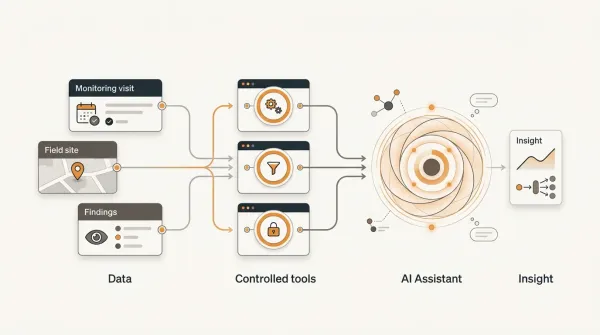
FieldOps AI does not need unrestricted access to the underlying database to perform this type of analysis.
Instead, the assistant can use controlled tools to retrieve the information required for the user's question.
The tools provide access to the relevant operational records.
The AI reasons over the returned information.
The underlying system remains responsible for storing the records.
This separation matters because the AI should have enough information to answer useful questions without becoming an unrestricted operator of the system.
The underlying records remain the evidence
Suppose the assistant identifies several sites with recurring findings.
The result should not become a new source of truth.
The relevant monitoring visits, findings and corrective actions remain the evidence.
The M&E professional should be able to investigate the underlying records and understand how the pattern was identified.
This creates an important distinction:
The monitoring system stores the evidence.
The AI connects and explains the evidence.
The M&E professional interprets the evidence.
That is particularly important when the analysis could influence programme management decisions.
Multi-site analysis can reveal questions, not just answers
One of the most useful outcomes of this type of AI interaction may be a better question.
Suppose the assistant identifies that a particular finding appears across several sites.
The next question might be:
"Why is this finding appearing across these sites?"
The monitoring data may not contain the answer.
But it may point the M&E professional toward an investigation.
Perhaps the team needs to examine training records.
Perhaps they need to review supervision practices.
Perhaps they need to examine whether the monitoring tool itself is capturing the issue consistently.
The AI does not need to solve the entire problem.
Helping the user identify where to investigate can itself be valuable.
From individual records to programme intelligence
Traditional monitoring workflows often require users to move through individual records.
That remains necessary.
But connected operational data makes another level of analysis possible.
Instead of only asking:
"What happened at this site?"
M&E teams can ask:
"What patterns are appearing across our sites?"
And then:
"Which of those patterns are persistent?"
And then:
"What corrective actions are associated with them?"
And finally:
"Which sites should we investigate more closely?"
These questions move from individual observations toward programme-level operational intelligence.
The underlying evidence remains the same.
The difference is how easily people can explore it.
FieldOps AI is designed for this kind of exploration
FieldOps brings together the operational relationships that make this type of analysis possible:
Programs → Projects → Sites → Visits → Findings → Corrective Actions
That structure provides the context required to move between individual monitoring records and broader programme patterns.
FieldOps AI adds a natural-language interface over that structure.
A user can ask a question.
The assistant can retrieve the relevant records through controlled tools.
The model can reason over the information.
The user can then investigate the underlying evidence.
Because the assistant is read-only, it does not independently modify the monitoring records while performing the analysis.
Seeing the pattern is only the beginning
Finding a pattern across multiple sites does not automatically tell an organization what to do about it.
That remains an M&E and programme management responsibility.
What AI can do is reduce some of the effort required to discover and investigate those patterns.
Instead of manually comparing site after site, users can ask questions that cross the boundaries between individual records.
Instead of looking only at the latest visit, they can examine repeated findings across monitoring cycles.
Instead of treating corrective actions as separate records, they can examine them in relation to the findings they were intended to address.
The result is a different way of interacting with monitoring data.
Not just:
"Show me this site's latest visit."
But also:
"What is happening across our sites?"
That shift—from individual monitoring records to connected programme-level patterns—is one of the ways AI can become a useful interface for operational M&E data.
The system captures the evidence.
AI helps connect the evidence.
M&E professionals decide what the pattern means and what should happen next.
Capture once. Use everywhere.
Move beyond data collection
FieldOps helps NGOs manage field visits, monitoring templates, findings, corrective actions, dashboards and donor reporting in one operational intelligence platform.
Learn more about FieldOps