How FieldOps AI Can Help M&E Teams Find Recurring Findings
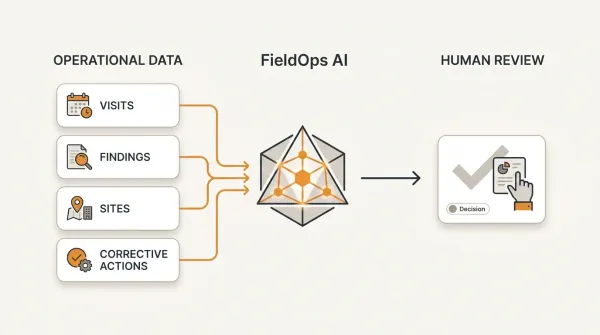
A finding recorded once may be an isolated issue. The same finding appearing across multiple monitoring visits can tell a very different story. Here is how connected monitoring data can help an AI assistant identify recurring findings and help M&E teams investigate them.
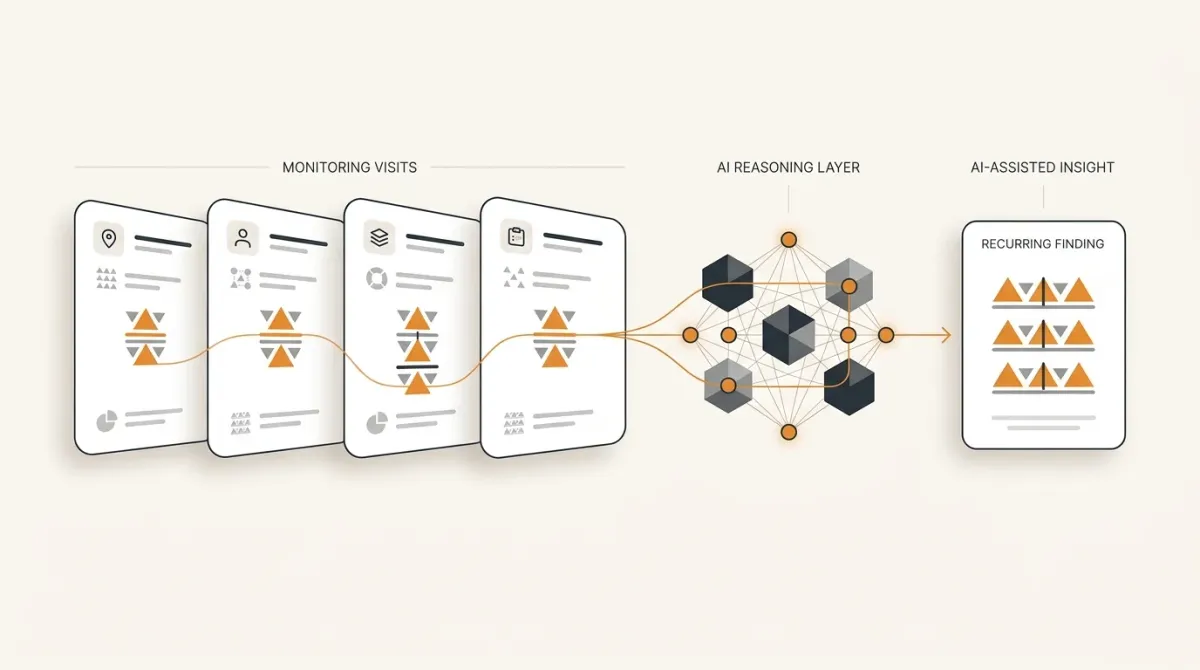
A finding recorded during one monitoring visit can be important.
But when the same issue appears again during another visit, it becomes more interesting.
And when it appears across several visits or multiple sites, an M&E team may need to investigate it differently.
This is where connected monitoring data can become particularly useful with AI.
Instead of asking an AI assistant to summarize one monitoring report, an M&E professional can ask questions such as:
Which findings are recurring across recent visits?
Or:
Which sites have recorded the same type of finding more than once?
These questions require the AI to look across multiple records and understand their relationships.
That is very different from asking a generic chatbot to summarize a document.
A single finding tells only part of the story
Imagine a monitoring visit where a field officer records:
Stock records were incomplete.
On its own, this is useful information.
But an M&E professional will probably have additional questions.
Was this the first time the issue was observed?
Which site was affected?
Which project does the site belong to?
When was the visit conducted?
Was a similar finding recorded during the previous visit?
Was a corrective action created?
Was that action completed?
The original finding is only one piece of the operational story.
To understand whether it represents a recurring problem, the system needs to connect it with other monitoring records.
Recurring is different from repeated text
There is an important distinction here.
Finding recurrence does not necessarily mean that two records contain exactly the same sentence.
Field officers may describe similar issues differently.
For example:
Stock cards were not updated.
Another visit might record:
Inventory records were missing recent transactions.
Another might say:
Physical stock could not be reconciled with the available records.
The wording is different.
But the underlying operational issue may be related.
This is one area where AI can potentially help.
A traditional report may group findings based on predefined categories.
An AI assistant can help users explore whether differently worded findings appear to describe a related pattern.
The important point is that the AI should still be grounded in the actual monitoring records rather than inventing a pattern simply because two sentences sound similar.
The importance of looking across visits
Consider a site that has been monitored several times.
During Visit 1:
Stock documentation incomplete.
During Visit 2:
Stock records not consistently updated.
During Visit 3:
Stock records still incomplete.
A user looking at only the latest visit sees one finding.
A user looking across all three visits sees something more important:
the issue has persisted.
That distinction can change the follow-up question.
Instead of:
What findings were recorded during the latest visit?
the M&E professional may want to know:
Which findings have persisted across monitoring visits?
That is a much more operational question.
This is where FieldOps' connected structure matters
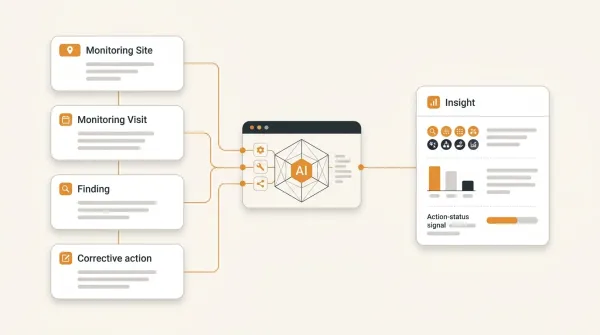
FieldOps does not treat a monitoring finding as an isolated piece of text.
The finding exists within a monitoring workflow.
It is associated with a visit.
The visit is associated with a site.
The site belongs to a project and program.
A finding can also be associated with a corrective action.
That creates a chain of context:
Program → Project → Site → Visit → Finding → Corrective Action
When an AI assistant works with this structure, it can investigate a question across the relationships rather than looking at one record in isolation.
That is one of the important differences between a generic AI conversation and a data-connected assistant.
Asking the first question
Imagine an M&E manager asks:
Which findings have appeared more than once in the last five monitoring visits?
The assistant needs to do several things.
It needs to identify the relevant visits.
It needs to examine their findings.
It needs to compare the findings.
It needs to determine which issues recur.
And it needs to present the result in a way the user can investigate further.
The answer is not simply sitting inside one database field.
It has to be constructed from several related records.
That is where the combination of structured data and AI reasoning becomes useful.
Then the investigation can continue
The first answer may lead to another question.
For example:
Which sites are affected by these recurring findings?
Now the assistant needs to connect the findings back to their sites.
The next question might be:
Which of those sites have had the issue during consecutive visits?
Now time and visit history become important.
Then:
Which corrective actions were created for those findings?
The assistant moves from findings to actions.
Then:
Which of those actions are still open?
The investigation has now moved through several parts of the monitoring workflow.
Visits → Findings → Sites → Corrective Actions → Status
The user did not need to manually build each query.
They continued the investigation through natural language.
Recurrence can be viewed at different levels
Another useful aspect is that "recurring finding" can mean different things.
A program manager may want to know:
Which issues are recurring across the program?
A project manager might ask:
Which findings are recurring within this project?
A site manager may want:
Which findings have recurred at this site?
These are different questions.
The underlying records may be the same, but the scope changes.
This is another reason context matters.
An AI assistant should understand the scope of the question rather than treating every monitoring record as belonging to one undifferentiated dataset.
Recurring at one site
Suppose a site has five monitoring visits.
One issue appears during four of those visits.
That may be operationally significant because it suggests persistence at that particular site.
An M&E professional might then want to investigate:
- when the issue was first recorded;
- how often it appeared;
- whether corrective actions were created;
- whether previous actions were completed;
- whether the finding changed over time.
The AI does not need to make the programmatic decision.
It can help assemble the evidence needed for the M&E professional to investigate it.
Recurring across multiple sites
Now consider a different pattern.
Suppose the same type of finding appears across many sites during the same monitoring period.
That may represent a different operational question.
The user might ask:
Which findings are common across multiple sites?
Then:
Which projects contain those sites?
And:
Are the same corrective actions being recommended?
The assistant can help move from individual site-level observations toward a broader program-level investigation.
Again, the purpose is not for the AI to decide what the problem means.
The purpose is to make the underlying information easier to explore.
Time changes the meaning of a finding
Monitoring data is inherently temporal.
A finding recorded yesterday is different from one recorded six months ago.
A finding that appears once may be an isolated observation.
A finding that appears repeatedly over several monitoring cycles may require a different investigation.
This means that an AI assistant working with M&E data needs more than the finding itself.
It needs to understand when the finding occurred and how it relates to other visits.
This is another reason why structured operational records matter.
Without dates, visit relationships and historical records, recurrence becomes much harder to establish.
Recurring findings can lead to corrective-action questions
Finding recurrence is also connected to follow-up.
Suppose the AI identifies that a similar finding appeared during three visits.
The next question is naturally:
Were corrective actions created?
If they were:
Were those actions completed?
And:
Did the finding appear again after the action was marked complete?
That last question is particularly interesting.
It moves the investigation from:
finding → action
to:
finding → action → subsequent monitoring → finding
Now the organization can investigate what happened after the corrective action.
The monitoring cycle becomes connected.
This is where the operational history becomes valuable
A monitoring system is not just a collection of reports.
It is a record of what organizations observed and what they did about those observations.
When visits, findings and corrective actions remain connected over time, the organization has an operational history.
AI can provide a natural-language interface for exploring that history.
For example:
Show me recurring findings that have remained unresolved.
Or:
Which sites continue to record findings after corrective actions were created?
Or:
Which findings disappeared after follow-up?
These questions require the assistant to reason across multiple stages of the monitoring lifecycle.
The AI should also know when the evidence is insufficient
There is an important limitation.
The assistant should not assume that two findings are recurring simply because they sound similar.
Nor should it claim that a problem persists when the organization does not have enough historical monitoring data to establish that.
Suppose a site has only been visited once.
The user asks:
Which findings are recurring at this site?
There is no meaningful historical basis for establishing recurrence.
A useful assistant should recognize that limitation.
It might explain that only one monitoring visit is available and that recurrence cannot be established from the available records.
That is much more useful than producing a confident-sounding answer from insufficient evidence.
This is one reason data quality matters
The ability to identify recurring findings depends on the quality and completeness of the underlying monitoring data.
If visits are missing dates, historical records are incomplete, findings are not consistently recorded or relationships between findings and visits are broken, AI reasoning becomes less reliable.
This connects directly to an earlier point in this series:
AI cannot reason over evidence that the system does not contain.
The AI may be capable of sophisticated reasoning.
But the quality of the conclusion still depends on the operational information available to it.
FieldOps AI is designed around this kind of investigation
This is one of the practical areas where the FieldOps AI approach becomes useful.
The assistant is not simply placed beside a blank chat box and asked to guess what an organization knows.
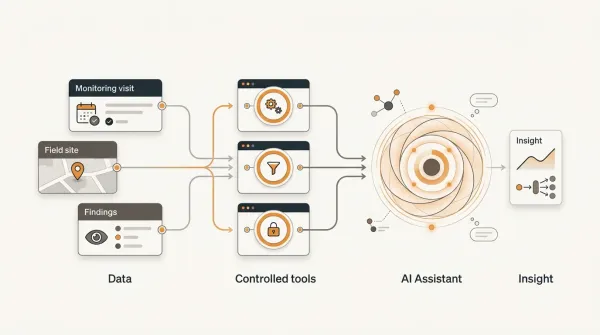
It can use controlled tools to retrieve information from the organization's operational records.
That allows questions to be grounded in the monitoring data.
The AI becomes a layer for exploring the information already captured in FieldOps.
The underlying system remains the source of record.
The assistant helps users investigate what that information contains.
The value is not the phrase "recurring finding"
The real value is what happens after the pattern is identified.
Finding a recurring issue is only the beginning.
The M&E team may then ask:
Where is it happening?
When did it start?
How widespread is it?
Has it been recorded before?
What corrective actions were created?
Were those actions completed?
Did the issue appear again afterward?
Those questions turn a finding into an investigation.
And that is where a data-connected AI assistant can become genuinely useful.
From individual records to operational patterns
Traditional monitoring workflows often require people to move manually between records.
Open a visit.
Review findings.
Open another visit.
Compare the findings.
Check the site.
Look at previous visits.
Open corrective actions.
Check their statuses.
Repeat.
That work is sometimes necessary.
But when the underlying records are connected, AI can provide another way to navigate them.
The user can start with the operational question instead.
What keeps appearing?
The assistant can help identify the relevant records.
Where is it happening?
The assistant can narrow the scope.
What has been done about it?
The assistant can connect the findings to corrective actions.
Did it happen again?
The assistant can look at subsequent visits.
The conversation becomes an investigation interface for the monitoring system.
The broader idea
Recurring findings are only one example.
The same approach can be applied to other M&E questions:
- Which sites have repeated monitoring issues?
- Which corrective actions remain unresolved?
- Which findings are common across projects?
- Which issues appeared after a particular monitoring period?
- Which sites have improved across successive visits?
- Which findings continue to appear after follow-up?
- Which operational issues are concentrated in particular projects?
The common factor is that these questions require more than a language model.
They require access to connected operational information.
That is the distinction FieldOps is exploring with AI.
The AI is not replacing the monitoring system.
It is making the information inside the monitoring system easier to investigate.
The monitoring record becomes more useful
A finding entered by a field officer should not become useful only when someone eventually opens a report.
That same record can contribute to follow-up, trend analysis, action tracking and operational investigation.
When the records are connected, an AI assistant can provide another interface for extracting that value.
The principle is simple:
Capture once. Use everywhere.
The more connected the monitoring information becomes, the more questions users can ask of it.
And the more useful those questions become, the more the monitoring system starts to function as an operational intelligence layer rather than simply a place where reports are stored.
That is the direction we are taking with FieldOps AI.
Move beyond data collection
FieldOps helps NGOs manage field visits, monitoring templates, findings, corrective actions, dashboards and donor reporting in one operational intelligence platform.
Learn more about FieldOps