How to Link Field Visit Findings to Corrective Actions
A field monitoring visit can identify important problems.
But identifying a problem is only the beginning.
The real operational challenge is making sure that every actionable finding leads to a clearly defined response and that the response remains connected to the original field observation.
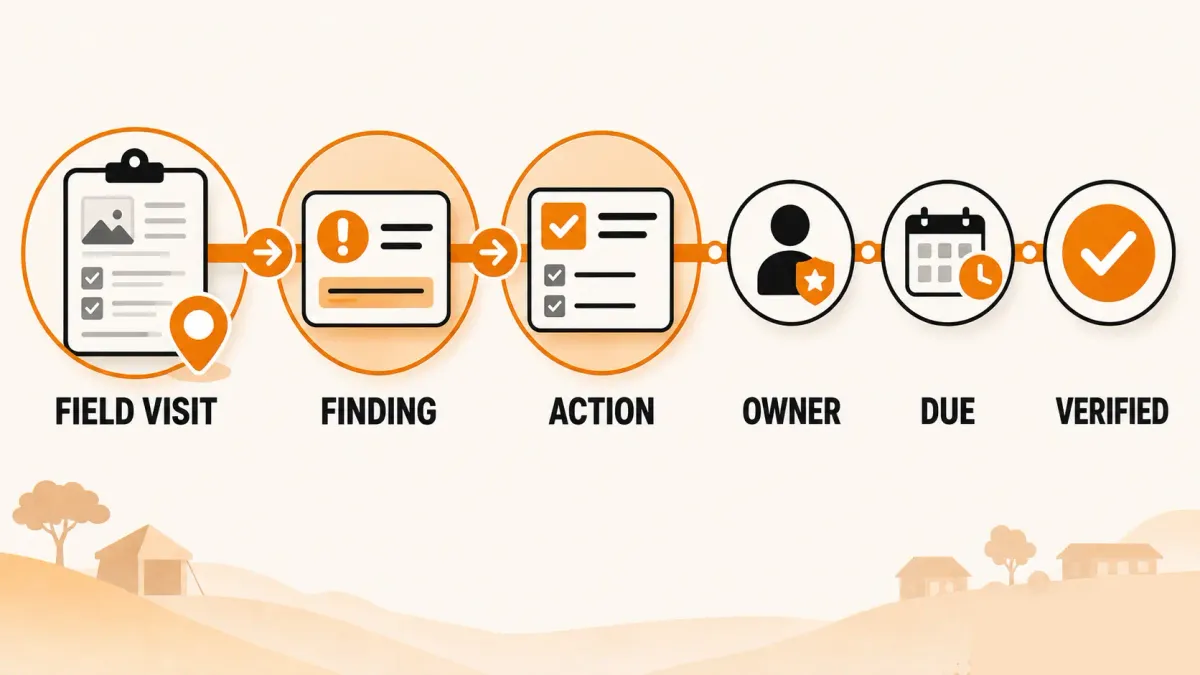
A useful monitoring chain is:
Field Visit → Finding → Corrective Action → Owner → Due Date → Evidence → Verification → Closure
When these records are disconnected, organizations often end up with two separate systems:
- one system containing monitoring reports and findings;
- another containing corrective-action spreadsheets or task lists.
The result is a loss of context.
A manager may know that a corrective action is overdue but have to search through previous reports to determine why the action exists.
A stronger approach keeps the finding and corrective action connected throughout their lifecycle.
What Does It Mean to Link a Finding to a Corrective Action?
Linking a finding to a corrective action means maintaining an explicit relationship between:
What was observed
and
What the organization decided to do about it.
For example:
Field Visit
Project: Community Health Program
Site: Site A
Visit Date: 15 September
Finding
A review of 30 beneficiary records found that 8 records were missing required referral documentation.
Corrective Action
Review active beneficiary records, complete missing documentation where appropriate, and introduce a monthly file-completeness review.
Owner
Site Manager.
Due Date
30 September.
Now the corrective action has context.
Anyone reviewing the action can trace it back to the specific field visit and finding that created it.
Why This Relationship Matters
A corrective-action list without its original findings is often difficult to interpret.
Consider a spreadsheet containing:
| Action | Owner | Due Date | Status |
|---|---|---|---|
| Improve documentation | Site Manager | 30 Sept | Open |
| Reconcile records | Data Officer | 15 Oct | Overdue |
| Conduct training | Program Officer | 20 Oct | Completed |
The list tells management what actions exist.
It does not necessarily explain:
- what triggered each action;
- which site was affected;
- which monitoring visit identified the problem;
- how serious the original finding was;
- what evidence supported the finding;
- or what the action is intended to resolve.
Now imagine each action is directly linked to its finding and field visit.
The operational context becomes:
Action → Finding → Visit → Site → Project
That relationship makes the action much more meaningful.
A Finding and a Corrective Action Are Different
These two concepts should not be treated as interchangeable.
Finding
Describes the condition observed during monitoring.
Corrective Action
Describes the response required to address that condition.
For example:
Finding:
Five of 20 sampled project files were missing required supporting documents.
Corrective Action:
Review all active files and ensure required supporting documentation is complete.
The finding is evidence of a problem.
The corrective action is the response to the problem.
Keeping them separate allows organizations to track whether the response actually addressed the issue.
Not Every Finding Requires a Corrective Action
This is also important.
A monitoring visit can contain:
- positive observations;
- routine observations;
- recommendations;
- findings;
- risks;
- and actionable non-conformities.
Not every observation necessarily requires a corrective action.
For example:
The site has introduced a new community-feedback mechanism.
This may be an observation worth recording without creating an action.
By contrast:
Required complaints are not being documented according to the approved procedure.
This may require a corrective action.
A monitoring system should therefore allow findings to be assessed and actions to be created where appropriate.
Start With a Well-Defined Finding
The quality of the corrective action depends heavily on the quality of the finding.
Weak finding:
Data quality is poor.
This is too broad.
A stronger finding is:
During a review of 50 beneficiary records, 7 records contained discrepancies between the source register and the project database.
Now the problem is measurable.
The corrective action can be more precise:
Review the seven affected records, correct verified discrepancies, and implement a monthly reconciliation process.
Specific findings produce more useful actions.
The Finding Should Explain the Gap
A useful finding generally makes the difference between the expected condition and observed condition clear.
For example:
Expected Condition
All sampled beneficiary records should contain the required referral documentation.
Observed Condition
8 of 30 sampled records did not contain the required documentation.
Finding
Referral documentation was incomplete in 27% of the sampled records.
Corrective Action
Review active beneficiary records and correct missing referral documentation.
This structure makes the relationship between the finding and action easier to understand.
One Finding Can Have Multiple Corrective Actions
Some problems require more than one response.
For example:
Finding
The project is repeatedly submitting monthly reports after the required deadline.
Possible causes may include unclear responsibilities and delayed data consolidation.
The organization might create two actions:
Action 1
Define reporting responsibilities and communicate the approved reporting calendar.
Action 2
Introduce a monthly data-review process before the reporting deadline.
Both actions should remain connected to the same finding.
This is better than creating two unrelated tasks with no explanation of why they exist.
Multiple Findings Can Sometimes Share an Action
The opposite can also occur.
Several related findings may result in a broader corrective action.
For example:
Finding 1: Staff are not consistently following the approved filing procedure.
Finding 2: Supporting documents are stored inconsistently.
Finding 3: Records cannot always be retrieved quickly.
A broader corrective action might be:
Standardize the records-management process and train responsible staff on the approved procedure.
Where multiple findings genuinely share one response, the relationship should be explicit.
The important principle is to preserve the connection between the problem and the action.
Give Every Corrective Action a Clear Owner
Once the action is defined, assign responsibility.
Possible owners include:
- Site Manager;
- Project Manager;
- Program Officer;
- Data Officer;
- Partner Organization;
- Facility Manager;
- M&E Officer.
An owner should know what is expected and when it is due.
For example:
Finding: Incomplete monthly reporting documentation.
Action: Complete missing documentation and implement a monthly completeness check.
Owner: Site Manager.
Due Date: 30 September.
This creates accountability.
Add a Due Date
The action should also have a deadline.
Without a due date, it becomes difficult to determine whether the response is progressing as expected.
A monitoring system should be able to distinguish between:
- Open;
- In Progress;
- Due Soon;
- Overdue;
- Submitted for Verification;
- Verified;
- Closed.
This turns the corrective action into an operational record rather than a note inside a monitoring report.
Preserve the Finding's Severity or Priority
Not every finding carries the same level of risk.
A corrective action should retain enough information about the original finding to help management understand its importance.
For example:
Finding Severity: High
Action Priority: High
This allows management to prioritize follow-up.
A high-risk finding should not become indistinguishable from a minor administrative observation simply because both were converted into tasks.
Keep Evidence Connected
Evidence supporting the original finding should remain associated with the finding where appropriate.
For example:
Finding:
Physical stock does not reconcile with the stock register.
Supporting evidence:
- stock register;
- physical inventory count;
- reconciliation document;
- relevant photographs.
The corrective action may later generate additional evidence:
- corrected register;
- reconciliation report;
- follow-up documentation.
Keeping these relationships clear creates a useful distinction between:
Evidence supporting the finding
and
Evidence supporting the corrective action.
Both can be important.
Preserve the Original Field Visit
The corrective action should remain connected to the field visit that generated the finding.
This allows the organization to answer:
Where did this action come from?
For example:
Corrective Action
→ Finding #24
→ Field Visit #103
→ Site A
→ Project B
This is particularly valuable when an organization manages hundreds or thousands of visits.
Without a persistent relationship, the source of an action can become difficult to determine.
Why Context Becomes More Important at Scale
Consider an organization with:
- 12 projects;
- 150 sites;
- 20 monitoring officers;
- 1,000 field visits per year;
- and several thousand findings.
A simple corrective-action spreadsheet can quickly become difficult to manage.
An action such as:
"Update records"
does not tell a manager enough.
Which project?
Which site?
Which visit?
Which finding?
What records?
Why were they identified as a problem?
Who originally observed the issue?
What evidence supported the finding?
The relationship between records becomes increasingly important as the monitoring operation grows.
Link Actions to the Specific Finding, Not Just the Visit
A field visit can produce many findings.
Suppose a visit produces:
Finding 1: Missing beneficiary documentation.
Finding 2: Incomplete stock records.
Finding 3: Late reporting.
Each finding can have a different corrective action.
If the system links all three actions only to the visit, the relationship is still incomplete.
A stronger structure is:
Visit
→ Finding 1
→ Corrective Action 1
and
Visit
→ Finding 2
→ Corrective Action 2
and
Visit
→ Finding 3
→ Corrective Action 3
This provides much greater precision.
Keep the Relationship Through the Entire Lifecycle
The connection should remain intact even after the action changes status.
For example:
Visit
→ Finding
→ Action
→ Evidence Submitted
→ Verification
→ Closed
If the action is later reopened, the history should still point back to the original finding.
This allows the organization to reconstruct the entire operational story.
What Happens When the Action Is Rejected?
Sometimes a proposed corrective action is not adequate.
For example:
Finding:
Required records are repeatedly incomplete.
Proposed action:
Remind staff to complete records.
During review, management determines that a reminder is insufficient.
The action may need to be revised:
Introduce a weekly record-completeness review with a named responsible officer.
The original finding should remain unchanged.
The corrective action can evolve while preserving the reason it was created.
This distinction is useful:
Finding = What was observed
Action = How the organization intends to respond
Preserve Changes to Important Records
Corrective actions and findings may be updated during review.
A robust monitoring process should preserve important historical information rather than silently replacing the previous state.
For example:
Original finding:
12 records missing required documents.
Reviewed finding:
10 records confirmed after validation.
The organization may legitimately correct the finding.
But it is useful to know that the record changed and why.
Version history and audit trails provide this historical context.
Link Follow-Up Visits to Previous Findings
A later field visit can provide an opportunity to verify the corrective action.
For example:
Visit 1
Finding: Incomplete stock documentation.
Action: Reconcile stock records.
Visit 2
The monitor reviews the stock records again.
The follow-up visit can therefore contribute to the verification of the original corrective action.
This creates continuity:
Visit 1 → Finding → Action → Visit 2 → Verification
The second visit is no longer an isolated monitoring event.
It becomes part of the history of the original issue.
Recurring Findings Become Easier to Understand
Suppose the same site produces:
Visit 1: Missing stock records.
Visit 2: Stock records partially reconciled.
Visit 3: Similar stock-record problem identified again.
When findings are linked to previous actions, the organization can see that the problem is recurring.
This may trigger deeper analysis.
Perhaps:
- the action was insufficient;
- the process was not sustained;
- staff changed;
- the owner did not have sufficient authority;
- the underlying cause was misunderstood;
- or the problem requires a broader intervention.
The historical relationship between visits, findings and actions provides the evidence needed to investigate.
Linking Findings to Actions Improves Management Reporting
Once findings and actions are connected, management can ask more useful questions.
For example:
- How many findings are currently open?
- How many have corrective actions?
- How many actions are overdue?
- Which projects have the most unresolved findings?
- Which sites have repeated findings?
- Which high-severity findings remain unresolved?
- Which actions are awaiting verification?
- Which findings have been closed?
- Which corrective actions originated from a particular monitoring visit?
These are operational questions, not simply reporting questions.
A Useful Finding-to-Action Structure
A practical structure might look like this:
| Field | Purpose |
|---|---|
| Project | Identifies the program context |
| Site | Identifies where the issue occurred |
| Visit | Identifies the monitoring event |
| Finding | Describes what was observed |
| Severity | Indicates importance or risk |
| Evidence | Supports the finding |
| Corrective Action | Defines the required response |
| Owner | Establishes accountability |
| Due Date | Defines expected completion |
| Action Evidence | Supports completion |
| Verification | Confirms whether the response was adequate |
| Status | Shows the current state |
| Closure | Records final resolution |
The exact fields will depend on the organization's monitoring methodology.
The key principle is the relationship between them.
Avoid Copying Findings Into a Separate Action Register
One common manual approach is:
- Complete a monitoring report.
- Identify findings.
- Copy findings into Excel.
- Create a corrective-action tracker.
- Manually type the action.
- Update the spreadsheet separately.
- Later return to the original report to understand the context.
This creates duplicate data.
It also creates opportunities for inconsistencies.
For example:
The monitoring report says:
8 beneficiary records were incomplete.
The corrective-action spreadsheet later says:
6 beneficiary records were incomplete.
Which is correct?
A connected system reduces the need to manually reproduce the same information across multiple records.
Why Connected Records Are Better Than Separate Documents
A document-oriented workflow might look like:
Visit Report.docx
Findings.xlsx
Corrective Actions.xlsx
Follow-up Report.docx
Evidence Folder
The information exists.
But the relationships between the records may exist only in people's memory.
A connected operational workflow instead creates:
Project → Site → Visit → Finding → Action → Evidence → Verification
The relationships become part of the data model.
That makes information easier to retrieve and analyze.
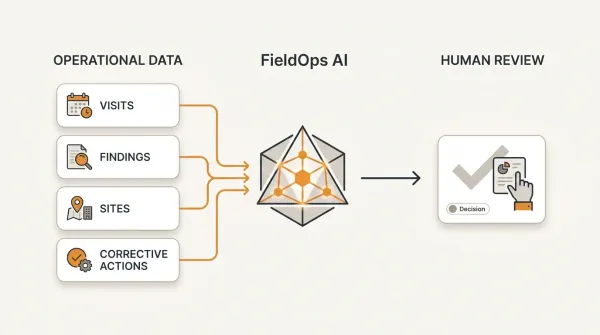
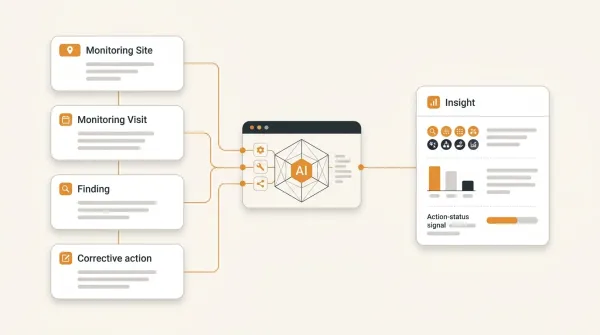
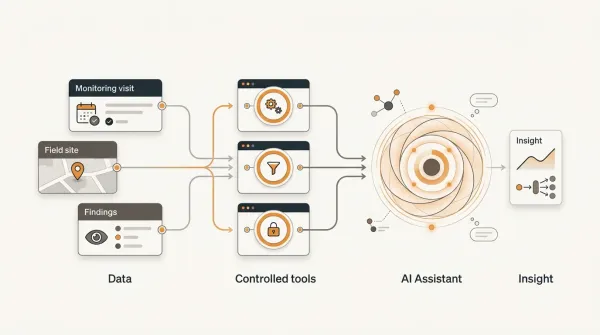
How FieldOps Links Field Visit Findings to Corrective Actions
FieldOps is built around the relationship between:
Organization → Program → Project → Site → Visit → Finding → Corrective Action
A finding generated during a field visit can be associated with the visit that identified it.
The finding can then lead to a corrective action containing operational information such as:
- action description;
- owner;
- due date;
- priority;
- status;
- and supporting evidence.
This allows teams to move from the original monitoring observation to the response without creating an unrelated task register.
FieldOps Preserves the Context of the Finding
Because findings remain connected to field visits, the corrective action retains its operational context.
A team can trace:
Corrective Action
→ Finding
→ Field Visit
→ Site
→ Project
This is useful when a manager needs to understand why an action exists or when an issue needs to be reviewed months after the original visit.
FieldOps Supports Follow-Up and Verification
A corrective action does not have to become the end of the monitoring process.
The action can remain part of the operational history surrounding the original finding.
Supporting evidence can be associated with the response, and verification can determine whether the corrective action adequately addressed the finding.
A later field visit can then provide additional context for determining whether an issue has remained resolved.
The result is a continuous workflow rather than a sequence of disconnected reports.
FieldOps Also Preserves Visit History
FieldOps supports versioned field visits and historical snapshots.
This means that important changes to a monitoring visit can remain traceable instead of simply replacing the previous state.
For organizations that need auditability, this provides an important historical layer around findings and corrective actions.
If someone needs to understand what was originally recorded during a visit, the organization has more than the latest version of the record.
A Practical FieldOps Example
Consider a project with 25 implementation sites.
During a field visit to Site 12, the monitor identifies:
Finding:
Required beneficiary documentation is incomplete in 8 of 30 sampled records.
The finding is recorded against the visit.
The organization creates:
Corrective Action:
Review active beneficiary records and correct missing documentation.
Owner:
Site Manager.
Due Date:
30 September.
Priority:
High.
The Site Manager submits supporting evidence.
The M&E Manager reviews the response.
The action is verified and closed.
Two months later, the site is visited again.
The previous finding is available as part of the site's monitoring history.
The monitor can therefore determine whether:
- the issue remains resolved;
- the same problem has returned;
- or a new finding has emerged.
The operational chain remains intact.
A Simple Finding-to-Action Checklist
Before creating a corrective action, ask:
About the Finding
- Is the finding specific?
- Is the observed condition clear?
- Is supporting evidence available?
- Is the finding linked to the field visit?
- Is the severity understood?
About the Action
- Does the action directly address the finding?
- Is the expected result clear?
- Is an owner assigned?
- Is there a due date?
- Is the priority appropriate?
About Follow-Up
- What evidence will demonstrate completion?
- How will the action be verified?
- Does the finding need a follow-up visit?
- What will constitute closure?
About Traceability
- Can the action be traced back to the finding?
- Can the finding be traced back to the visit?
- Can the visit be traced to the project and site?
- Will the relationship remain available after closure?
If these relationships are maintained, corrective-action tracking becomes substantially more reliable.
The Key Principle
A corrective action should never lose the context of the problem that created it.
The essential relationship is:
Field Visit → Finding → Corrective Action
Everything that follows should remain connected:
Field Visit → Finding → Action → Owner → Due Date → Evidence → Verification → Closure
This allows an organization to answer not just:
What actions are open?
but:
Why do these actions exist?
That second question is critical for effective project monitoring.
Conclusion
Field monitoring is most useful when observations lead to accountable action.
To achieve that, organizations need more than a list of findings and a separate corrective-action spreadsheet.
They need a connected chain:
Visit → Finding → Action → Owner → Due Date → Evidence → Verification → Closure
The finding explains the problem.
The corrective action defines the response.
The owner establishes accountability.
The due date creates a timeframe.
The evidence supports completion.
Verification determines whether the response was adequate.
Closure records the outcome.
When these elements remain connected, organizations can trace every corrective action back to the field observation that created it.
That makes monitoring more transparent, more auditable, and more useful for management.
The ultimate question is simple:
Can you start with a corrective action and trace it all the way back to the field visit that created it?
If the answer is yes, your monitoring process has a strong foundation for operational traceability.
Move beyond data collection
FieldOps helps NGOs manage field visits, monitoring templates, findings, corrective actions, dashboards and donor reporting in one operational intelligence platform.
Learn more about FieldOps