How to Review and Approve Field Monitoring Visits: A Practical M&E Quality Assurance Workflow
Learn how to build a reliable review and approval workflow for field monitoring visits, from submission and evidence checks to corrections, approval, findings, and corrective actions.
A field monitoring visit does not automatically become a reliable monitoring record simply because a field officer has submitted it.
Before monitoring information is used for management decisions, donor reporting, corrective actions, or performance analysis, organizations need a process for reviewing the visit and determining whether it is complete, credible, and ready for approval.
A practical workflow is:
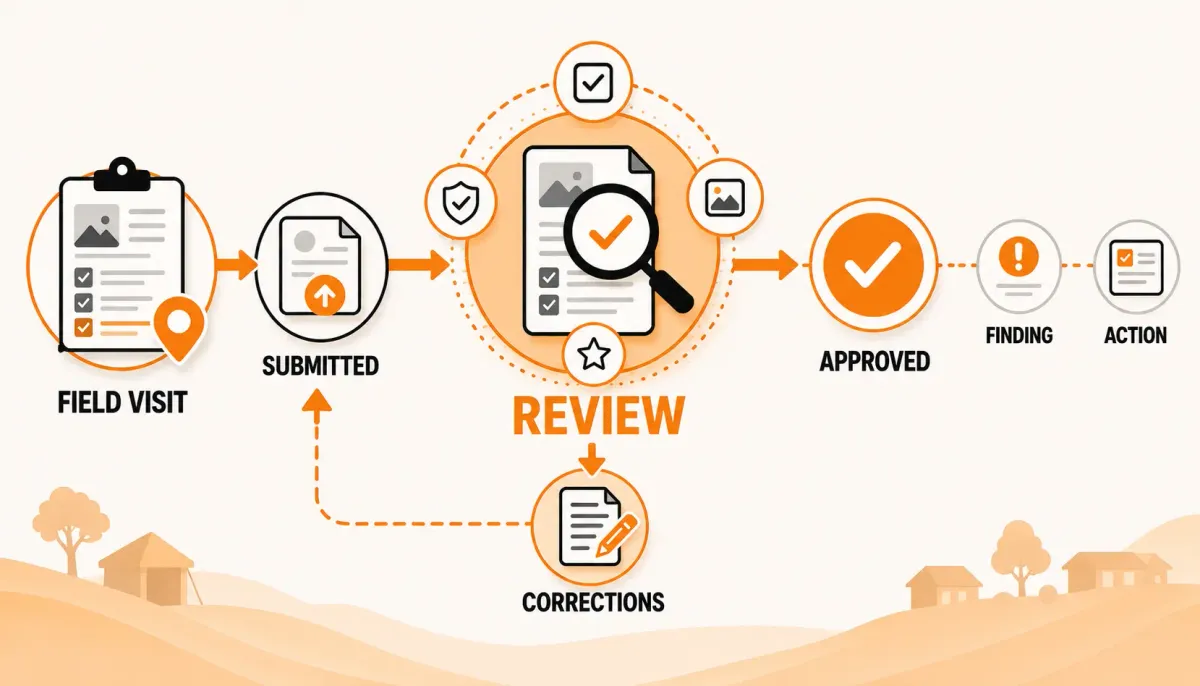
Draft → Submitted → Reviewed → Approved / Rejected
The review stage provides quality assurance.
The approval stage establishes that the organization has accepted the monitoring record as an official record of the visit.
This distinction is important for organizations managing multiple projects, sites, field officers, implementing partners, and monitoring activities.
What Is a Field Monitoring Visit Review?
A field monitoring visit review is a structured quality-assurance process in which a designated reviewer examines a submitted field visit before it is approved.
The reviewer may check:
- whether all required sections were completed;
- whether observations are sufficiently specific;
- whether supporting evidence is present;
- whether findings are properly documented;
- whether findings are supported by evidence;
- whether corrective actions are appropriate;
- whether required fields are complete;
- whether the visit follows the organization's monitoring methodology;
- and whether the record is ready for approval.
The purpose is not simply to check whether a form has been filled in.
The purpose is to determine whether the resulting monitoring record is sufficiently reliable for organizational use.
Why Field Monitoring Visits Need Review
Field monitoring is often conducted by people working away from the organization's central office.
A field officer may visit a project site, collect information, interview staff, inspect documents, observe activities, take photographs, and record findings.
The submitted record may contain important information.
But organizations still need to ask:
Is this visit complete and internally consistent?
Is the evidence sufficient?
Are the findings clearly stated?
Do the corrective actions address the findings?
Does the record meet the organization's monitoring standards?
Without a review process, the organization may discover problems only after the information has already been incorporated into reports or management decisions.
Review Is Different From Data Collection
Data collection answers:
What information was captured during the visit?
Review answers:
Is the submitted monitoring record acceptable and sufficiently reliable?
These are different activities.
A field officer may successfully submit a visit containing 100 fields.
That does not necessarily mean the visit is:
- complete;
- internally consistent;
- adequately evidenced;
- methodologically sound;
- or ready for approval.
A quality-assurance workflow adds a second layer between collection and organizational acceptance.
A Practical Field Monitoring Approval Workflow
A robust workflow can be represented as:
1. Visit Planned
↓
2. Visit Conducted
↓
3. Visit Saved as Draft
↓
4. Visit Submitted
↓
5. Reviewer Checks Submission
↓
6. Corrections Required?
↓
Yes → Returned for Correction
No → Approved
↓
7. Findings and Corrective Actions Followed Up
This creates a controlled lifecycle for monitoring records.
Stage 1: Plan the Monitoring Visit
Review and approval begin before the field officer submits anything.
The organization should establish:
- which project is being monitored;
- which site will be visited;
- who is responsible for the visit;
- what monitoring template will be used;
- when the visit is expected to occur;
- and what areas require particular attention.
A standardized monitoring template helps ensure that different field officers collect information against a consistent set of requirements.
For organizations monitoring many sites, standardization becomes increasingly important.
Stage 2: Conduct the Field Visit
During the visit, the monitoring officer may collect information through:
- interviews;
- observations;
- document reviews;
- physical inspections;
- record sampling;
- photographs;
- measurements;
- beneficiary discussions;
- or other approved monitoring methods.
The resulting record should capture what was actually observed.
The monitoring officer should distinguish between:
Observation
and
Finding
An observation describes what was seen or established.
A finding identifies a condition requiring attention or action.
Stage 3: Save the Visit as a Draft
A draft state allows the monitoring officer to complete the record before formally submitting it for review.
This is useful when:
- the visit contains many sections;
- evidence needs to be attached;
- the officer needs to verify information before submission;
- connectivity is intermittent;
- or the monitoring process involves several stages of data entry.
A draft should not automatically be treated as an official monitoring record.
The organization should have a clear point at which the officer declares the visit ready for review.
Stage 4: Submit the Visit for Review
Submission creates an important boundary.
The field officer is effectively saying:
This monitoring visit is ready for organizational review.
At this point, the review process can begin.
The organization can distinguish between:
Draft
and
Submitted
This simple distinction prevents incomplete records from being confused with records that have been formally submitted.
Stage 5: Review the Submitted Visit
The reviewer should evaluate the visit against a defined quality-assurance standard.
A useful review can examine five areas:
1. Completeness
Are all required sections completed?
2. Consistency
Do the answers and observations make sense together?
3. Evidence
Is sufficient supporting evidence attached where required?
4. Findings
Are findings specific, relevant, and supported by the monitoring evidence?
5. Actions
Do corrective actions appropriately respond to the identified findings?
The exact review criteria should reflect the organization's monitoring methodology.
Check Completeness
The first question is straightforward:
Is the monitoring record complete?
For example, a required monitoring visit might require:
- visit date;
- site;
- monitoring officer;
- project;
- key observations;
- evidence;
- findings;
- corrective actions where required;
- and other mandatory sections.
A reviewer should be able to identify missing information before approving the visit.
Completeness checks are especially important when monitoring information feeds downstream reporting.
Check Internal Consistency
A record can be complete while still containing contradictions.
For example:
Observation:
All sampled records were available.
Finding:
Several required records could not be located.
The reviewer should identify this inconsistency.
Another example:
Finding:
The site has no functioning cold-chain equipment.
Evidence:
A photograph showing functioning equipment.
The reviewer may need to investigate the discrepancy.
Review therefore requires more than checking whether fields contain values.
It requires examining whether the information makes sense as a whole.
Check Supporting Evidence
Evidence requirements depend on the monitoring methodology.
Evidence may include:
- photographs;
- documents;
- registers;
- sampled records;
- attendance sheets;
- stock records;
- reports;
- interview notes;
- or other supporting material.
The reviewer should ask:
Does the available evidence adequately support the observation or finding?
Evidence should be relevant to the claim being made.
More evidence is not automatically better evidence.
The goal is to have appropriate evidence supporting important monitoring conclusions.
Check Findings
A finding should normally be sufficiently specific for someone else to understand:
- what happened;
- where it happened;
- what requirement or expectation was not met;
- and why the issue matters.
Weak finding:
Documentation is poor.
Stronger finding:
During a review of 30 beneficiary files, 8 files were missing the required referral documentation.
The second finding gives management something actionable.
It also makes it easier to determine whether a subsequent corrective action actually addressed the problem.
Check the Relationship Between Findings and Actions
A corrective action should respond to the finding.
For example:
Finding
Eight of 30 sampled beneficiary files were missing required referral documentation.
Corrective Action
Review active beneficiary files and complete missing documentation where appropriate.
This relationship is logical.
Now consider:
Finding
Monthly project reports are repeatedly submitted after the required deadline.
Corrective Action
Conduct a one-time staff training session.
The action may be relevant, but the reviewer should ask whether training alone is sufficient to address the underlying problem.
Perhaps the corrective action should also include:
- a reporting calendar;
- assigned responsibilities;
- a review deadline;
- and escalation procedures.
Review therefore helps ensure that findings are not merely converted into arbitrary tasks.
Check Severity and Priority
Findings should be assessed consistently.
For example, an organization may classify findings as:
- Low;
- Medium;
- High;
- Critical.
The exact categories will vary.
The purpose is to help management distinguish routine issues from problems requiring urgent attention.
A reviewer should check whether the assigned severity is reasonable given the evidence and potential impact.
This also helps organizations prioritize corrective actions.
Check the Monitoring Methodology
The reviewer should determine whether the field officer followed the required monitoring approach.
Depending on the organization, this could include checking:
- required sampling procedures;
- required documents;
- required interviews;
- required observations;
- required evidence;
- and mandatory monitoring sections.
This is one reason standardized monitoring templates are useful.
They create a common framework against which field visits can be reviewed.
What Should Happen When a Visit Has Problems?
A review workflow should not force the reviewer to approve an inadequate record.
There should be a clear correction process.
For example:
Submitted
↓
Reviewed
↓
Corrections Required
↓
Returned to Monitor
↓
Monitor Updates Record
↓
Resubmitted
↓
Reviewed Again
↓
Approved
This is better than asking the reviewer to approve a record simply because the visit has already taken place.
Avoid Editing the Field Officer's Record Without Traceability
There is an important difference between:
Reviewing a record
and
silently changing the record.
If important information is changed after submission, organizations may need to preserve the history of what was originally submitted.
This is especially important when monitoring records are used for:
- compliance;
- donor reporting;
- management decisions;
- investigations;
- audits;
- or performance assessments.
A good monitoring system should make important changes traceable.
Approval Creates an Important Organizational Boundary
Approval means more than:
"Someone looked at the form."
It establishes that the organization has reviewed and accepted the monitoring record according to its process.
This provides a useful distinction between:
Submitted
and
Approved
A submitted visit is awaiting organizational review.
An approved visit has passed that review.
Rejection Should Be Different From Minor Corrections
Not every problem requires complete rejection.
For example:
Minor correction
A monitoring officer forgot to attach a required document.
The reviewer can return the visit for correction.
Substantive problem
The monitoring methodology was not followed and the findings cannot be adequately supported.
The reviewer may need to reject the submission and require a more substantial response.
Organizations should define how these situations are handled.
Approval Should Not Automatically Mean Every Finding Is Resolved
This is another important distinction.
A monitoring visit can be approved even when it contains unresolved findings.
For example:
Visit: Approved
Finding: High-risk documentation gap
Corrective Action: Assigned to Site Manager
Status: Open
The visit record itself has passed quality assurance.
The finding and corrective action continue through their own lifecycle.
This separation is useful because approval of the monitoring record is not the same as resolution of the problems identified during monitoring.
The Complete Workflow
A mature monitoring workflow therefore looks like:
Visit Planned
↓
Visit Conducted
↓
Draft
↓
Submitted
↓
Reviewed
↓
Corrections Required?
↓
Resubmitted if necessary
↓
Approved
↓
Findings Identified
↓
Corrective Actions Assigned
↓
Evidence Submitted
↓
Verification
↓
Resolution
This creates continuity from field activity to organizational action.
Why This Matters for Organizations With Many Sites
Consider an organization with:
- 10 projects;
- 80 implementation sites;
- 25 monitoring officers;
- and hundreds of visits each year.
Without a structured review workflow, management may receive hundreds of monitoring records with inconsistent quality.
One officer may provide detailed evidence.
Another may submit vague observations.
One may document findings clearly.
Another may write:
"Site needs improvement."
One may attach supporting evidence.
Another may not.
A standardized review process provides a consistent quality gate.
Review Criteria Should Be Standardized
Organizations should define a practical review checklist.
For example:
Completeness
- Required sections completed?
- Required evidence attached?
- Required findings documented?
Quality
- Observations clear?
- Findings specific?
- Evidence relevant?
- Internal inconsistencies identified?
Corrective Action
- Action addresses finding?
- Owner assigned?
- Due date defined?
- Priority appropriate?
Compliance
- Required monitoring methodology followed?
- Required procedures followed?
- Required approvals obtained?
Record Integrity
- Important changes traceable?
- Historical record preserved?
- Supporting evidence retained?
A checklist makes reviewer decisions more consistent.
Who Should Review a Field Monitoring Visit?
The reviewer depends on the organization's structure.
Possible reviewers include:
- M&E Manager;
- MEAL Manager;
- Project Manager;
- Program Manager;
- Technical Specialist;
- Monitoring Supervisor;
- Quality Assurance Officer;
- or another authorized role.
The important principle is that the reviewer should have sufficient responsibility and knowledge to assess the record.
In some workflows, separation between the person conducting the visit and the person approving the record provides an additional quality-control layer.
Review Workflows Should Reflect Organizational Authority
Not every user should necessarily be able to approve every monitoring visit.
Organizations may need controls based on:
- project;
- program;
- site;
- role;
- geography;
- or organizational responsibility.
For example:
A Site Supervisor may review visits for assigned sites.
A Project Manager may approve project-level monitoring.
A Program Manager may review escalated or high-severity findings.
The workflow should reflect how accountability actually works within the organization.
What Makes a Field Monitoring Approval Workflow Auditable?
A useful audit trail should make it possible to answer:
Who created the visit?
When was it submitted?
Who reviewed it?
What changes were requested?
Was it resubmitted?
Who approved it?
When was it approved?
What findings resulted?
What corrective actions were assigned?
What happened afterward?
This creates a historical record of the monitoring process rather than only a final document.
Version History Matters
Monitoring records can change.
A reviewer may request corrections.
A field officer may update an observation.
Evidence may be added.
A finding may be clarified.
A robust system should therefore distinguish between the current record and its history.
For example:
Version 1
Original field submission.
Version 2
Corrections made after review.
Version 3
Final approved record.
Preserving this history provides greater accountability than simply overwriting the original submission.
Approval and Auditability Work Together
A strong workflow combines:
Status Control
with
Version History
and
User Accountability
For example:
Submitted by: Monitoring Officer
Reviewed by: M&E Manager
Returned: 12 September
Resubmitted: 14 September
Approved by: M&E Manager
Approved: 15 September
The exact information captured should depend on the organization's requirements.
The principle is that important transitions should be traceable.
How FieldOps Supports Field Visit Review and Approval
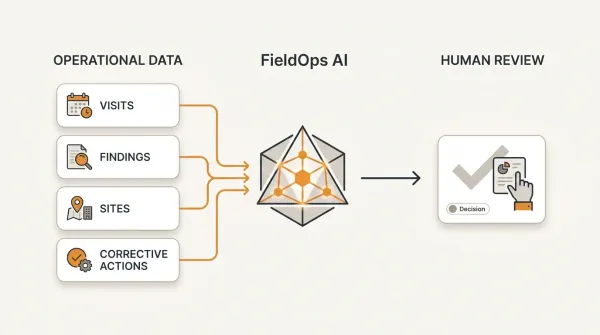
FieldOps provides a structured lifecycle for monitoring visits:
Draft → Submitted → Reviewed → Approved / Rejected
This gives organizations a controlled workflow between field data collection and an accepted monitoring record.
Instead of treating every submitted form as final, FieldOps allows organizations to introduce an explicit review and approval stage.
FieldOps Connects Approval to Findings and Corrective Actions
The value of review does not stop when a visit is approved.
A monitoring visit can produce findings.
Those findings can lead to corrective actions.
Corrective actions can then be followed through their lifecycle.
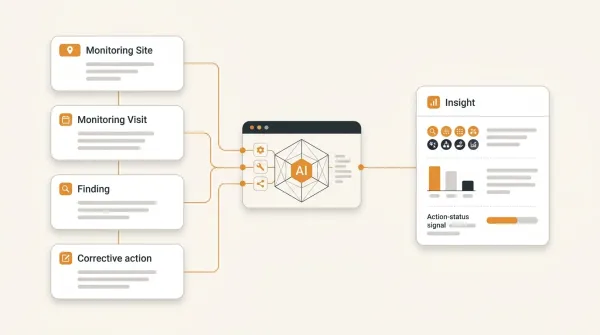
This creates:
Visit → Review → Approval → Finding → Corrective Action → Verification
The monitoring record therefore becomes the starting point for operational follow-up.
FieldOps Preserves Visit History
FieldOps supports versioned field visits and historical snapshots.
This is important when a monitoring record changes during the review process.
Rather than relying exclusively on the latest version, organizations can maintain historical context around the visit.
That can be valuable when a record needs to be reviewed later for:
- internal quality assurance;
- donor reporting;
- management review;
- compliance;
- or audit purposes.
FieldOps Keeps Monitoring Context Connected
A field visit in FieldOps is associated with the organization's operational hierarchy:
Organization → Program → Project → Site → Visit
This means the approved monitoring record retains its project and site context.
When findings and corrective actions are generated, they can remain connected to the monitoring activity that produced them.
This makes it easier to move from:
"A problem was identified"
to:
"This problem was identified during this visit at this site, and this action was assigned to address it."
A Practical Example
Consider an NGO monitoring 40 health facilities.
A monitoring officer visits Facility 17.
During the visit, the officer identifies:
8 of 30 sampled patient files are missing required documentation.
The officer records the finding and supporting evidence.
The visit is submitted.
The M&E supervisor reviews it.
The supervisor checks:
- whether the required sections are complete;
- whether the evidence supports the finding;
- whether the finding is specific;
- whether the severity is appropriate;
- and whether the proposed corrective action addresses the problem.
The supervisor requests one correction.
The officer updates the record and resubmits it.
The supervisor approves the visit.
The corrective action remains open.
The facility manager later submits evidence showing that the missing documentation has been addressed.
The M&E supervisor verifies the response.
The finding is then resolved.
The complete operational history is:
Facility 17
→ Monitoring Visit
→ Finding
→ Corrective Action
→ Evidence
→ Verification
→ Resolution
This is the kind of continuity that a field monitoring system should provide.
Common Mistakes in Field Monitoring Review
Mistake 1: Treating Submission as Approval
A submitted record has not necessarily been reviewed.
Better approach
Use distinct workflow states for submission and approval.
Mistake 2: Reviewing Only for Missing Fields
A record can be complete but still contain weak findings or unsupported conclusions.
Better approach
Review completeness, consistency, evidence and findings.
Mistake 3: Approving Every Visit Automatically
Automatic approval removes the quality gate.
Better approach
Require an appropriate review before approval.
Mistake 4: Treating Approval as Finding Closure
An approved visit can contain unresolved problems.
Better approach
Separate visit approval from corrective-action resolution.
Mistake 5: Overwriting Previous Versions
This can make it difficult to understand how the record changed.
Better approach
Preserve meaningful historical versions and review changes.
Mistake 6: Separating Findings From Their Source Visit
A corrective-action spreadsheet may eventually lose the context of the original finding.
Better approach
Keep the relationship between:
Visit → Finding → Corrective Action
Mistake 7: Using Different Review Standards for Different Officers
This can produce inconsistent monitoring quality.
Better approach
Use standardized review criteria and monitoring templates.
Field Monitoring Review Checklist
Before approving a field monitoring visit, reviewers can ask:
Visit Information
- Is the correct project identified?
- Is the correct site identified?
- Is the visit date correct?
- Is the responsible monitoring officer identified?
Completeness
- Are all mandatory sections complete?
- Are required supporting documents attached?
- Are required observations recorded?
Evidence
- Does the evidence support important observations?
- Are photographs or documents relevant?
- Are evidence gaps documented?
Findings
- Are findings specific?
- Are findings supported by evidence?
- Is the severity appropriate?
- Is the expected condition clear?
Corrective Actions
- Does each actionable finding have an appropriate response?
- Is an owner assigned?
- Is a due date defined?
- Is the action proportionate to the finding?
Quality Assurance
- Are there internal inconsistencies?
- Was the monitoring methodology followed?
- Were required procedures followed?
Approval
- Is the record ready to become an approved monitoring record?
- Are requested corrections complete?
- Is the review decision documented?
Auditability
- Is the submission history preserved?
- Are important changes traceable?
- Is the reviewer identifiable?
- Is the approval decision recorded?
The Key Principle
A field monitoring visit should pass through a quality gate before it becomes an approved organizational record.
The basic distinction is:
Draft ≠ Submitted ≠ Reviewed ≠ Approved
Each state has a different meaning.
A well-designed workflow allows an organization to determine:
- what has been collected;
- what has been submitted;
- what has been reviewed;
- what requires correction;
- what has been approved;
- and what findings still require action.
This creates a much stronger monitoring process than treating every completed form as a final report.
Conclusion
Field data collection is only one part of effective monitoring.
Organizations also need a reliable process for determining whether submitted monitoring visits are complete, credible, sufficiently evidenced and ready for organizational acceptance.
A practical workflow is:
Draft → Submitted → Reviewed → Corrected if Necessary → Approved
After approval, findings can continue through:
Finding → Corrective Action → Evidence → Verification → Resolution
Keeping these stages distinct provides clearer accountability.
It also allows organizations to preserve the history of monitoring records, identify who reviewed and approved them, and maintain the connection between field observations and subsequent corrective actions.
For organizations operating across multiple projects and sites, this becomes increasingly important.
The goal is not simply to collect more field data.
The goal is to create reliable, reviewable and traceable monitoring records that can lead to action.
A useful test is:
Can your organization show who submitted a field visit, who reviewed it, what happened when corrections were required, who approved it, and what happened to the findings afterward?
If the answer is yes, your monitoring workflow has a strong foundation for quality assurance and accountability.
Move beyond data collection
FieldOps helps NGOs manage field visits, monitoring templates, findings, corrective actions, dashboards and donor reporting in one operational intelligence platform.
Learn more about FieldOps