How to Track Corrective Actions From Field Monitoring Visits
Learn how to turn field monitoring findings into trackable corrective actions with clear ownership, deadlines, evidence, verification and closure.
A field monitoring visit can identify a problem in a few minutes.
Resolving that problem can take weeks or months.
This creates one of the most important challenges in project monitoring:
How do you make sure that findings identified during field visits actually lead to corrective action and verified resolution?
A monitoring system that records findings but does not effectively track what happens afterward can leave organizations with a large collection of reports but limited visibility into whether identified problems were resolved.
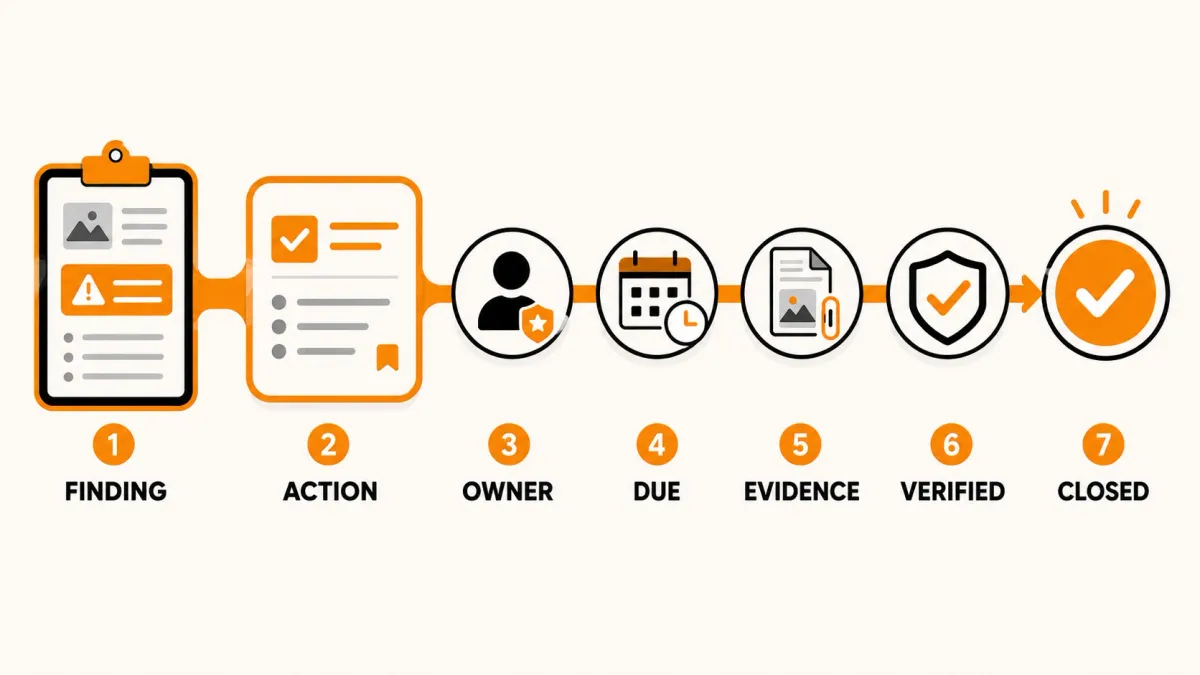
A stronger approach connects the entire process:
Field Visit → Finding → Corrective Action → Owner → Due Date → Evidence → Verification → Closure
This is the difference between documenting problems and managing their resolution.
What Is a Corrective Action?
A corrective action is a specific action intended to address a problem, gap, non-compliance, weakness, or other finding identified during monitoring.
For example:
Finding:
The site did not maintain complete records of beneficiary referrals.
Corrective action:
Update the referral register, reconcile missing entries, and implement a monthly review of referral records.
The finding describes what was wrong.
The corrective action describes what needs to happen next.
Keeping these two concepts separate makes monitoring much easier to manage.
Why Findings Alone Are Not Enough
Imagine that an M&E team conducts 200 field visits during a year.
The visits identify:
- 47 documentation gaps;
- 31 training issues;
- 18 stock-management problems;
- 22 reporting weaknesses;
- 14 safeguarding-related follow-up issues;
- and dozens of other observations.
The organization may have excellent documentation of these findings.
But management eventually needs to answer different questions:
- Which findings are still open?
- Which actions are overdue?
- Who is responsible?
- Which sites have recurring problems?
- Which findings have been resolved?
- Which completed actions have been verified?
- Which issues require escalation?
A repository of monitoring reports does not automatically answer these questions.
The organization needs a corrective-action tracking process.
The Corrective-Action Lifecycle
A practical corrective-action lifecycle is:
Finding Identified
↓
Action Defined
↓
Owner Assigned
↓
Due Date Set
↓
Action Implemented
↓
Evidence Submitted
↓
Action Verified
↓
Finding Resolved
This lifecycle provides a clear path from observation to resolution.
It also makes it possible to identify where an issue is currently stuck.
Step 1: Record the Finding Clearly
A corrective action should begin with a clearly documented finding.
Weak finding:
Documentation is poor.
Better finding:
A review of 20 beneficiary files found that 6 did not contain the required referral documentation.
The second finding is stronger because it identifies:
- what was reviewed;
- the sample size;
- the observed gap;
- and the scale of the issue.
Good findings provide enough context for someone who was not present during the field visit to understand the issue.
Step 2: Define the Required Action
The corrective action should directly address the finding.
For example:
Finding:
Six of 20 beneficiary files were missing referral documentation.
Corrective action:
Review all active beneficiary files, complete missing referral documentation where appropriate, and introduce a monthly file-completeness review.
This is much more useful than:
Improve documentation.
The action should be specific enough that someone can later determine whether it was completed.
Step 3: Assign an Owner
Every corrective action should have a clearly identified owner.
Possible owners include:
- Project Manager;
- Site Manager;
- Program Officer;
- Partner Organization;
- Facility Manager;
- Data Officer;
- M&E Officer.
The owner is the person or role responsible for ensuring that the action is addressed.
Without ownership, corrective actions can easily become organizational orphan records.
Everyone knows the problem exists, but nobody is clearly accountable for moving it forward.
Step 4: Set a Due Date
A corrective action should normally have a realistic deadline.
Compare:
Reconcile beneficiary records.
with:
Reconcile all active beneficiary records and submit the reconciliation to the Project Manager by 30 September.
The second creates a measurable expectation.
A tracking system can then identify actions that are:
- Open;
- In Progress;
- Due Soon;
- Overdue;
- Submitted for Verification;
- Verified;
- Closed.
This gives management an immediate view of where follow-up is required.
Step 5: Define What Counts as Evidence
Completion should be supported by evidence where appropriate.
For example:
Action:
Conduct refresher training for site staff.
Possible evidence:
- training attendance register;
- training materials;
- signed participant list;
- training report;
- photographs where appropriate.
For a documentation finding, evidence might include:
- corrected records;
- reconciliation report;
- updated register;
- quality-control checklist.
The evidence required should depend on the corrective action.
The important principle is:
Do not simply record that an action was completed. Preserve evidence that supports the completion claim.
Step 6: Verify the Action
This is where many corrective-action processes become weak.
An action marked "Completed" does not automatically mean that the underlying problem has been resolved.
Suppose a monitoring visit identifies:
Finding:
Staff are not consistently following the required reporting procedure.
Corrective action:
Conduct refresher training.
The training may genuinely have happened.
But the monitoring team may still need to determine whether reporting compliance improved.
Verification could involve:
- reviewing subsequent reports;
- checking records;
- conducting another monitoring visit;
- reviewing supporting documentation;
- interviewing relevant staff;
- or checking a defined performance measure.
The verification method should match the nature and risk of the finding.
Completion and Verification Are Different
This distinction is important.
Completion asks:
Did the responsible party perform the required action?
Verification asks:
Is there sufficient evidence that the required response was completed and adequately addressed?
In some cases, completion evidence is sufficient.
In other cases, a follow-up review is necessary.
Treating every completed action as automatically resolved can create a false sense of closure.
Step 7: Close the Finding
A finding should be closed only when the organization has determined that the required response has been adequately addressed.
A useful status progression might be:
Open → In Progress → Submitted for Verification → Verified → Closed
The exact terminology can vary.
What matters is that the organization can distinguish between:
- a problem that has been identified;
- an action that has been assigned;
- an action that someone says is complete;
- an action that has been verified;
- and an issue that has actually been closed.
Keep Overdue Actions Visible
One of the biggest weaknesses in manual corrective-action tracking is that overdue actions can disappear into old monitoring reports.
Consider:
Finding: Missing stock reconciliation
Owner: Site Manager
Due: 15 July
Current date: 30 August
Status: Open
The fact that the original field visit occurred two months ago does not make the finding less relevant.
The corrective action is still outstanding.
A useful monitoring system should therefore surface overdue actions independently of the age of the original visit.
Connect Corrective Actions to Their Original Field Visit
A corrective action should not exist as an isolated task.
It should remain connected to the monitoring event that generated it.
For example:
Project: Community Health Program
Site: Site A
Visit: 15 August
Finding: Incomplete stock documentation
Corrective Action: Reconcile stock records
Owner: Site Manager
Due Date: 30 August
Evidence: Reconciliation report
Verification: M&E Manager
Status: Verified
This connection provides context.
When someone reviews the corrective action, they can understand:
- where it originated;
- what was observed;
- what evidence supported the finding;
- and what happened afterward.
Why This Connection Matters
Without the relationship between visits and corrective actions, a manager may see:
Reconcile stock records — overdue.
But they may have to search through multiple reports to discover why the action exists.
With a connected monitoring workflow, the manager can move directly from:
Action → Finding → Visit → Site → Project
That dramatically improves traceability.
Preserve the Finding History
Findings can also change.
A finding may be:
- edited;
- reviewed;
- reclassified;
- assigned a different severity;
- linked to additional evidence;
- or updated after follow-up.
For important monitoring records, preserving historical versions helps the organization understand how the finding evolved.
The objective is not to prevent legitimate corrections.
It is to prevent important history from silently disappearing.
Corrective Actions Should Remain Traceable After Closure
Closing an action should not erase its history.
Suppose an action was:
Opened: 10 June
Assigned: 11 June
Due: 30 June
Evidence submitted: 28 June
Verified: 5 July
Closed: 5 July
That history can be useful later.
If the same problem appears during another visit, the organization can determine that the issue was previously identified and supposedly resolved.
This makes recurring problems easier to identify.
Recurring Findings Are a Management Signal
Suppose the same site receives the following findings:
Visit 1: Incomplete beneficiary records
Visit 2: Missing beneficiary records
Visit 3: Inconsistent beneficiary records
The wording may vary.
The underlying problem may be the same.
This should prompt a management question:
Why is the issue recurring despite previous corrective action?
Possible explanations include:
- the corrective action was insufficient;
- staff turnover occurred;
- the process was not implemented;
- supervision was inadequate;
- the original root cause was misunderstood;
- or the intervention addressed the symptom rather than the underlying problem.
A connected corrective-action history makes these patterns much easier to investigate.
Don't Confuse Corrective Action With Root-Cause Analysis
A corrective action describes what needs to be done.
Root-cause analysis asks why the problem occurred.
For example:
Finding:
Monthly reports are repeatedly submitted late.
Immediate corrective action:
Submit all outstanding reports and establish a reporting calendar.
But management may also ask:
Why are reports repeatedly late?
The underlying cause might be:
- unclear responsibilities;
- inadequate staffing;
- poor data-flow processes;
- delayed source documents;
- lack of review;
- or an unrealistic reporting schedule.
The corrective action may therefore need to address both the immediate problem and its underlying cause.
Prioritize Corrective Actions by Risk
Not every finding has the same importance.
A monitoring system should allow organizations to distinguish between low-priority and high-priority issues.
For example:
Low
Minor documentation formatting issue.
Medium
Incomplete supporting documentation affecting routine reporting.
High
A significant compliance, safeguarding, financial, quality, or operational issue requiring prompt action.
Prioritization helps management focus attention where it matters most.
Use a Standard Corrective-Action Structure
A useful corrective-action record can include:
| Field | Purpose |
|---|---|
| Finding | What was identified |
| Site | Where it occurred |
| Visit | Which monitoring activity identified it |
| Severity | Relative importance or risk |
| Action | What needs to be done |
| Owner | Who is responsible |
| Due date | When it should be completed |
| Evidence | What supports completion |
| Verification | How completion is checked |
| Status | Current state |
| Closure date | When the issue was closed |
The exact structure will vary between organizations.
The principle is to keep enough information to reconstruct the complete follow-up process.
Avoid Tracking Corrective Actions Only in Excel
Spreadsheets can be useful for simple lists.
But corrective-action management becomes increasingly difficult when organizations have:
- many projects;
- many sites;
- multiple monitoring teams;
- hundreds of visits;
- hundreds of findings;
- changing staff;
- multiple owners;
- different due dates;
- supporting evidence;
- and repeated follow-up.
A spreadsheet may tell you:
"Action 184 is overdue."
It may not provide a reliable operational relationship between:
Action 184 → Finding → Visit → Site → Project → Evidence → Verification
That relationship becomes increasingly important as monitoring operations grow.
The Difference Between Reporting and Operational Follow-Up
A monitoring report is primarily a record of what happened.
Corrective-action tracking is about what happens next.
This distinction matters.
A report can say:
"The site had incomplete records."
Operational follow-up should answer:
Who is fixing the records?
By when?
What evidence will demonstrate completion?
Who will verify it?
Has the issue been resolved?
The second set of questions is what turns monitoring into an operational management process.
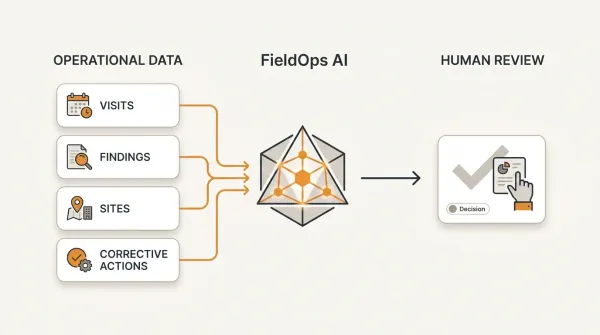
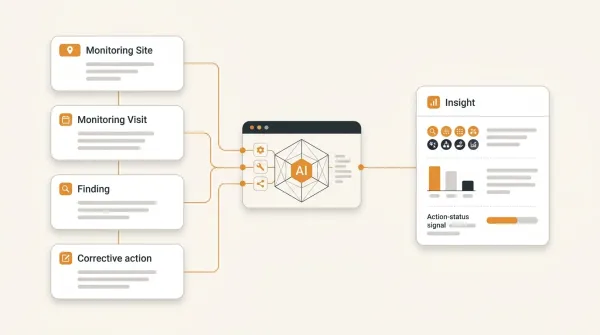
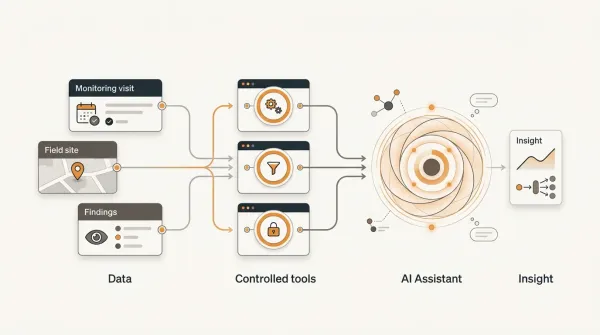
How FieldOps Tracks Corrective Actions
FieldOps connects corrective actions directly to the findings generated during field monitoring.
The operational relationship is:
Project → Site → Visit → Finding → Corrective Action
This means corrective actions retain the context of the monitoring activity that generated them.
A manager can work from the original field visit and its findings into the actions that require follow-up.
The workflow can include important operational information such as:
- finding details;
- severity;
- action description;
- responsible owner;
- due date;
- priority;
- status;
- and supporting evidence.
This creates a single operational chain rather than separate monitoring reports and follow-up spreadsheets.
FieldOps Keeps Field Monitoring History Connected
FieldOps also maintains historical visit information and versions.
This matters when a finding or visit needs to be understood later.
Instead of relying only on the latest state of a record, an organization can maintain historical context around the monitoring activity.
That helps answer questions such as:
- What was originally observed?
- Which finding resulted?
- What action was assigned?
- Who was responsible?
- What changed?
- What evidence was provided?
- Was the action verified?
This is particularly useful for organizations that need stronger auditability across their field operations.
A Practical Example
Consider an organization managing 50 project sites.
During a field visit, the M&E officer identifies:
Finding:
Required beneficiary documentation is missing from 12 of 50 sampled records.
The monitoring team creates:
Corrective Action:
Review all active beneficiary records and correct missing documentation.
Owner:
Site Manager.
Due Date:
30 September.
Priority:
High.
The Site Manager later submits evidence.
The M&E team reviews the evidence.
If the evidence is sufficient, the action is verified and closed.
During the next field visit, the monitor can review the previous finding and determine whether the issue has remained resolved.
If the problem appears again, the organization now has a historical record showing that the issue was previously identified and addressed.
That is much stronger than simply having two independent monitoring reports.
Questions a Corrective-Action System Should Answer
At any point, management should be able to answer:
What is still unresolved?
Identify all open findings and corrective actions.
What is overdue?
Identify actions whose deadlines have passed without resolution.
Who is responsible?
See the owner associated with each action.
Where are problems concentrated?
Identify projects and sites with large numbers of findings.
What are the highest-risk issues?
Filter findings and actions by priority or severity.
What keeps recurring?
Compare findings across visits and sites.
What has actually been verified?
Distinguish completed actions from verified actions.
What happened after a field visit?
Trace the visit through its findings and corrective actions.
These questions are at the heart of operational monitoring.
A Corrective-Action Tracking Checklist
Before considering a corrective-action process effective, ask:
Findings
- Is every important finding recorded?
- Is the finding connected to the field visit?
- Is the finding sufficiently specific?
Actions
- Does every actionable finding have a defined response?
- Is the action specific and measurable?
- Is the action linked to the finding?
Accountability
- Does every action have an owner?
- Is the owner clearly identified?
Timing
- Does every action have a due date?
- Are overdue actions visible?
Evidence
- Is completion evidence recorded?
- Is evidence connected to the relevant action?
Verification
- Can someone verify whether the action was actually completed?
- Is verification recorded separately from completion where appropriate?
Closure
- Is the final status clear?
- Is the closure date recorded?
- Does closure preserve the history of the action?
Recurrence
- Can previous findings be reviewed during future visits?
- Can recurring findings be identified?
If the answer is yes, corrective-action management becomes a continuous part of monitoring rather than an administrative task performed after the monitoring report is written.
The Key Principle
The purpose of field monitoring is not simply to identify problems.
It is to provide evidence that helps an organization improve performance.
That requires a complete chain:
Observe → Document → Find → Act → Verify → Learn
A finding without an action may document a problem.
An action without an owner may not be implemented.
An action without a deadline may not be prioritized.
An action marked complete without evidence may be difficult to validate.
An action without verification may create false closure.
A monitoring process becomes substantially stronger when these elements remain connected.
Conclusion
Effective corrective-action tracking begins with a simple principle:
Every important finding should have a clear path from identification to resolution.
That path should connect:
Field Visit
→ Finding
→ Corrective Action
→ Owner
→ Due Date
→ Evidence
→ Verification
→ Closure
For organizations managing multiple projects and sites, this connection becomes increasingly important.
Field monitoring should not end when the monitor submits the report.
The real operational value often begins afterward.
The question is not only:
What did we find?
It is also:
What happened because we found it?
A strong monitoring system should make that answer easy to trace.
Move beyond data collection
FieldOps helps NGOs manage field visits, monitoring templates, findings, corrective actions, dashboards and donor reporting in one operational intelligence platform.
Learn more about FieldOps