How to Verify That Corrective Actions Were Actually Resolved
Learn how to verify corrective actions after field monitoring, distinguish completion from resolution, preserve evidence, and maintain a reliable audit trail from finding to closure.
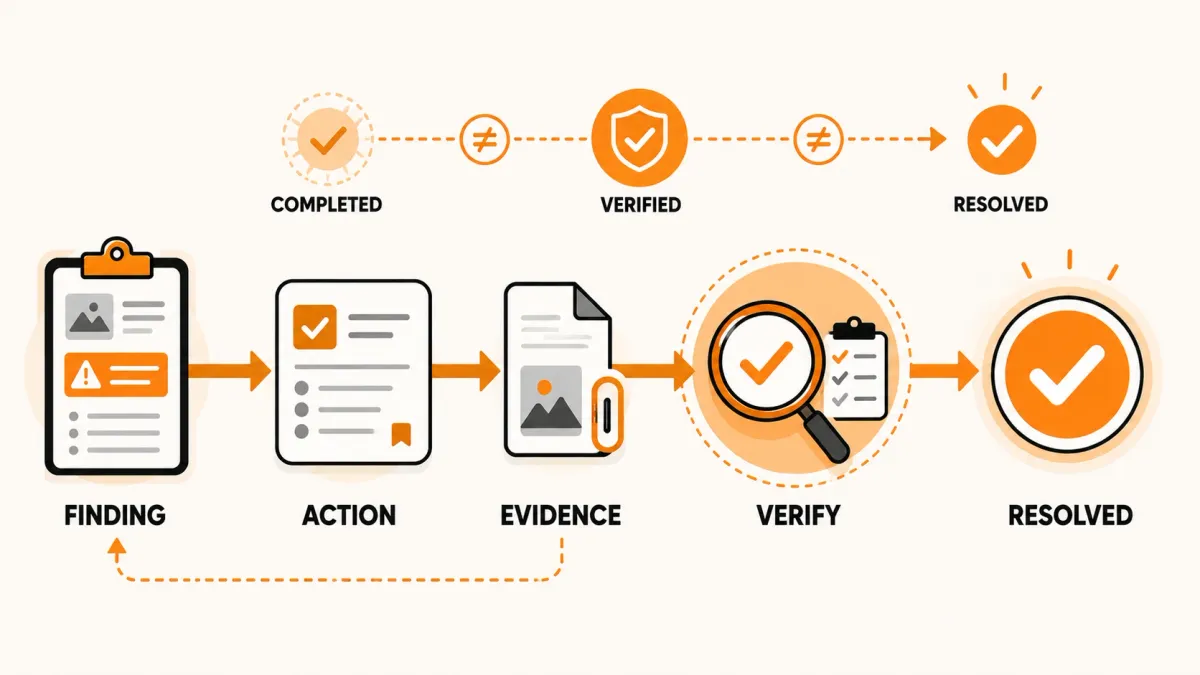
A corrective action marked "Completed" does not necessarily mean that the underlying problem has been resolved.
This distinction is critical in field monitoring.
A monitoring team may identify a problem during a site visit, assign a corrective action, and later receive confirmation that the action was completed. But unless the organization has an appropriate way to verify the response, it may not know whether the original finding was actually addressed.
A reliable corrective-action process therefore needs to distinguish between:
Action assigned → Action completed → Action verified → Finding resolved
These are not necessarily the same thing.
For organizations managing projects across multiple sites, partners, facilities, or implementation locations, verification provides the final accountability link between a monitoring finding and its resolution.
What Does It Mean to Verify a Corrective Action?
Verification means determining, using appropriate evidence, whether the required corrective action was completed and whether it adequately addressed the finding.
For example:
Finding
A health facility's stock records do not reconcile with the physical stock count.
Corrective Action
Reconcile the stock register with the physical inventory and establish a monthly reconciliation process.
Completion Claim
The facility manager reports that the records have been reconciled.
Verification
The M&E officer reviews the reconciliation documentation and confirms during a follow-up review that the records are now consistent.
Resolution
The finding is verified and closed.
The important step is the verification between the completion claim and the final resolution.
Completion Is Not the Same as Resolution
Consider this example.
A monitoring visit identifies:
Staff are not consistently following the required data-quality procedure.
The corrective action is:
Conduct refresher training for all relevant staff.
The responsible manager conducts the training and marks the action:
Completed
The training happened.
But has the original problem been resolved?
Not necessarily.
The organization may need to determine whether staff subsequently followed the required procedure.
This could require:
- reviewing new records;
- checking subsequent reports;
- observing the process;
- conducting a follow-up visit;
- or reviewing another appropriate source of evidence.
The training itself is evidence that the action occurred.
It is not automatically evidence that the underlying problem was eliminated.
Why Verification Matters in Monitoring
Without verification, organizations can accumulate corrective actions that appear closed but have never been independently assessed.
This creates several risks.
False Closure
An action is marked complete even though the original problem remains.
Recurring Findings
The same issue appears during later monitoring visits.
Weak Accountability
Management cannot distinguish between actions that were claimed as completed and actions that were actually verified.
Poor Management Information
Reported completion rates may look strong while unresolved problems remain.
Audit Difficulties
The organization may struggle to demonstrate how it determined that a finding was resolved.
Verification reduces these risks by creating evidence around the transition from completion to resolution.
A Strong Corrective-Action Lifecycle
A useful lifecycle is:
Finding Identified
↓
Corrective Action Defined
↓
Owner Assigned
↓
Due Date Set
↓
Action Implemented
↓
Evidence Submitted
↓
Verification Performed
↓
Finding Resolved
This lifecycle makes the status of an issue much clearer.
Instead of having only:
Open / Closed
the organization can distinguish between the stages that occur before closure.
Step 1: Start With a Specific Finding
Verification becomes difficult when the original finding is vague.
Weak finding:
Reporting needs improvement.
There is no clear condition against which resolution can be assessed.
A stronger finding is:
During the review of 30 beneficiary records, 8 records were missing the required referral documentation.
Now the organization has something specific to address.
The corrective action can also be specific:
Review all active beneficiary records, complete missing documentation where appropriate, and introduce a monthly completeness review.
The more precise the finding, the easier it becomes to define appropriate verification criteria.
Step 2: Define What "Resolved" Means
Before an action is implemented, the monitoring team should ideally know what successful resolution will look like.
For example:
Finding
Monthly project reports are repeatedly submitted after the reporting deadline.
Corrective Action
Establish a reporting calendar, assign reporting responsibilities, and submit future reports according to the approved schedule.
Verification Criteria
The next three monthly reports are submitted by the required deadline.
Now the organization has a measurable basis for determining whether the problem has been addressed.
This is stronger than simply asking whether someone completed a reporting training session.
Step 3: Assign Responsibility
Every corrective action should have a clear owner.
The owner might be:
- Project Manager;
- Site Manager;
- Program Officer;
- Facility Manager;
- Partner Organization;
- Data Officer;
- or another responsible role.
The owner is responsible for implementing the required response.
The person verifying the action may be different.
This separation can strengthen accountability because the person responsible for completing the action is not necessarily the person determining whether it has been adequately addressed.
Step 4: Set a Deadline
A due date establishes when the corrective action should be addressed.
For example:
Action: Reconcile stock records.
Owner: Facility Manager.
Due date: 30 September.
Once the deadline passes, the organization can identify whether the action is:
- completed;
- awaiting verification;
- overdue;
- verified;
- or still open.
Without a deadline, it becomes much harder to distinguish an active corrective action from an abandoned one.
Step 5: Define the Verification Method
Different findings require different verification methods.
There is no single verification method that works for every corrective action.
Document Review
Useful when the action involves records, reports, policies, registers, or other documentation.
Evidence Review
Useful when the responsible party can provide supporting evidence demonstrating that an action occurred.
Follow-Up Field Visit
Useful when the finding concerns a physical condition, operational practice, service-delivery process, or site-level behavior.
Data Review
Useful when the corrective action should result in measurable changes in reported data.
Observation
Useful when the organization needs to determine whether a process is actually being followed.
Interview or Discussion
Useful when verification requires confirmation from responsible staff or stakeholders.
The verification method should be appropriate to the nature and risk of the finding.
Step 6: Collect Supporting Evidence
Evidence should support the verification decision.
For example, if the corrective action is:
Update the facility inventory records.
Potential evidence could include:
- updated inventory register;
- reconciliation report;
- supporting stock documentation;
- photographs where appropriate;
- or records generated by the updated process.
The objective is not to collect evidence for its own sake.
The objective is to have sufficient information to support the conclusion that the required action was addressed.
Step 7: Verify Against the Original Finding
This is an important principle.
Verification should not only ask:
Did the owner perform the action?
It should also ask:
Did the action address the problem identified during monitoring?
Consider:
Finding
The site was not maintaining required attendance records.
Action
Train the site administrator on attendance-record procedures.
Completion
Training completed.
Verification
A subsequent review confirms that attendance records are now complete and maintained according to the required procedure.
The final verification connects the action back to the original finding.
Completion Evidence vs Resolution Evidence
These can sometimes be different.
Completion Evidence
Shows that the corrective action occurred.
Example:
Staff training attendance sheet.
Resolution Evidence
Shows that the original problem was adequately addressed.
Example:
Subsequent records demonstrating consistent compliance with the required procedure.
In simple cases, one piece of evidence may serve both purposes.
In more complex cases, they may require different evidence.
The important principle is to understand what the evidence actually demonstrates.
Do Not Automatically Close an Action When Evidence Is Uploaded
Uploading a document should not necessarily trigger automatic closure.
For example:
Action: Replace damaged equipment.
Evidence uploaded: Photograph of new equipment.
The photograph may show that equipment was delivered.
But verification might still require determining:
- whether the correct equipment was installed;
- whether it is operational;
- whether it meets the required specification;
- and whether the original problem has been addressed.
Evidence is an input to verification.
It is not necessarily the verification decision itself.
Use Clear Verification Outcomes
A useful verification workflow can include outcomes such as:
Verified
The evidence and review are sufficient to confirm that the action adequately addressed the finding.
Partially Verified
Some requirements have been addressed, but additional work is necessary.
Not Verified
The available evidence is insufficient or the required action has not been adequately completed.
Reopened
A previously addressed issue has reappeared or the verification process has identified that the underlying problem remains.
The exact terminology can vary by organization.
The important principle is to avoid treating every submitted completion claim as successful resolution.
What Happens When an Action Fails Verification?
Failure to verify should not necessarily mean the monitoring process starts again from zero.
The organization should be able to:
- record why the action was not verified;
- request additional evidence;
- revise the corrective action;
- extend the deadline where justified;
- assign a new owner where necessary;
- escalate the issue;
- or schedule another follow-up.
For example:
Finding: Required financial documentation is incomplete.
Action: Reconcile missing documentation.
Evidence submitted: Partial reconciliation.
Verification: Not verified.
Reason: 15 of the 40 missing records remain unresolved.
Next action: Complete the remaining reconciliation.
This creates continuity instead of losing the history of the original problem.
Verification Should Preserve the Audit Trail
A strong monitoring system should preserve the history of the corrective action.
For example:
15 August: Finding identified.
16 August: Corrective action assigned.
30 August: Action due.
28 August: Evidence submitted.
2 September: Verification performed.
2 September: Action verified.
2 September: Finding closed.
If the record is later questioned, the organization can reconstruct the sequence.
This is particularly important when monitoring information contributes to management decisions, donor reporting, compliance reviews, or audits.
Keep the Original Finding Connected to the Verification
The verification record should remain connected to the finding that created the corrective action.
This provides context.
Instead of seeing:
Corrective Action #184 — Verified
the organization should be able to trace:
Corrective Action #184
→ Finding
→ Field Visit
→ Site
→ Project
→ Evidence
→ Verification
This relationship makes the record much more useful.
Verification Can Happen During a Later Field Visit
Not every corrective action requires a separate verification process.
Sometimes the most appropriate verification occurs during the next monitoring visit.
For example:
Previous Visit
Finding:
Required patient records were not consistently maintained.
Corrective action:
Ensure all required patient records are complete.
Next Visit
The monitor reviews a sample of records and determines whether the documentation has improved.
The new visit therefore becomes part of the verification history of the previous finding.
This creates continuity between monitoring cycles.
Use Follow-Up Visits to Test Sustainability
A corrective action can appear successful immediately after implementation but fail later.
For example:
Finding: Staff are not completing required data-quality checks.
Action: Conduct training and implement a data-quality checklist.
One week later, the checklist is being used.
Three months later, staff have stopped using it.
The original action may have been implemented but the underlying improvement was not sustained.
For recurring or high-risk findings, follow-up verification can therefore examine whether the corrective change remains effective over time.
Recurring Findings Should Trigger Attention
Suppose a site has:
January: Finding identified.
February: Action marked complete.
March: Finding verified.
June: Similar finding appears again.
The organization now has important information.
The original corrective action may not have addressed the root cause.
A recurring finding can indicate:
- inadequate corrective action;
- insufficient supervision;
- staff turnover;
- weak procedures;
- resource constraints;
- or an incorrectly identified root cause.
Historical corrective-action records make these patterns visible.
Verification Helps Measure More Than Activity
Without verification, an organization may report:
95% of corrective actions completed.
That sounds positive.
But if completion means only that responsible parties marked actions as done, the number may not tell management whether problems were actually resolved.
A stronger metric might distinguish:
- actions assigned;
- actions completed;
- actions awaiting verification;
- actions verified;
- actions overdue;
- actions reopened;
- findings closed.
These measures provide a more accurate picture of corrective-action performance.
A Useful Corrective-Action Dashboard
Management may want to know:
Open Actions
How many corrective actions remain unresolved?
Overdue Actions
How many have passed their due date?
Awaiting Verification
How many actions have been submitted for review?
Verified
How many actions have been independently verified?
Reopened
How many previously resolved findings have reappeared?
By Project
Which projects have the largest number of unresolved actions?
By Site
Which sites require additional attention?
By Severity
Which high-risk findings remain unresolved?
The value of these metrics depends on the underlying records being reliable and connected.
Avoid Treating Every Finding the Same Way
Verification should be proportionate to risk.
A minor formatting issue may require a simple document check.
A high-risk compliance or safeguarding finding may require a more rigorous verification process.
Organizations should therefore consider:
- severity;
- potential impact;
- recurrence;
- complexity;
- evidence requirements;
- and organizational risk.
The verification process should be strong enough to provide reasonable confidence that the issue has been addressed.
A Practical Verification Framework
For each corrective action, ask five questions.
1. What was the original problem?
The finding should be clearly documented.
2. What was required?
The corrective action should define the expected response.
3. What evidence demonstrates completion?
The owner should provide appropriate supporting evidence.
4. What verification was performed?
The organization should record how the evidence or outcome was assessed.
5. Has the original problem been adequately addressed?
The final decision should determine whether the finding can be closed.
This simple framework can prevent many weak closure decisions.
Example: Verifying a Data-Quality Finding
Consider a project where a monitoring visit identifies:
12% of sampled beneficiary records contain inconsistent dates between the source register and the project database.
Corrective Action
Review the affected records, correct discrepancies, and implement a monthly data-quality reconciliation process.
Owner
Project Data Officer.
Due Date
30 September.
Completion Evidence
- corrected records;
- reconciliation report;
- completed data-quality checklist.
Verification
The M&E Manager reviews the reconciliation report and samples corrected records.
Follow-Up
The next month's data-quality review is checked to determine whether the reconciliation process is being maintained.
Resolution
The finding is closed when the organization has sufficient evidence that the identified discrepancies were addressed and the required process is functioning.
This is a much stronger process than simply changing the action status from Open to Completed.
How FieldOps Supports Corrective-Action Verification
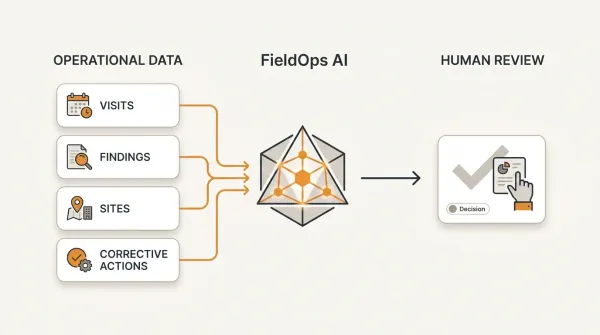
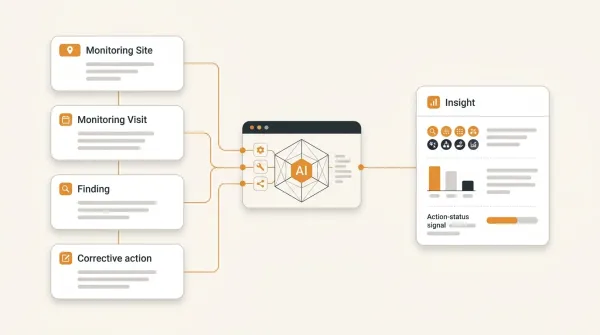
FieldOps connects corrective actions to the findings generated during field monitoring.
This allows an organization to maintain the relationship between:
Visit → Finding → Corrective Action
The corrective action can retain important operational information such as:
- action description;
- responsible owner;
- due date;
- priority;
- status;
- and supporting evidence.
This provides the foundation for following an issue from identification through response and verification.
FieldOps Keeps Findings and Follow-Up Connected
Because findings remain associated with their originating field visits, teams can retain the context behind corrective actions.
A manager reviewing an action can understand:
- which project it belongs to;
- which site generated the finding;
- which field visit identified it;
- what the finding was;
- what action was required;
- and what evidence was associated with the response.
This is important when an organization manages many projects and sites.
Without this relationship, corrective-action lists can become disconnected task registers.
FieldOps Supports Historical Visit Records
FieldOps also provides versioned field visits and historical snapshots.
This means organizations can preserve important historical states of a visit instead of relying exclusively on the current version.
That matters when a finding or corrective action needs to be understood months later.
The organization can retain the historical context surrounding the monitoring activity rather than reconstructing it from separate spreadsheets, emails, and files.
FieldOps Makes Verification Part of the Monitoring Workflow
The operational model is:
Field Visit
↓
Finding
↓
Corrective Action
↓
Evidence
↓
Verification
↓
Resolution
This makes corrective-action management part of the field-monitoring workflow rather than a separate administrative process.
The goal is not merely to know how many actions were marked complete.
The goal is to know which findings have been adequately addressed.
A Verification Checklist for M&E Teams
Before closing a corrective action, ask:
Finding
- Is the original finding clearly documented?
- Is it linked to the relevant field visit?
- Is the finding sufficiently specific?
Corrective Action
- Does the action directly address the finding?
- Is the responsible owner identified?
- Is there a realistic deadline?
Evidence
- Has appropriate completion evidence been submitted?
- Does the evidence demonstrate what it is supposed to demonstrate?
Verification
- Has someone reviewed the evidence?
- Was an appropriate verification method used?
- Does the verification address the original finding?
Resolution
- Has the issue actually been addressed?
- Is additional work required?
- Should the finding remain open or be reopened?
Audit Trail
- Is the verification decision recorded?
- Is the evidence preserved?
- Can the organization reconstruct what happened later?
If these questions can be answered, the organization has a much stronger basis for declaring a corrective action resolved.
The Key Principle
The most important distinction in corrective-action management is simple:
Completed is not always the same as resolved.
A responsible person can complete an activity.
An organization must still determine whether that activity adequately addressed the finding.
The strongest workflow therefore separates:
Completion
from
Verification
and ultimately from
Resolution.
That distinction improves accountability, strengthens monitoring records, and provides management with more reliable information about whether identified problems are actually being addressed.
Conclusion
Field monitoring creates value when it leads to improvement.
That requires more than identifying findings.
It requires following those findings through to resolution.
A reliable corrective-action process connects:
Finding → Action → Owner → Due Date → Evidence → Verification → Closure
Verification is the step that tests whether the response was sufficient.
For some findings, verification may be a document review.
For others, it may require data analysis, observation, evidence review, or a follow-up field visit.
The appropriate method depends on the nature and risk of the finding.
What matters is that the organization can demonstrate how it reached its conclusion.
A field monitoring system should therefore make it possible to answer:
What was found?
What action was required?
What evidence was provided?
Who verified it?
Was the original problem actually resolved?
When these answers remain connected to the original field visit, the result is more than a completed task.
It is a traceable chain of accountability from field observation to verified resolution.
Move beyond data collection
FieldOps helps NGOs manage field visits, monitoring templates, findings, corrective actions, dashboards and donor reporting in one operational intelligence platform.
Learn more about FieldOps