How to Identify and Prevent Recurring Problems in Project Monitoring
Learn how M&E teams can identify recurring findings, distinguish isolated issues from systemic problems, and use monitoring data to improve project implementation.
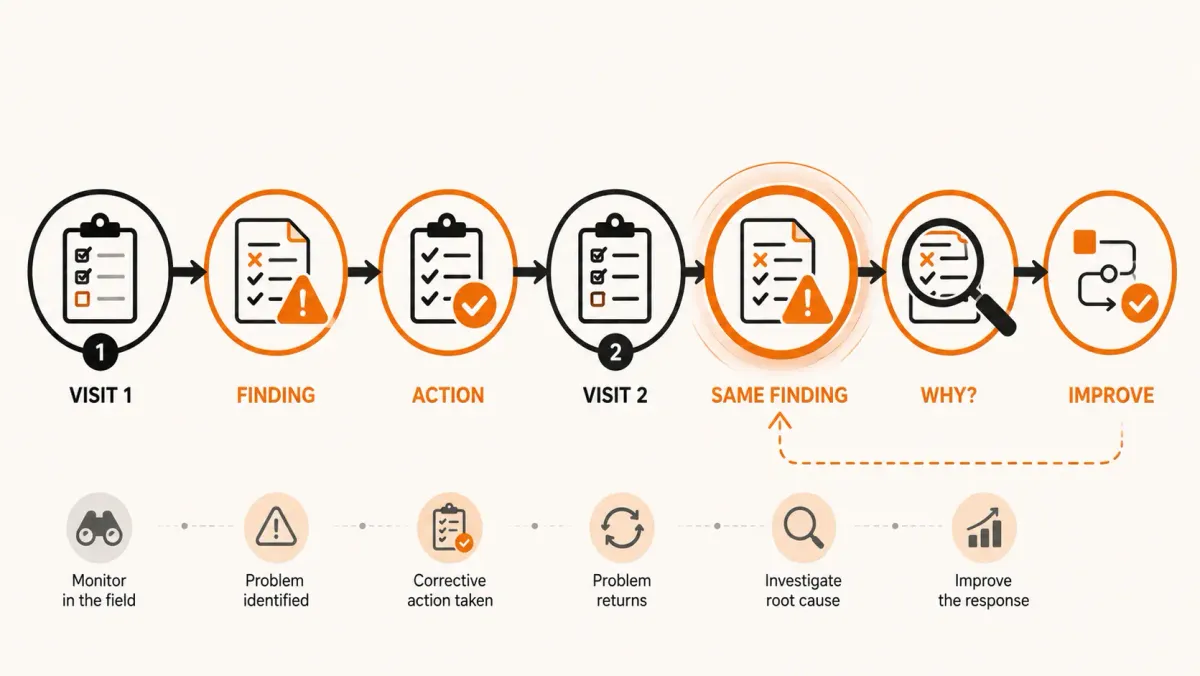
A monitoring visit identifies a problem.
The project creates a corrective action.
The action is completed.
Then, during the next monitoring visit, the same problem appears again.
What should the M&E team do?
The answer should not simply be:
"Create another corrective action."
A recurring finding is often a signal that the organization needs to understand why the problem keeps returning.
The issue may be inadequate training. It may be weak supervision, insufficient resources, an ineffective process, unclear responsibilities, poor tools, or an intervention that addressed the symptom rather than the underlying cause.
This is why recurring findings are more than another category of monitoring data.
They are evidence about whether the project's response to problems is actually working.
A strong monitoring system should therefore allow an organization to move beyond:
Finding → Action → Closed
and toward:
Finding → Action → Verification → Recurrence analysis → Learning → Adaptation
This approach is consistent with the broader principle of using monitoring and evaluation information to support adaptive management: monitoring should provide information that helps teams interpret what is happening, make decisions, and adapt implementation when necessary. :contentReference[oaicite:0]{index=0}
What is a recurring finding?
A recurring finding is a substantially similar issue that is identified more than once within a defined monitoring period, either:
- at the same project site across multiple monitoring visits, or
- across multiple sites within a project or program.
For example:
January
Finding: Incomplete beneficiary documentation.
April
Finding: Incomplete beneficiary documentation.
July
Finding: Incomplete beneficiary documentation.
The repeated observation deserves attention.
But recurrence should not be determined by matching words alone.
Two findings can use similar language while having different underlying causes.
Conversely, the same underlying problem can be described differently by different monitors.
A useful recurrence process therefore combines:
- structured finding categories,
- consistent definitions,
- site identifiers,
- monitoring dates,
- finding history,
- corrective-action history,
- and professional judgment.
Why recurring findings matter
A single finding tells you that a problem was observed.
A recurring finding tells you something more important:
The existing response may not have been sufficient to prevent the problem from returning.
That does not necessarily mean that someone failed.
It means the organization has new evidence that deserves interpretation.
For example:
First monitoring visit
Finding: Incomplete stock records.
Action: Train facility staff on stock documentation.
Follow-up monitoring visit
Finding: Incomplete stock records.
At this point, the organization should ask:
Did the training fail?
But it should also ask:
Was training actually the correct intervention?
Perhaps staff already understood the procedure.
Perhaps the stock records were unavailable.
Perhaps the reporting process was too complicated.
Perhaps there was inadequate supervision.
Perhaps staffing levels made the process difficult to maintain.
The recurring finding is therefore a reason to investigate, not simply a reason to repeat the previous intervention.
A recurring finding is not automatically proof of failure
This distinction is important.
Suppose a problem appears again after a corrective action.
Several explanations are possible.
The action may have:
- not been implemented;
- been implemented only partially;
- been implemented but not sustained;
- addressed one contributing factor but not the underlying cause;
- been appropriate, but the problem later returned;
- been based on an incorrect diagnosis of the problem.
Therefore, organizations should avoid concluding:
"The corrective action failed."
before examining the evidence.
A better question is:
What does the recurrence tell us about the problem, the intervention, and the implementation context?
That approach is more consistent with adaptive management, where monitoring information is used to support learning and deliberate adjustments during implementation. :contentReference[oaicite:1]{index=1}
The difference between a repeated observation and a recurring problem
Consider this example.
During the first visit, an M&E officer finds:
Three beneficiary files are missing signatures.
The issue is corrected.
During the next visit, the officer finds:
Two beneficiary files are missing signatures.
The wording is similar.
But the organization still needs to establish whether this represents:
- the same unresolved process problem,
- a new isolated occurrence,
- a different cause producing the same symptom,
- or a broader documentation problem.
Recurrence analysis therefore requires context.
The important question is not:
"Did these two findings use similar words?"
It is:
"Does the evidence indicate that substantially the same underlying issue remains unresolved or has returned?"
The five dimensions of a recurring problem
A useful way to assess recurrence is to examine five dimensions.
1. Frequency
How many times has the issue occurred?
2. Duration
How long has the issue persisted?
3. Breadth
How many sites, regions, projects, or beneficiaries are affected?
4. Severity
How serious is the consequence or risk?
5. Response history
What actions have already been taken, and what happened afterward?
These dimensions should be considered together.
A finding that occurs once but has critical consequences may require more urgent attention than a low-severity finding that occurs 20 times.
Frequency alone is not enough
Suppose a project has two recurring findings.
Finding A
Documentation gaps.
Occurrences: 18.
Severity: Low.
Finding B
Safeguarding concern.
Occurrences: 1.
Severity: Critical.
It would be inappropriate to conclude that Finding A is automatically more important because it occurs more often.
Frequency is useful for identifying patterns.
It is not a substitute for risk assessment.
A practical M&E system should therefore combine recurrence with the organization's established severity and risk framework.
Track duration as well as frequency
A problem does not have to occur many times to be persistent.
Consider:
January
Finding identified.
February
Corrective action remains open.
March
Action becomes overdue.
April
Finding remains unresolved.
May
The issue is identified again.
This is a persistent problem even though there may only be two formal finding records.
The time between identification, action, verification and recurrence therefore matters.
The importance of monitoring history
A current monitoring visit should not exist in isolation.
Suppose an M&E officer sees:
Current finding:
Poor documentation.
Without historical context, this appears to be an ordinary finding.
Now add:
Previous visit:
Poor documentation.
Visit before that:
Poor documentation.
Previous action:
Staff training completed.
The interpretation changes significantly.
The organization now has evidence of a pattern.
This is why longitudinal monitoring records are important.
Monitoring and evaluation are intended to support program management and decision-making; monitoring without reflection and use is insufficient for adaptive management. :contentReference[oaicite:2]{index=2}
Build a finding history
For each significant finding, the organization should ideally be able to determine:
- when it was first identified;
- where it occurred;
- what category it belongs to;
- how severe it was;
- what evidence supported it;
- what action was created;
- who was responsible;
- when the action was due;
- whether it was completed;
- whether completion was verified;
- and whether the issue appeared again.
This creates a longitudinal history.
For example:
March
Finding identified.
↓
March
Corrective action assigned.
↓
April
Action reported complete.
↓
April
Action verified.
↓
June
Same issue identified again.
The important conclusion is not simply:
"The action was closed."
The important conclusion is:
"The problem recurred after the action was verified."
That is a much more useful management signal.
Closed does not necessarily mean solved
This distinction deserves particular attention.
An action can be closed because:
- the assigned task was completed;
- evidence was submitted;
- and the responsible reviewer accepted the evidence.
But the underlying problem may still return.
For example:
Finding
Poor stock documentation.
Action
Conduct refresher training.
Action status
Closed.
Next monitoring visit
Poor stock documentation identified again.
The organization has learned something.
The training happened.
But the problem persisted.
The next step should therefore be investigation.
Separate findings from corrective actions
A strong M&E data model should distinguish between:
Finding
and:
Corrective action
A finding answers:
What was observed?
An action answers:
What should be done about it?
For example:
Finding
Incomplete referral documentation at Site A.
Corrective action
Review referral documentation procedures and implement a weekly record review.
Owner
Site Manager.
Due date
September 15.
Verification
M&E Officer.
This structure makes it possible to analyze the complete chain.
Track the action lifecycle
A corrective action should have a defined lifecycle.
For example:
Open
↓
In progress
↓
Submitted for verification
↓
Verified
↓
Closed
An organization may also use:
Overdue
when an action passes its due date without being completed.
The exact statuses should be defined by the organization.
The important principle is that action status should communicate operational reality.
Action completion is not outcome improvement
This is one of the most important concepts in corrective-action management.
Suppose:
Finding
Poor data quality.
Action
Conduct staff training.
Status
Completed.
The organization knows that training occurred.
It does not yet know whether:
- data quality improved;
- reporting errors decreased;
- staff behavior changed;
- the underlying process improved;
- or the finding will recur.
Therefore:
Action completion
is different from:
Problem resolution
and both are different from:
Outcome improvement.
These should not be treated as interchangeable measures.
Ask what happened after the action
A useful follow-up process asks:
Was the action implemented?
If no, why not?
Was the action implemented as intended?
If not, what changed?
Was the underlying problem resolved?
If no, why?
Did the finding recur?
If yes, what was different?
Did the relevant performance indicator change?
If yes, what other factors may have contributed?
This produces a much richer learning process.
Do not assume causation
Suppose a project records:
Before action
Performance: 61%.
After action
Performance: 78%.
That is potentially encouraging.
But the organization should not automatically conclude:
"The corrective action caused the improvement."
Other factors may have changed.
For example:
- staffing,
- funding,
- service availability,
- reporting practices,
- external conditions,
- seasonality,
- or other interventions.
The correct interpretation is:
The performance improved after the intervention, and the organization should examine the evidence to understand the contribution of the intervention and other factors.
This distinction is essential for credible M&E.
Look for recurring findings across sites
Recurrence does not only happen at one site.
Suppose a project monitors 40 facilities.
The same finding appears at:
18 facilities.
That is a very different management signal.
It may suggest a program-wide issue.
For example:
Finding category:
Incomplete documentation.
Affected sites:
18 of 40.
Regions:
3 of 4.
Previous intervention:
Training provided.
This should prompt a broader investigation.
Site-specific versus systemic problems
A recurring issue at one site may indicate a site-specific problem.
For example:
- local staffing;
- site leadership;
- local supply problems;
- site-specific workflow;
- or supervision.
A similar issue across many sites may indicate a systemic problem.
For example:
- unclear policy;
- inadequate training materials;
- complicated processes;
- centralized supply constraints;
- common technology problems;
- or project design weaknesses.
The distinction matters because the appropriate response may be different.
Example: a site-specific problem
Suppose only Site A repeatedly reports:
Late monthly reports.
Other sites consistently report on time.
The investigation might focus on:
- site staffing,
- local supervision,
- local workload,
- or site-specific processes.
A targeted intervention may be appropriate.
Example: a systemic problem
Suppose 30 of 40 sites report:
Late monthly reports.
The problem is unlikely to be explained entirely by individual site performance.
The project should investigate:
- reporting requirements,
- data flow,
- supervision,
- system design,
- staffing,
- and other common factors.
The solution may need to occur at the project level.
Recurring findings can reveal root causes
A recurring finding is often an opportunity to move from:
Symptom
to:
Underlying cause
For example:
Symptom
Monthly reports are late.
Initial response
Retrain reporting staff.
Recurrence
Reports remain late.
Investigation
Staff already understand the reporting procedure.
Further investigation
The report requires data from three departments.
Underlying issue
The data is not available before the reporting deadline.
The appropriate intervention may therefore be to change the workflow rather than provide another training session.
This is why recurring findings can be valuable sources of organizational learning.
Do not make training the default solution
Training is useful when the evidence indicates a knowledge or skill gap.
But not every recurring problem is a training problem.
A recurring issue may instead result from:
- inadequate staffing;
- insufficient resources;
- poor supervision;
- unclear roles;
- complex procedures;
- unavailable tools;
- system limitations;
- weak incentives;
- or an unrealistic implementation model.
The intervention should match the evidence.
Ask "why" more than once
A simple root-cause exercise can help.
Consider:
Problem: Reports are consistently late.
Why?
Staff submit reports late.
Why?
They cannot complete the reporting form on time.
Why?
The form requires information from multiple sources.
Why?
Those sources are managed separately.
Why?
The reporting process was designed around departmental responsibilities rather than the actual workflow.
The final explanation is very different from:
"Staff need training."
The purpose of asking "why" is not to mechanically reach a predetermined number of levels.
It is to investigate the causal chain sufficiently to identify a plausible and testable explanation.
Use evidence during root-cause analysis
Root-cause analysis should not become a guessing exercise.
Useful evidence can include:
- monitoring observations;
- interviews;
- process records;
- performance trends;
- previous findings;
- action history;
- supervision records;
- system logs;
- documentation;
- and stakeholder feedback.
The organization should distinguish:
Observed evidence
from:
Hypothesis
For example:
Observed
Three consecutive visits found incomplete records.
Observed
Staff demonstrated knowledge of the procedure.
Observed
Required documentation forms were unavailable during two visits.
Hypothesis
The recurrence may be related to availability of the documentation tool rather than staff knowledge.
That is a more defensible basis for action.
Recurring findings can improve project design
Sometimes the correct response to a recurring problem is not another site-level corrective action.
It may be a change to the project itself.
For example:
A project repeatedly finds that community workers cannot complete a monitoring form correctly.
After investigation, the organization discovers that:
- the form is too long;
- several questions duplicate each other;
- some required information is unavailable in the field.
The solution may be:
- simplify the form;
- remove unnecessary questions;
- change the workflow;
- improve data availability;
- or redesign the process.
Monitoring has therefore contributed to project improvement.
Recurring findings and adaptive management
Adaptive management involves deliberately using information to adjust implementation under conditions of uncertainty.
Monitoring and evaluation can support this process by providing evidence about:
- whether implementation is proceeding as expected;
- whether assumptions are holding;
- what is changing;
- and where adaptation may be needed. :contentReference[oaicite:3]{index=3}
Recurring findings are particularly valuable because they provide evidence about the persistence of implementation problems.
A useful cycle is:
Monitor
↓
Identify
↓
Investigate
↓
Act
↓
Observe
↓
Adapt
This is more useful than:
Monitor
↓
Report
↓
Archive
Use recurring findings to improve supervision
Supervisory resources are limited.
If a project has 100 sites, it may not be practical to provide the same level of attention to every site.
Evidence can help prioritize.
A site with:
- recurring high-severity findings;
- overdue actions;
- declining performance;
- and an overdue monitoring visit
may warrant additional attention.
A site with:
- consistently strong performance;
- few significant findings;
- and timely corrective actions
may require a different level of supervision.
The precise prioritization framework should be defined by the organization.
The principle is:
Use monitoring evidence to inform where management attention is most needed.
Use recurrence to improve monitoring plans
Historical findings can also inform future monitoring.
For example, if a site repeatedly has problems with:
Stock management
the next monitoring visit may include more focused verification of:
- stock records;
- ordering procedures;
- physical stock;
- reconciliation;
- and responsible staff.
This is more useful than treating every monitoring visit as completely disconnected from the previous one.
Preserve the monitoring history
A project site should ideally have a chronological record of:
Visit 1
Findings.
Actions.
Verification.
Visit 2
Findings.
Actions.
Verification.
Visit 3
Findings.
Actions.
Verification.
This creates institutional memory.
It also means that a new M&E officer does not have to reconstruct the site's history from:
- old Excel files;
- email threads;
- PDF reports;
- shared folders;
- and individual staff knowledge.
Why recurrence becomes difficult in spreadsheet-based workflows
Excel can be extremely useful for M&E analysis.
The problem arises when operational history becomes fragmented across multiple files.
For example:
January findings.xlsx
April monitoring tracker.xlsx
Quarter 2 corrective actions.xlsx
Site follow-up.xlsx
Project performance.xlsx
Now the question:
"Which sites had the same high-severity finding more than once during the past year?"
may require manually combining several sources.
The challenge is not that Excel cannot perform analysis.
The challenge is maintaining consistent:
- identifiers;
- categories;
- relationships;
- versions;
- dates;
- statuses;
- and historical records.
As the number of projects and sites increases, this becomes increasingly difficult to manage reliably.
Use structured finding categories
Consider two monitoring records.
Record A
Poor documentation.
Record B
Records not completed correctly.
A human may recognize these as similar.
A computer cannot reliably infer that they represent the same category unless the organization provides structured classification.
A better data model might include:
Finding category
Documentation.
Finding type
Incomplete records.
Severity
Medium.
Narrative
Supporting explanation.
This allows structured analysis while preserving qualitative context.
Stable site identifiers are essential
Site names can change.
They can also be spelled differently.
For example:
- Kijiji Health Centre;
- Kijiji HC;
- Kijiji Health Center;
- Kijiji H/C.
These may refer to the same location.
A stable site identifier provides a stronger basis for longitudinal analysis.
For example:
SITE-1042
The organization can then associate all relevant visits and findings with that site.
This becomes particularly important when monitoring information comes from multiple systems.
Finding categories should be governed
Classification systems should be documented.
For example:
Data quality
- missing records;
- inconsistent records;
- delayed reporting.
Service delivery
- unavailable service;
- inadequate coverage;
- workflow gap.
Supply management
- stock discrepancy;
- stock-out;
- incomplete inventory records.
Documentation
- incomplete records;
- missing signatures;
- missing supporting evidence.
The exact taxonomy should reflect the organization's program.
The important point is consistency.
Recurring findings can be analyzed at multiple levels
A mature M&E system can ask:
Site level
What problems keep returning at this site?
Project level
What problems are common across sites?
Regional level
Are findings concentrated geographically?
Program level
Which categories are recurring across projects?
Organization level
Are multiple programs experiencing the same process problem?
This allows local observations to become broader management intelligence.
Example: moving from site-level findings to organizational learning
Imagine an organization operates:
5 projects
across:
3 countries
with:
200 sites.
Monitoring identifies the same documentation problem at:
47 sites.
The organization can now ask:
Is there a common organizational process contributing to this problem?
Perhaps all projects use the same reporting template.
Perhaps all teams received the same guidance.
Perhaps the central process itself is too complicated.
A finding that began at individual sites has now become evidence for organizational learning.
Combine recurrence with performance data
Recurring findings can become even more useful when compared with performance trends.
For example:
| Site | Repeated Finding | Performance Trend |
|---|---|---|
| Site A | None | Improving |
| Site B | Documentation | Stable |
| Site C | Stock management | Declining |
| Site D | Documentation | Improving |
| Site E | Stock management | Declining |
The table does not prove causation.
But it identifies patterns that deserve investigation.
For example:
Why do sites with repeated stock-management findings also show declining performance?
That is a better M&E question than simply:
"What is the average project performance?"
Do not confuse correlation with causation
This is essential for credible M&E.
If sites with recurring findings have poorer performance, several explanations are possible.
The findings may contribute to poor performance.
Poor performance may contribute to the findings.
Both may be caused by another factor.
Or the apparent relationship may be influenced by differences in measurement, reporting or context.
Therefore, integrated M&E data should be used to identify:
- patterns;
- anomalies;
- hypotheses;
- and questions for further investigation.
It should not automatically be presented as proof of causation.
Measure whether recurrence is declining
Organizations can establish metrics for recurrence.
For example:
Recurring finding rate
The percentage of eligible findings that recur within a defined period.
Sites with recurring findings
The number or percentage of monitored sites with repeated issues.
High-severity recurring findings
The number of recurring findings above a defined severity threshold.
Repeat findings after verified closure
The number of findings that return after an action was verified as complete.
Time to resolution
The elapsed time between identification and verified resolution.
These metrics can help management determine whether corrective-action processes are improving.
Define metrics precisely
A metric is only useful when its definition is clear.
For example:
Recurring finding rate: The percentage of eligible findings for which substantially the same issue is identified again within the organization's defined recurrence period.
The organization should document:
- numerator;
- denominator;
- timeframe;
- eligibility rules;
- finding classification;
- and treatment of reopened or linked findings.
Otherwise, two teams may calculate different numbers while using the same metric name.
A practical recurrence scoring framework
Organizations may choose to create a recurrence-priority score.
For example:
Severity
Low / Medium / High / Critical
Frequency
1 / 2 / 3+ occurrences
Breadth
1 site / several sites / many sites
Duration
Short / persistent / long-standing
Action status
On track / overdue / repeatedly ineffective
This should be treated as a decision-support framework, not a universal formula.
Organizations should adapt the approach to their own risk-management requirements.
What to do when a finding recurs
A practical response can follow seven steps.
1. Confirm the recurrence
Determine whether the current finding is substantially the same issue.
2. Review the history
Examine previous findings, actions and verification.
3. Review the previous intervention
Determine what was actually implemented.
4. Investigate the underlying cause
Use evidence rather than assumptions.
5. Choose an appropriate response
The response may involve:
- training;
- supervision;
- process change;
- resource allocation;
- tool redesign;
- management intervention;
- or another appropriate measure.
6. Assign responsibility
Define the owner and expected completion date.
7. Verify and monitor
Determine whether the intervention resolved the problem and whether recurrence decreases.
This creates a repeatable operational process.
Do not automatically escalate every recurrence
Recurrence is a signal.
It is not automatically a disciplinary event.
Escalation should depend on factors such as:
- severity;
- risk;
- persistence;
- number of affected sites;
- previous response;
- accountability requirements;
- and organizational policy.
A low-risk recurring administrative issue may require process improvement.
A recurring critical risk may require immediate escalation.
Recurrence can also demonstrate improvement
The same data can be used to show that an intervention is working.
Suppose:
Before intervention
15 sites with documentation findings.
After intervention
8 sites.
Later
3 sites.
The trend suggests a reduction in the problem.
The organization should still examine whether other factors contributed to the change.
But recurrence analysis can therefore support both:
problem identification
and:
evidence of improvement.
M&E should create institutional memory
Programs often experience staff turnover.
When a monitoring officer leaves, knowledge about previous site problems can easily disappear if it exists primarily in personal spreadsheets, email or memory.
A structured monitoring history preserves:
- what was found;
- when it was found;
- what action was taken;
- who owned it;
- whether it was verified;
- and whether it returned.
This makes the organization's M&E function less dependent on individual staff memory.
From findings to organizational learning
The ultimate purpose of recurrence analysis is not to produce a list of repeated problems.
It is to learn.
The learning cycle can be represented as:
Observation
↓
Interpretation
↓
Action
↓
Verification
↓
Reflection
↓
Adaptation
This is consistent with the broader movement toward monitoring and evaluation systems that support learning and adaptive management rather than functioning only as reporting mechanisms. :contentReference[oaicite:4]{index=4}
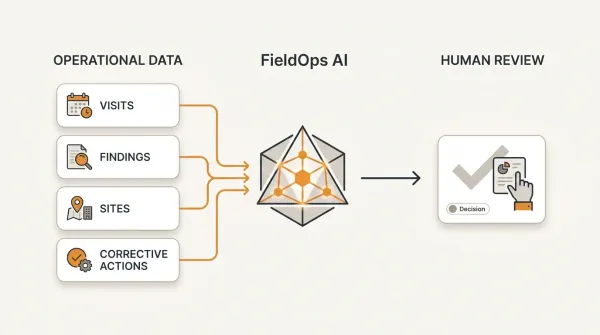
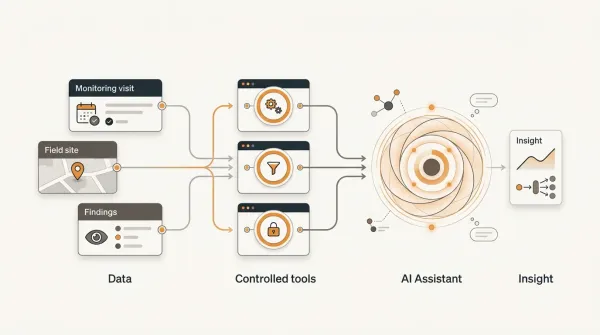
How FieldOps fits into recurring-problem management
FieldOps is designed around the operational relationship between:
Project
→
Site
→
Visit
→
Finding
→
Action
→
Follow-up
This structure provides a foundation for maintaining monitoring history at the project and site level.
A finding can be associated with the visit where it was identified.
A corrective action can be associated with that finding.
The action can have:
- an owner;
- a due date;
- a status;
- and verification.
Future monitoring can then provide evidence about whether the issue was resolved or whether a similar finding has appeared again.
The result is a continuous operational record rather than a collection of disconnected monitoring reports.
Example: recurring finding workflow in FieldOps
Consider a project monitoring 100 sites.
Visit 1
Site: Site A
Finding: Incomplete documentation.
Severity: Medium.
Action: Review documentation procedures.
Owner: Site Manager.
Due date: April 30.
Follow-up
The action is completed and verified.
Visit 2
The same documentation issue appears again.
Instead of treating this as an entirely new problem, the M&E team can review the site's history.
The team sees:
Previous finding: Incomplete documentation.
Previous action: Procedure review.
Previous status: Verified.
Current finding: Similar documentation problem.
The recurrence becomes a signal.
The team investigates.
It discovers that staff understand the procedure, but the documentation process is cumbersome and the required form is not consistently available.
The new response is therefore different:
Action: Simplify the documentation workflow and ensure forms are consistently available.
Visit 3
The finding does not recur.
The organization has completed a useful learning cycle:
Finding
→
Action
→
Verification
→
Recurrence
→
Investigation
→
Adapted action
→
Follow-up
This is the difference between merely recording monitoring findings and using them to improve implementation.
FieldOps does not need to replace your existing data-collection tools
Many organizations already use systems such as:
- KoboToolbox;
- ODK;
- DHIS2;
- Excel;
- or other specialized tools.
Those systems can continue serving their intended purposes.
The operational challenge is what happens after information has been collected.
A field-data system can capture an observation.
A routine information system can provide performance data.
An operational M&E layer can help connect those observations to:
projects
sites
visits
findings
actions
and:
follow-up.
This is a complementary approach rather than a requirement to replace every existing system.
A practical checklist for managing recurring findings
For every significant finding, ask:
Identification
- What exactly was observed?
- Where did it occur?
- When did it occur?
- How severe is it?
History
- Has the issue appeared before?
- At which sites?
- How many times?
- Over what period?
Previous response
- What action was taken?
- Who owned it?
- Was it completed?
- Was it verified?
- What happened afterward?
Investigation
- Is this substantially the same problem?
- What evidence supports recurrence?
- What factors may explain it?
- Did the previous intervention address the underlying cause?
Response
- What should happen now?
- Who is responsible?
- What is the deadline?
- What evidence will demonstrate completion?
Follow-up
- Was the action implemented?
- Was the problem resolved?
- Did performance change?
- Did the finding recur?
- Should the intervention be adapted?
The five questions every M&E team should ask about recurrence
When the same problem appears again, ask:
1. What exactly has recurred?
Define the issue precisely.
2. What happened last time?
Review the previous finding and action.
3. Did the previous intervention address the underlying cause?
Do not assume it did.
4. What does the new evidence tell us?
Look at monitoring evidence, context and performance.
5. What should we change now?
Use the evidence to determine the next intervention.
These questions turn recurrence from a reporting problem into a learning opportunity.
Conclusion
A monitoring system should not only tell an organization what went wrong.
It should help the organization determine whether its response actually worked.
When a finding appears once, the appropriate response may be straightforward.
When the same finding keeps returning, the organization has a deeper question to answer:
Why has the problem not been resolved?
That question can reveal weaknesses in:
- implementation;
- supervision;
- staffing;
- training;
- resources;
- processes;
- tools;
- accountability;
- or project design.
The key is to preserve the relationship between:
Project
→
Site
→
Monitoring Visit
→
Finding
→
Corrective Action
→
Verification
→
Follow-up
When this history is available, M&E teams can distinguish isolated problems from persistent ones and site-specific issues from systemic patterns.
They can see what interventions have already been attempted.
They can identify actions that are overdue.
They can recognize when a supposedly resolved issue returns.
They can investigate underlying causes.
And they can use monitoring evidence to adapt implementation.
The value of tracking findings is not knowing how many problems were found. The value is knowing whether those problems are actually being solved.
FieldOps provides an operational structure for organizations that need to connect project sites, monitoring visits, findings, corrective actions and follow-up over time.
The objective is not another report.
It is a continuous improvement cycle:
Monitor → Identify → Investigate → Act → Verify → Learn → Improve
When the same problem appears again, the organization should have enough history to ask:
What did we do last time, why did the problem return, and what should we change now?
That is where project monitoring becomes more than compliance.
It becomes a mechanism for learning and improving implementation.
Key Takeaways
-
A recurring finding is a substantially similar issue identified more than once within a defined monitoring period.
-
Recurrence is a signal for investigation, not automatic proof of failure.
-
Monitoring history is essential for determining whether a problem is isolated, persistent or recurring.
-
Findings and corrective actions should be tracked as related but distinct records.
-
Closing an action does not necessarily mean that the underlying problem has been permanently resolved.
-
Frequency, duration, breadth and severity should be considered together when prioritizing recurring problems.
-
A recurring issue at one site may require a site-level response, while the same issue across many sites may indicate a systemic problem.
-
Training should not automatically be treated as the solution to every recurring finding.
-
Root-cause investigation should use evidence rather than assumptions.
-
Recurring findings can reveal weaknesses in processes, supervision, staffing, resources, tools or project design.
-
Monitoring data can support adaptive management when evidence is deliberately used to inform decisions and adjustments.
-
Recurrence should be analyzed alongside action history and, where relevant, performance trends.
-
Correlation between recurring findings and poor performance does not automatically establish causation.
-
Stable site identifiers and consistent finding categories improve longitudinal analysis.
-
A structured history creates institutional memory that is less dependent on individual staff members.
-
The objective of recurrence analysis is not more reporting; it is better interventions and fewer unresolved problems.
-
A mature M&E process should move from monitoring and findings toward investigation, action, verification, learning and adaptation.
Frequently Asked Questions
What is a recurring finding in M&E?
A recurring finding is a substantially similar issue identified more than once within a defined period, either at the same site across multiple monitoring visits or across multiple sites within a project or program.
Why are recurring findings important?
Recurring findings can indicate that a problem has not been effectively resolved, that an intervention was insufficient, or that a broader systemic issue exists.
Does a recurring finding mean the corrective action failed?
Not necessarily. The action may not have been implemented, may have been partially implemented, may have addressed only one contributing factor, or the underlying cause may have been incorrectly diagnosed.
What is the difference between a finding and a corrective action?
A finding describes an observed issue or condition. A corrective action describes what should be done in response to that issue.
Why should findings and actions be separate?
Separating them allows organizations to determine what was observed, what response was assigned, whether that response was completed, and whether the original issue later returned.
How can M&E teams identify recurring findings?
Use consistent finding categories, stable site identifiers, monitoring dates and historical records. Recurrence should be assessed using both structured data and professional judgment.
Should recurrence be based only on matching finding descriptions?
No. Similar wording does not necessarily mean the same underlying problem. Recurrence should consider the nature of the issue, context, evidence and previous findings.
How do you measure recurring findings?
One possible metric is the recurring finding rate: the percentage of eligible findings for which substantially the same issue is identified again within a defined period.
The organization should clearly define the numerator, denominator, timeframe and eligibility criteria.
What causes recurring monitoring findings?
Potential causes include inadequate training, weak supervision, unclear procedures, insufficient resources, staffing constraints, poor tools, ineffective corrective actions and weaknesses in project design.
The cause should be investigated rather than assumed.
Is training always the right response to recurring findings?
No. Training is appropriate when evidence indicates a knowledge or skill gap. If the problem is caused by process design, staffing, resources, supervision or tools, training alone may not resolve it.
How can recurring findings identify systemic problems?
If the same finding appears across many sites, regions or projects, the organization can investigate whether a common policy, process, tool, resource or implementation condition is contributing to the problem.
Can recurring findings be compared with performance data?
Yes. Comparing recurring findings with performance trends can identify relationships and patterns that deserve investigation. However, such relationships do not automatically prove causation.
Why is historical monitoring data important?
Historical records allow teams to see what happened before and after interventions. Without history, it is difficult to determine whether a finding is new, persistent or recurring.
What is the difference between action completion and problem resolution?
Action completion means the planned activity was completed. Problem resolution means the underlying issue was addressed. These are not necessarily the same.
What should happen when a finding recurs?
The team should confirm the recurrence, review previous actions, assess whether those actions addressed the underlying cause, investigate new evidence, determine an appropriate response, assign responsibility and monitor the result.
Should every recurring finding be escalated?
No. Escalation should depend on the organization's risk and accountability framework. Severity, persistence, breadth, duration and previous response should inform the decision.
Can recurring findings improve project design?
Yes. Persistent findings can reveal that a process, tool, reporting requirement, staffing model or implementation approach needs to change.
How does recurring-finding analysis support adaptive management?
It provides evidence about what is and is not working during implementation. That evidence can be used to revise interventions, processes or assumptions rather than simply continuing the original approach. :contentReference[oaicite:5]{index=5}
How can FieldOps help manage recurring findings?
FieldOps connects projects, sites, monitoring visits, findings and corrective actions, creating a structured operational history that can help teams understand what was identified, what action was taken and what happened during subsequent monitoring.
Does FieldOps replace KoboToolbox or ODK?
No. Organizations can continue using KoboToolbox or ODK for field data collection while using FieldOps as an operational layer for monitoring visits, findings, corrective actions and follow-up.
Does FieldOps replace DHIS2?
No. DHIS2 can continue providing routine performance information while FieldOps can provide project and site-level operational context for monitoring and follow-up.
What is the most important question when a finding recurs?
A useful question is:
"What did we do last time, why did the problem return, and what should we change now?"
That question turns recurring findings from a reporting issue into an opportunity for continuous improvement.
Move beyond data collection
FieldOps helps NGOs manage field visits, monitoring templates, findings, corrective actions, dashboards and donor reporting in one operational intelligence platform.
Learn more about FieldOps