Inspection Management Software: Beyond Digital Checklists and Inspection Forms
Digital inspection forms improve data collection, but modern inspection management requires much more than checklists. Learn how connected workflows, corrective actions, dashboards and Operational Intelligence help organisations turn inspections into measurable operational improvement.

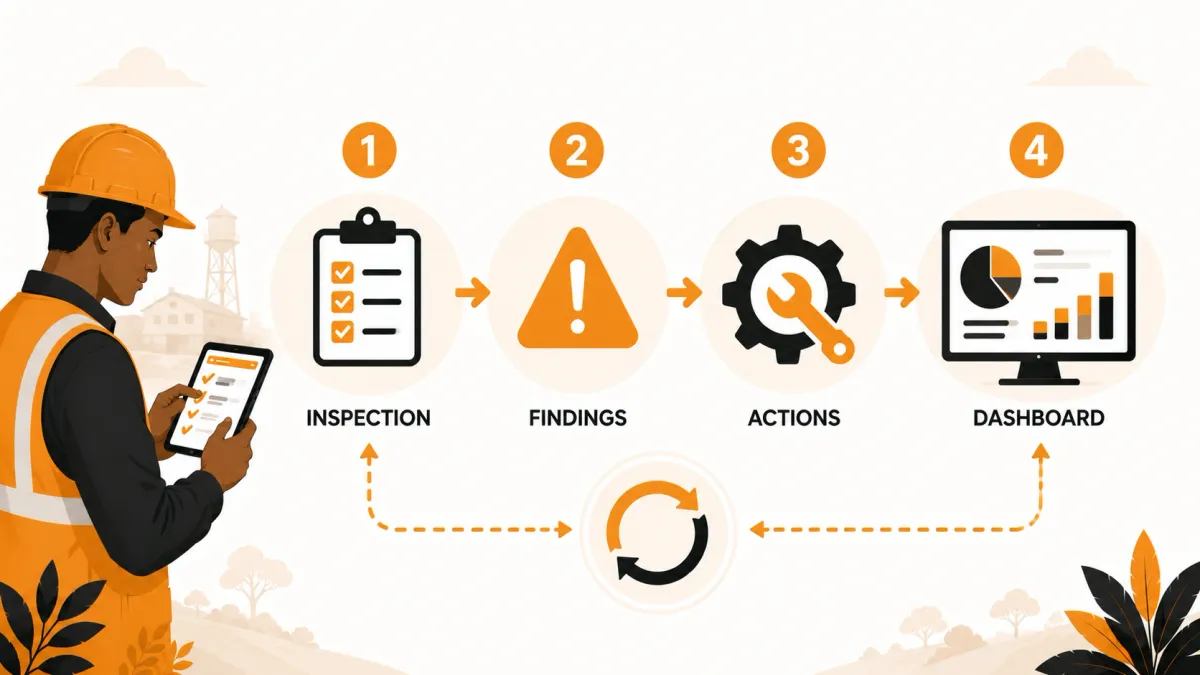
Digital inspection forms have transformed how organisations collect information, but many inspections still end the moment the checklist is submitted. Modern inspection management is about much more than digital forms. It is about connecting inspections, findings, corrective actions, verification and reporting into one continuous operational workflow that improves performance over time.
Key Takeaways
- Digital inspection forms improve data collection but do not automatically improve operations.
- Effective inspection management covers the complete lifecycle from planning to verification.
- Findings should always result in accountable corrective actions.
- Inspection software should support governance, auditability and operational visibility.
- Modern Operational Intelligence platforms connect inspections with dashboards, reporting and continuous improvement.
Whether you're inspecting health facilities, schools, construction projects, agricultural programmes, environmental compliance or public infrastructure, the objective is rarely to complete a checklist.
The objective is to improve operational performance.
Yet many organisations still approach inspections as isolated events.
Inspectors travel to a site.
A checklist is completed.
Photographs are uploaded.
The inspection is submitted.
A report is generated.
The process appears complete.
Unfortunately, this is often where the operational value ends.
The findings remain buried inside reports.
Corrective actions are managed in spreadsheets or email.
Managers struggle to identify recurring issues.
Leadership receives reports weeks later, long after opportunities for intervention have passed.
The organisation successfully collected inspection data.
It did not successfully manage the inspection process.
An inspection only creates value when it leads to better operational decisions.
Why Digital Checklists Aren't Enough
Over the past decade, organisations have invested heavily in replacing paper inspection forms with mobile applications.
That transition has delivered significant benefits.
Inspectors can now:
- complete inspections on mobile devices
- capture photographs and supporting evidence
- record GPS locations automatically
- work offline in remote locations
- submit inspection results immediately
These capabilities improve efficiency.
However, they do not solve the operational challenges that follow.
Many organisations still struggle with questions such as:
- Which critical findings remain unresolved?
- Which facilities repeatedly fail inspections?
- Which corrective actions are overdue?
- Which inspectors require additional support?
- Where are operational risks increasing?
- Which programmes require management attention?
Digital forms answer what was observed.
Operational Intelligence explains what should happen next.
Collecting inspections is only the beginning. Managing what happens afterwards is where operational performance improves.
The Complete Inspection Lifecycle
An inspection should never be viewed as a single event.
It is one stage within a broader operational process that begins long before an inspector arrives on site and continues long after the inspection has been completed.
High-performing organisations manage inspections as a continuous lifecycle where every stage contributes to operational improvement.
| Stage | Purpose | Typical Outputs |
|---|---|---|
| Planning | Define inspection objectives and priorities | Inspection schedules, assigned sites |
| Preparation | Prepare inspectors and inspection templates | Assigned inspections, ready equipment |
| Inspection | Collect evidence | Responses, photographs, GPS, observations |
| Review | Verify quality and completeness | Approved inspections, reviewer comments |
| Findings | Identify issues and risks | Findings, observations, recommendations |
| Corrective Actions | Resolve identified issues | Assigned actions, deadlines and owners |
| Verification | Confirm corrective actions are effective | Verified actions, follow-up inspections |
| Reporting | Support operational decisions | Dashboards, compliance reports and executive summaries |
| Continuous Improvement | Strengthen future inspections | Updated procedures, improved templates and training |
Every stage depends on the quality of the one before it.
Weak planning creates inconsistent inspections.
Weak reviews reduce confidence in findings.
Weak follow-up allows the same issues to recur.
Weak reporting delays operational decisions.
When organisations manage inspections as a connected operational lifecycle instead of isolated site visits, inspections become a tool for continuous improvement rather than simple compliance.
The purpose of an inspection is not to complete a checklist. It is to improve how the organisation operates.
Real-World Inspection Scenarios
Health Facility Inspections
District health teams inspect clinics to evaluate medicine availability, infection prevention measures, staffing levels and equipment functionality.
Without structured operational workflows, recurring deficiencies appear in every inspection because recommendations are documented but never systematically tracked.
With a complete inspection lifecycle, every finding becomes a corrective action with an owner, due date, verification process and management visibility.
School Quality Inspections
Education officers inspect schools to assess classroom conditions, attendance records, sanitation facilities and learning resources.
Inspection reports are submitted promptly, but regional managers still struggle to determine which schools require immediate intervention.
Operational dashboards that combine inspection history, recurring findings and overdue corrective actions allow managers to prioritise resources where they will have the greatest impact.
Construction Quality Inspections
Infrastructure inspectors verify workmanship, safety standards and project progress.
Photographs and GPS locations provide valuable evidence, but if defects are recorded without assigning corrective actions, the same issues often reappear during subsequent inspections.
Inspection management therefore extends beyond recording defects to ensuring they are resolved and verified.
Environmental Compliance Inspections
Environmental regulators inspect industrial facilities for compliance with environmental standards.
Inspection findings often require corrective measures within defined timeframes.
Effective inspection management enables regulators to monitor outstanding actions, schedule follow-up inspections and identify facilities with repeated compliance failures.
Agricultural Extension Inspections
Extension officers inspect demonstration farms, irrigation systems and farmer groups throughout the growing season.
Inspection findings influence training priorities, equipment allocation and programme planning.
Connecting inspection history with operational dashboards allows programme managers to identify emerging trends before they become widespread operational problems.
Across every sector, inspections create the greatest value when evidence leads directly to accountability, corrective action and operational learning.
Common Inspection Management Mistakes
Many organisations successfully digitise their inspection forms but continue to manage the rest of the inspection process manually.
As a result, inspections become easier to complete without becoming more effective.
The operational challenges simply move from paper forms to spreadsheets, emails and disconnected reporting systems.
The most common mistakes include:
| Mistake | Better Practice |
|---|---|
| Treating inspections as one-time events | Manage inspections as a continuous operational lifecycle |
| Focusing only on digital checklists | Connect inspections with findings, corrective actions and verification |
| Tracking corrective actions in spreadsheets | Assign owners, deadlines and verification workflows |
| Measuring inspections completed | Measure operational improvements achieved |
| Generating static reports | Use operational dashboards for continuous visibility |
| Managing data in isolated systems | Connect inspections, reporting and analytics into one operational model |
| Reviewing inspection reports manually | Implement structured review and approval workflows |
| Storing inspection history without analysis | Identify recurring operational risks and improvement opportunities |
Completing an inspection is not the objective. Improving operations is.
How Modern Operational Intelligence Platforms Solve This
Modern inspection management platforms do far more than replace paper forms.
They provide a structured operational framework that connects inspections with planning, governance, reporting and continuous improvement.
Rather than treating inspections as isolated events, they manage the complete operational lifecycle.
Principle 1: Inspections Are Operational Workflows
An inspection is not complete when the checklist is submitted.
It progresses through planning, execution, review, findings, corrective actions, verification and reporting.
Every stage contributes to organisational accountability.
How FieldOps Applies This Principle
FieldOps manages inspections as part of a structured operational workflow.
Inspection records progress through configurable review and approval stages, ensuring that operational decisions are based on verified information rather than raw submissions.
Principle 2: Findings Must Lead to Accountability
Inspection findings should never disappear inside lengthy reports.
Every significant issue should have:
- an owner
- a priority
- a target completion date
- supporting evidence
- verification before closure
How FieldOps Applies This Principle
FieldOps allows findings to become tracked corrective actions with ownership, priorities, deadlines, progress updates and verification workflows, ensuring that inspection outcomes remain visible until they have been resolved.
Principle 3: Inspection Data Should Become Operational Intelligence
Collecting inspection data is only valuable if leadership can use it to improve decision-making.
Managers should be able to identify:
- recurring inspection failures
- overdue corrective actions
- high-risk facilities
- regional performance trends
- inspection coverage
- compliance performance
without manually consolidating spreadsheets.
How FieldOps Applies This Principle
FieldOps transforms inspection data into operational dashboards that provide real-time visibility across programmes, projects, sites and inspection teams, allowing managers to focus on operational risks rather than report preparation.
Principle 4: Reporting Should Scale With the Organisation
As inspection programmes expand, reporting requirements grow rapidly.
Large organisations may manage hundreds of inspectors, thousands of inspections and millions of individual inspection responses.
Reporting should continue to perform efficiently without affecting inspectors working in the field.
How FieldOps Applies This Principle
FieldOps separates operational processing from enterprise analytics through analytics-ready reporting datasets and a secure BI API.
This architecture allows Microsoft Power BI, Tableau and other business intelligence platforms to analyse millions of inspection records without slowing day-to-day inspection operations.
Modern inspection management is not measured by how quickly inspections are completed. It is measured by how consistently inspections improve operational performance.
Inspection Management Software Evaluation Checklist
Choosing inspection management software is about far more than replacing paper forms with digital checklists.
The platform should strengthen the entire inspection process—from planning and execution through corrective actions, reporting and continuous improvement.
Use the following questions when evaluating potential solutions.
Inspection Planning
Can the software:
- Schedule inspections across multiple programmes, regions or facilities?
- Assign inspectors based on roles or responsibilities?
- Support recurring inspection schedules?
- Standardise inspection templates across teams?
- Work offline when connectivity is unavailable?
Inspection Execution
Can inspectors:
- Capture structured inspection data?
- Record GPS coordinates automatically?
- Attach photographs and supporting documents?
- Record observations and recommendations?
- Complete inspections using mobile devices?
Review and Governance
Does the platform support:
- Structured review and approval workflows?
- Inspection version history?
- Complete audit trails?
- User attribution for operational decisions?
- Role-based permissions?
Findings and Corrective Actions
Can the software:
- Create findings directly from inspection results?
- Assign corrective actions with owners and deadlines?
- Track action progress?
- Require verification before closure?
- Identify recurring operational issues?
Dashboards and Reporting
Can managers:
- Monitor inspection coverage?
- View overdue corrective actions?
- Identify high-risk locations?
- Analyse trends across multiple reporting periods?
- Generate executive dashboards without manually combining spreadsheets?
Enterprise Readiness
As inspection programmes grow, can the platform:
- Support thousands of inspections across multiple organisations or departments?
- Integrate with existing operational systems?
- Connect to Microsoft Power BI, Tableau and other business intelligence tools?
- Provide secure APIs for enterprise reporting?
- Scale reporting independently of day-to-day inspection operations?
If the answer to several of these questions is "No", the platform may successfully digitise inspections without significantly improving operational performance.
The best inspection management software doesn't simply record inspections. It helps organisations improve what they inspect.
Final Thoughts
Digital inspection forms have transformed how organisations collect operational information.
That is an important step forward.
However, collecting information is only one stage in a much larger operational journey.
Planning determines what should be inspected.
Structured reviews improve confidence in inspection results.
Findings highlight operational risks.
Corrective actions create accountability.
Verification confirms that improvements have actually been made.
Dashboards help leadership prioritise resources.
Continuous learning strengthens future inspections.
When these activities are connected into one operational workflow, inspections become far more than compliance exercises.
They become one of the most valuable tools an organisation has for improving quality, reducing risk and strengthening operational performance.
Whether you're inspecting health facilities, schools, infrastructure projects, agricultural programmes or regulatory compliance, the objective should never be to complete more checklists.
The objective should be to make better operational decisions.
That is the foundation of Operational Intelligence.
The purpose of an inspection is not to complete a checklist.
The purpose is to improve operations.
Move beyond data collection
FieldOps helps NGOs manage field visits, monitoring templates, findings, corrective actions, dashboards and donor reporting in one operational intelligence platform.
Learn more about FieldOps