Monitoring and Evaluation Software: What Modern M&E Platforms Should Really Do

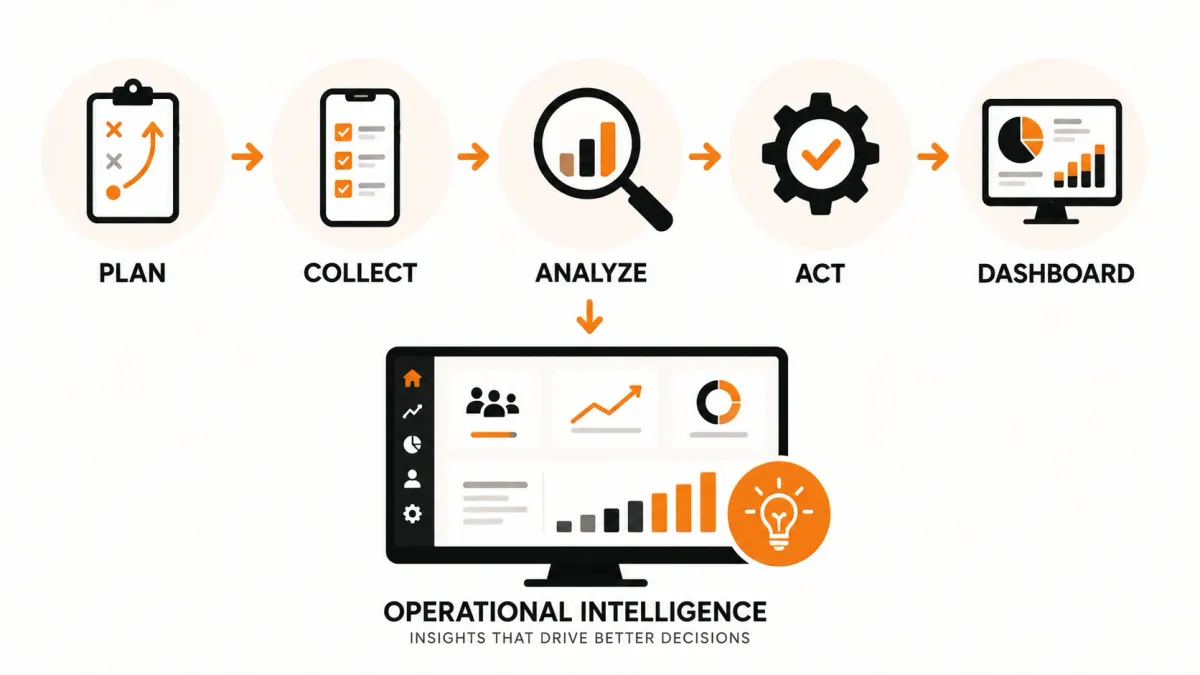
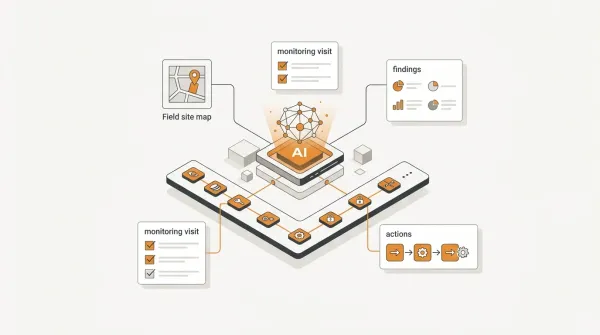
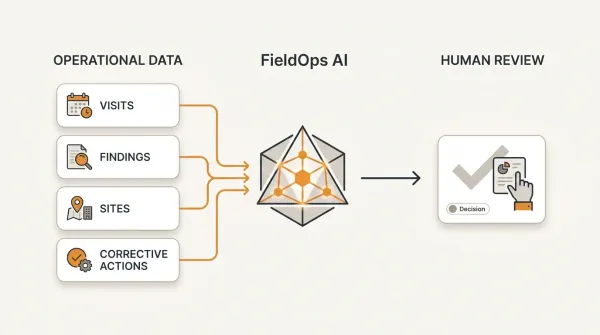
Monitoring and Evaluation (M&E) software has evolved far beyond indicator tracking and digital forms. Modern organisations need platforms that connect planning, field operations, findings, corrective actions, reporting and analytics into one governed operational workflow. Operational Intelligence begins when monitoring data becomes better decisions.
Key Takeaways
- Modern M&E software should support the complete operational lifecycle, not just indicator collection.
- Reliable monitoring depends on governed operational processes, not spreadsheets and disconnected tools.
- Findings should lead to corrective actions, accountability and measurable improvement.
- Dashboards and reporting should use trusted operational records rather than manually consolidated data.
- Operational Intelligence transforms monitoring data into continuous organisational learning and decision-making.
Monitoring and Evaluation (M&E) software has become a critical part of programme delivery across NGOs, governments and development programmes.
Most organisations recognise the importance of collecting indicators, tracking outputs and measuring results.
As a result, digital data collection tools have largely replaced paper-based processes.
Field teams collect information using mobile devices.
Programme managers review dashboards.
Donors expect timely, accurate reporting.
Yet despite these advances, many organisations continue to experience familiar operational challenges.
Monitoring data is collected successfully.
Reports still take weeks to prepare.
Corrective actions are tracked separately.
Programme reviews depend on spreadsheets.
Leadership struggles to identify emerging operational risks before they become significant programme issues.
The challenge is no longer collecting monitoring data.
The challenge is transforming that data into consistent operational improvement.
Good Monitoring and Evaluation software does more than collect indicators. It helps organisations improve the programmes those indicators represent.
Why Traditional M&E Software Falls Short
Many monitoring platforms were designed primarily to capture programme indicators.
While this remains essential, modern programme management requires much more than indicator collection.
Programme teams need to understand:
- Which findings require immediate attention?
- Which corrective actions remain overdue?
- Which sites consistently underperform?
- Which operational risks are increasing?
- Which programmes require additional support?
- Which trends should influence future planning?
Indicators explain what has happened.
Operational Intelligence helps organisations understand why it happened, what should happen next and how future performance can improve.
Measuring programme performance is important. Managing programme performance is transformational.
The Evolution of Monitoring and Evaluation Software
Monitoring and Evaluation software has changed significantly over the past two decades.
Early systems focused primarily on collecting indicators and producing periodic reports.
Success was measured by the ability to capture data more efficiently than paper-based processes.
As technology matured, organisations adopted mobile data collection, cloud-based databases, GPS-enabled field visits and digital dashboards.
These innovations dramatically improved how monitoring information was collected and shared.
However, many organisations discovered that better data collection did not automatically result in better programme management.
Monitoring information still needed to be reviewed.
Findings still required investigation.
Corrective actions still had to be assigned.
Programme managers still relied on spreadsheets to consolidate information from multiple systems.
Executive teams still waited weeks for reporting.
The technology had evolved.
The operational processes often had not.
Modern Monitoring and Evaluation platforms therefore need to move beyond collecting information.
They must connect planning, field activities, governance, reporting and organisational learning into one continuous operational lifecycle.
The future of Monitoring and Evaluation is not better data collection. It is better operational decision-making.
Real-World Monitoring and Evaluation Scenarios
Although Monitoring and Evaluation practices vary across sectors, the operational challenges are remarkably consistent.
NGO Programmes
An NGO manages education, livelihoods and health projects across multiple counties.
Field officers collect monitoring information using mobile devices.
Programme managers review progress every month.
Without an integrated operational workflow, findings remain disconnected from corrective actions, making it difficult to improve programme delivery between reporting cycles.
Modern M&E platforms connect monitoring activities directly with operational decisions, ensuring that programme teams can respond quickly to emerging issues.
Government Monitoring
Government departments regularly monitor public services, infrastructure projects and community development programmes.
Thousands of monitoring visits may be completed each year across multiple regions.
Without centralised operational visibility, leadership struggles to identify recurring implementation challenges, regional disparities and systemic risks.
Operational dashboards supported by governed monitoring data allow decision-makers to prioritise interventions based on evidence rather than assumptions.
Health Systems Strengthening
Health programmes monitor medicine availability, service delivery, staffing levels and facility readiness across large geographical areas.
Collecting accurate information is essential, but sustainable improvements depend on responding quickly when gaps are identified.
Monitoring systems that connect findings with corrective actions help health managers strengthen service delivery rather than simply documenting deficiencies.
Education Programmes
Education officers monitor school attendance, classroom observations, infrastructure and learning resources throughout the academic year.
Monitoring data should support continuous improvement rather than serving only annual reporting requirements.
Connecting monitoring results with follow-up visits, improvement plans and management dashboards allows education systems to respond proactively instead of reactively.
Donor-Funded Development Projects
Donors increasingly expect timely, transparent and auditable reporting.
Project teams therefore need more than indicator databases.
They require governed operational information that supports reporting, accountability, audit trails and continuous programme improvement.
When monitoring records become trusted operational assets rather than isolated data points, donor reporting becomes faster, more reliable and significantly more valuable.
Across every sector, Monitoring and Evaluation creates the greatest value when monitoring information continuously supports operational decisions instead of periodic reporting alone.
Common Monitoring and Evaluation Software Mistakes
Many organisations invest in Monitoring and Evaluation software expecting technology alone to solve operational challenges.
While digital tools improve data collection and reporting, they cannot compensate for fragmented operational processes.
The result is often a modern monitoring platform sitting alongside spreadsheets, email chains and manual reporting processes.
The most common mistakes include:
| Mistake | Better Practice |
|---|---|
| Measuring success by the number of indicators collected | Measure operational improvements achieved |
| Treating monitoring as a reporting activity | Make monitoring part of a continuous operational lifecycle |
| Managing findings outside the monitoring platform | Connect findings directly to monitoring records |
| Tracking corrective actions in spreadsheets | Use structured corrective action workflows |
| Building dashboards from exported data | Drive dashboards from trusted operational records |
| Using inconsistent indicator definitions | Govern KPIs centrally across the organisation |
| Producing reports only for donors | Use monitoring information for day-to-day operational decision-making |
Good Monitoring and Evaluation software should reduce operational uncertainty—not simply increase the amount of information collected.
How Modern Operational Intelligence Platforms Solve This
Modern Monitoring and Evaluation platforms do far more than collect indicators.
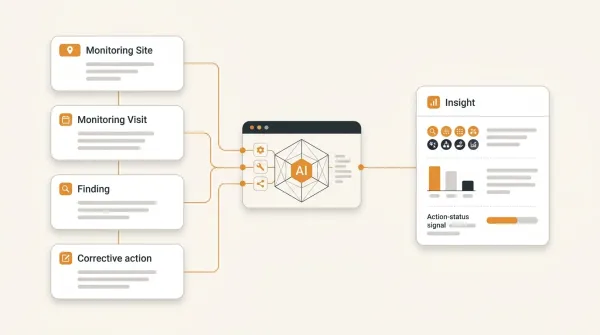
They connect planning, field operations, reviews, findings, corrective actions, reporting and analytics into one governed operational environment.
Rather than treating monitoring as a periodic reporting exercise, they support continuous operational improvement.
Principle 1: Monitoring Begins Before Data Collection
Effective monitoring starts with clear programme objectives, standardised templates, governed indicators and well-defined operational processes.
Collecting data without this foundation creates inconsistent results that are difficult to compare across programmes and reporting periods.
How FieldOps Applies This Principle
FieldOps enables organisations to define structured monitoring templates, governed KPI definitions and standardised field workflows before data collection begins, improving consistency across programmes and teams.
Principle 2: Monitoring Data Should Become Trusted Operational Records
Collecting monitoring information is only valuable if organisations can trust it.
Submissions should progress through structured review and approval workflows before becoming part of official reporting and analytics.
How FieldOps Applies This Principle
FieldOps manages monitoring visits through configurable review and approval workflows, creating trusted operational records supported by complete audit history and version tracking.
Principle 3: Monitoring Should Lead to Action
Monitoring identifies opportunities for improvement.
Without structured follow-up, the same issues continue appearing across reporting periods.
Findings should become corrective actions with clear ownership, priorities, deadlines and verification before closure.
How FieldOps Applies This Principle
FieldOps allows monitoring findings to become tracked corrective actions that remain visible until they have been resolved and verified, creating accountability throughout the operational lifecycle.
Principle 4: Reporting Should Support Better Decisions
Programme managers and executive leadership require more than periodic reports.
They need continuous operational visibility.
Modern Monitoring and Evaluation platforms should support executive dashboards, trend analysis and enterprise reporting without affecting day-to-day operational performance.
How FieldOps Applies This Principle
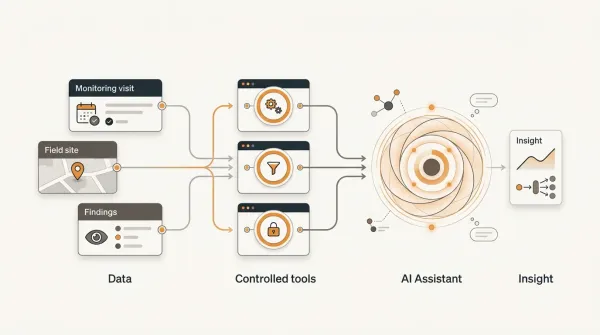
FieldOps provides analytics-ready operational datasets and a secure BI API that integrate with Microsoft Power BI, Tableau and Excel, enabling organisations to analyse millions of monitoring records while field teams continue working without interruption.
Modern Monitoring and Evaluation is not measured by the volume of indicators collected. It is measured by how effectively organisations use those indicators to improve programme performance.
Monitoring and Evaluation Software Evaluation Checklist
Selecting Monitoring and Evaluation software is about much more than choosing a platform that collects indicators.
The right solution should strengthen programme delivery from planning and field operations through reporting, corrective actions and organisational learning.
Use the following questions when evaluating potential solutions.
Programme Planning
Can the software:
- Support multiple programmes, projects and implementation sites?
- Standardise monitoring templates across teams?
- Govern KPI and indicator definitions centrally?
- Support recurring monitoring schedules?
- Adapt to different programme methodologies?
Field Data Collection
Can field teams:
- Collect data using mobile devices?
- Work offline in remote locations?
- Capture GPS coordinates, photographs and supporting documents?
- Record structured observations consistently?
- Submit monitoring visits securely?
Review and Governance
Does the platform support:
- Structured review and approval workflows?
- Complete audit trails?
- Version history for monitoring records?
- Role-based permissions?
- Transparent operational accountability?
Findings and Corrective Actions
Can the software:
- Convert monitoring observations into findings?
- Assign corrective actions with owners and deadlines?
- Track implementation progress?
- Verify corrective actions before closure?
- Identify recurring operational issues?
Dashboards and Reporting
Can programme managers:
- Monitor implementation progress in real time?
- Analyse trends across multiple reporting periods?
- Produce executive dashboards without manual spreadsheet consolidation?
- Connect operational information directly to business intelligence platforms?
- Generate trusted donor reports using governed operational data?
Enterprise Readiness
As programmes expand, can the platform:
- Integrate with KoboToolbox, ODK Central, Excel and other operational systems?
- Support Microsoft Power BI, Tableau and other enterprise analytics platforms?
- Provide secure APIs for reporting and integration?
- Scale to millions of operational records without affecting field performance?
- Maintain one trusted operational data model across the organisation?
If the answer to several of these questions is "No", the platform may improve monitoring activities while leaving organisations to manage governance, reporting and operational improvement through disconnected systems.
The best Monitoring and Evaluation software does more than measure programme performance. It helps organisations continuously improve it.
Final Thoughts
Monitoring and Evaluation has always been about learning from programme implementation.
Technology has made it easier than ever to collect information from the field.
What distinguishes high-performing organisations today is not the volume of monitoring data they collect.
It is how effectively they use that information to improve programme delivery.
Modern Monitoring and Evaluation software should therefore do much more than digitise forms or produce indicator reports.
It should connect planning, field operations, reviews, findings, corrective actions, dashboards and reporting into one continuous operational workflow.
When every monitoring activity contributes to better operational decisions, Monitoring and Evaluation becomes far more than a reporting function.
It becomes an engine for organisational learning, accountability and continuous improvement.
That is the foundation of Operational Intelligence.
The purpose of Monitoring and Evaluation software is not simply to measure programme performance.
The purpose is to help organisations improve programme performance every day.
Move beyond data collection
FieldOps helps NGOs manage field visits, monitoring templates, findings, corrective actions, dashboards and donor reporting in one operational intelligence platform.
Learn more about FieldOps