NGO Field Visit Management Software: Beyond Scheduling and Data Collection
Learn why modern field visit management software should go beyond digital forms by connecting planning, governance, findings, corrective actions and enterprise reporting into a complete Operational Intelligence lifecycle.

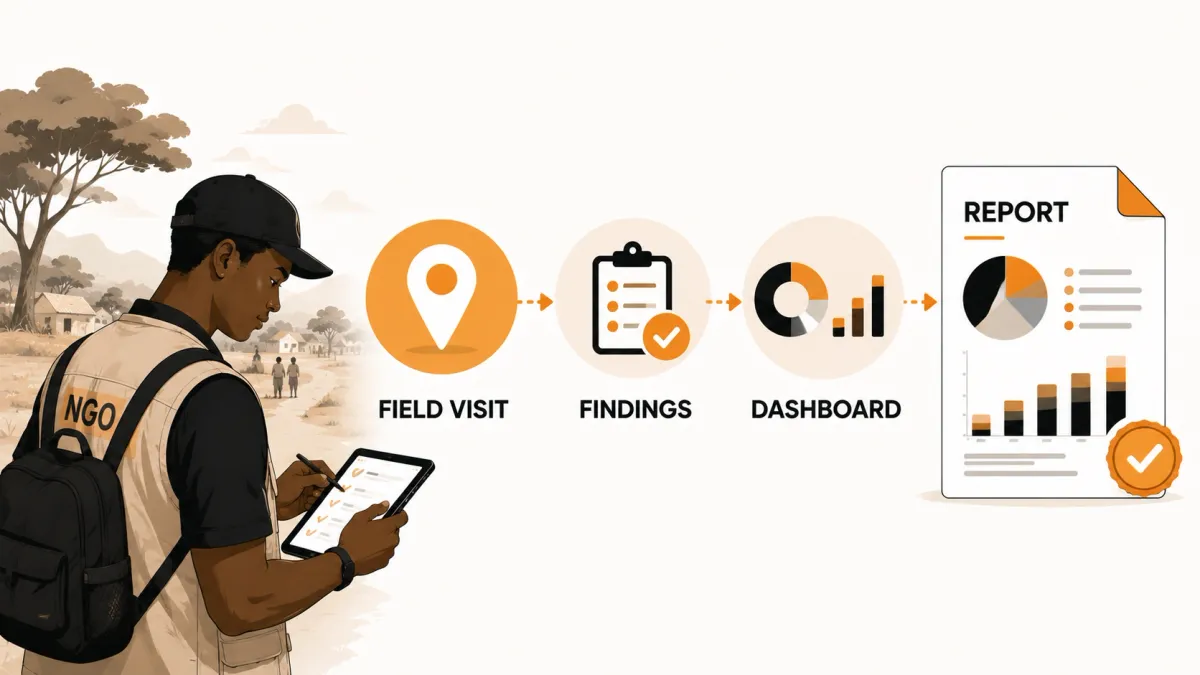
Field visits create some of the most valuable operational information within NGOs, governments and development programmes. Their value, however, is not determined by how much data they collect, but by how effectively that information flows through planning, governance, findings, corrective actions and enterprise reporting. Modern field visit management is therefore about managing operational workflows—not simply digitising forms.
Key Takeaways
- Field visit management is an operational process rather than a data collection exercise.
- Modern platforms should manage the complete lifecycle from planning to enterprise reporting.
- Connected operational workflows improve governance, accountability and organisational learning.
- Findings and corrective actions should be managed as structured operational records.
- Enterprise reporting depends on trusted operational data supported by review workflows, audit trails and version history.
- Operational Intelligence transforms field visits into continuous organisational improvement.
Field Visits Are the Foundation of Operational Intelligence
Every development programme depends on reliable information from the field.
Whether supervising health facilities, inspecting infrastructure projects, monitoring agricultural interventions, evaluating education programmes or assessing humanitarian activities, field visits provide the operational evidence that enables organisations to understand what is happening beyond headquarters.
Unfortunately, many organisations continue viewing field visits primarily as opportunities to collect data.
Once questionnaires have been completed, reports submitted and photographs uploaded, the visit is often considered complete.
This perspective overlooks where the greatest operational value actually lies.
The purpose of a field visit is not simply to generate information.
Its purpose is to improve programme performance.
That improvement depends on everything that happens after information has been collected.
Programme managers review observations.
Technical specialists validate findings.
Regional coordinators assign corrective actions.
Leadership monitors implementation.
Donors evaluate progress.
Future visits are planned based on previous results.
When these activities operate independently, operational information becomes fragmented. Valuable observations remain buried inside reports. Corrective actions are tracked separately. Management reporting requires manual consolidation. Teams spend increasing amounts of time preparing reports instead of improving programmes.
Operational Intelligence addresses this challenge by treating field visits as connected operational events rather than isolated reporting exercises.
Instead of asking:
"Was the visit completed?"
Modern organisations increasingly ask:
- What operational issues were identified?
- Which findings require immediate attention?
- Who is responsible for resolving them?
- How quickly are corrective actions being implemented?
- What recurring trends are emerging across projects?
- Which locations require additional supervision?
- How should future operational priorities change?
These questions shift the conversation from collecting information to managing operations.
That distinction represents one of the most significant changes currently taking place across development programmes.
Why Traditional Field Visit Processes Break Down
Many organisations begin their digital transformation by replacing paper forms with mobile data collection applications.
This is undoubtedly an improvement.
Electronic forms reduce transcription errors, improve data availability and simplify information collection in remote environments.
However, digitising forms addresses only one stage of a much larger operational process.
Planning still occurs in spreadsheets.
Assignments are coordinated through email.
Approvals happen via messaging applications.
Corrective actions are tracked in separate documents.
Management reporting requires manual consolidation from multiple systems.
As programmes expand, these disconnected processes become increasingly difficult to coordinate.
Consider a national development programme operating across several counties.
Regional teams conduct supervision visits.
Technical advisors perform specialised assessments.
Implementing partners submit monitoring reports.
Programme managers prepare donor reports.
Each activity generates valuable operational information.
Yet because every process operates independently, leadership struggles to answer seemingly straightforward questions.
- Which sites have not received supervision this quarter?
- Which findings remain unresolved?
- Which implementing partners consistently experience compliance issues?
- Which operational risks occur most frequently?
- Where should future monitoring resources be allocated?
The information exists.
It simply does not exist in a connected operational architecture.
The result is an organisation rich in data but poor in operational visibility.
| Traditional Approach | Operational Consequence |
|---|---|
| Visit planning managed in spreadsheets | Duplicate visits and poor resource allocation |
| Standalone mobile forms | Operational context is lost after submission |
| Narrative reports distributed by email | Findings become difficult to monitor |
| Corrective actions tracked separately | Accountability becomes fragmented |
| Multiple reporting templates | Inconsistent programme reporting |
| Manual report consolidation | High administrative workload |
| Limited review workflows | Reduced confidence in reported information |
These challenges rarely result from poor field teams.
They are usually symptoms of operational processes that evolved independently rather than being designed as an integrated system.
Understanding the Field Visit Operational Lifecycle
One of the biggest misconceptions surrounding field visit management is that the visit begins when a field officer arrives on site and ends when the collected information is uploaded.
From an operational perspective, this is only one phase of a much larger lifecycle.
Every successful field visit passes through a series of connected operational stages that collectively determine whether the visit contributes to organisational improvement.
| Stage | Purpose | Primary Outcome |
|---|---|---|
| Planning | Define objectives and priorities | Targeted operational activities |
| Assignment | Allocate staff and schedules | Coordinated field operations |
| Execution | Collect observations and evidence | Verified operational information |
| Review | Validate completeness and quality | Trusted operational records |
| Findings | Record issues requiring attention | Structured operational observations |
| Corrective Actions | Assign ownership and deadlines | Organisational accountability |
| Approval | Confirm operational acceptance | Authoritative programme records |
| Reporting | Aggregate operational information | Management visibility |
| Learning | Analyse trends and recurring issues | Continuous programme improvement |
Each stage builds upon the previous one.
Planning determines where organisational effort should be directed.
Execution produces evidence.
Review establishes confidence.
Findings identify opportunities for improvement.
Corrective actions create accountability.
Reporting supports informed decision-making.
Learning strengthens future programme delivery.
Viewed this way, the field visit itself represents only one component of a continuous operational cycle.
Organisations that recognise this distinction move beyond simply digitising field activities. They begin designing operational systems capable of supporting governance, organisational learning and enterprise reporting at scale.
What Modern Field Visit Management Software Should Deliver
Selecting field visit management software should never begin with a comparison of mobile forms, offline capabilities or reporting dashboards.
Those capabilities are important, but they are individual components within a much larger operational architecture.
The more important question is whether a platform enables an organisation to manage field operations as a connected operational process rather than a collection of independent activities.
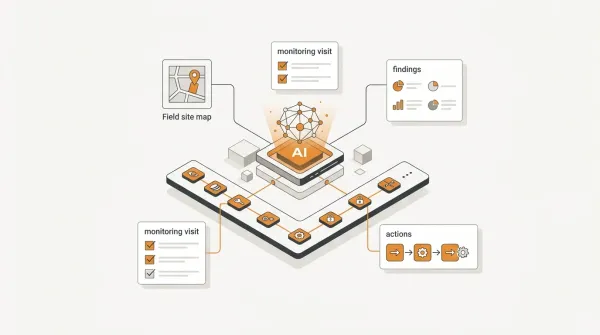
Modern field visit management software should connect planning, execution, governance and reporting into a single operational workflow where information captured during one activity immediately becomes available to support the next.
The following capabilities provide a practical framework for evaluating modern field visit management platforms.
1. Structured Visit Planning
Effective field operations begin before anyone travels to a project site.
Programme managers should be able to determine:
- Which sites require supervision.
- Which projects have not been monitored recently.
- Which locations have recurring findings.
- Which implementing partners require additional oversight.
- Which donor commitments require verification.
- Which operational risks require immediate attention.
Without structured planning, field visits become reactive rather than strategic.
Resources are consumed visiting low-risk locations while genuinely important operational issues remain unnoticed.
Modern platforms should therefore support prioritised operational planning rather than simple scheduling.
2. Coordinated Assignment and Resource Management
Once visits have been planned, organisations need an efficient way to coordinate field teams.
Assignments should clearly define:
- Visit objectives
- Assigned staff
- Programme or project
- Site or facility
- Planned schedule
- Monitoring template
- Expected deliverables
As programmes expand across multiple regions or countries, coordinated assignments become increasingly important for avoiding duplicate visits, reducing travel costs and improving utilisation of limited field resources.
3. Flexible Monitoring Without Sacrificing Standardisation
Development organisations frequently manage diverse programmes.
A nutrition project measures different indicators from an education programme.
Infrastructure inspections differ significantly from safeguarding assessments.
Yet executive leadership still requires consistent organisational reporting.
Modern field visit management platforms should therefore support two seemingly contradictory objectives:
- Organisational standardisation
- Programme flexibility
Core governance processes should remain consistent while allowing monitoring templates to adapt to programme-specific requirements.
This balance enables organisations to compare operational performance across programmes without forcing every project into an identical monitoring methodology.
4. Review and Quality Assurance
Collecting information should never represent the end of the operational process.
Before operational information informs management decisions, it should pass through appropriate review procedures.
Depending on organisational governance, this may include:
- Supervisor review
- Technical validation
- Regional approval
- National quality assurance
- Donor verification
Review workflows improve data quality while creating confidence that operational records accurately represent field conditions.
More importantly, they establish organisational trust.
Without trusted operational information, dashboards become questionable, reports become difficult to defend and management decisions become increasingly uncertain.
5. Structured Findings Management
Every field visit generates observations.
Some confirm good performance.
Others identify operational weaknesses, compliance concerns or implementation risks.
Unfortunately, many organisations continue documenting findings as narrative paragraphs inside lengthy reports.
While this approach captures information, it makes operational management extremely difficult.
Managers should be able to answer questions such as:
- Which findings remain unresolved?
- Which issues recur across multiple projects?
- Which operational risks occur most frequently?
- Which implementing partners require additional support?
- Which findings are becoming more severe over time?
These questions cannot easily be answered when findings remain buried within narrative reports.
Modern platforms should therefore manage findings as structured operational records that can be searched, analysed, prioritised and monitored throughout their lifecycle.
6. Corrective Action Management
Identifying operational issues creates little value unless organisations consistently resolve them.
This represents one of the greatest weaknesses in traditional monitoring processes.
Reports identify problems.
Recommendations are written.
Meetings are held.
Eventually attention shifts elsewhere.
Whether recommendations were implemented often becomes difficult to determine.
Modern field visit management software should transform findings into accountable corrective actions.
Each action should clearly define:
- Responsible person or team
- Priority
- Due date
- Current status
- Progress updates
- Completion evidence
Instead of producing reports that simply describe operational challenges, organisations create workflows that actively support programme improvement.
7. Enterprise Reporting
Field visits serve many audiences simultaneously.
Field officers require operational guidance.
Supervisors monitor quality.
Programme managers oversee implementation.
Country directors require strategic visibility.
Donors expect accountability.
Executive leadership monitors organisational performance.
Producing separate reports for every audience quickly becomes unsustainable.
Modern platforms should instead capture operational information once and reuse it throughout the organisation.
This approach significantly reduces administrative effort while improving reporting consistency.
It also creates a shared operational record that supports multiple reporting requirements without repeated data entry.
This philosophy can be summarised in a simple principle:
Capture once. Use everywhere.
Why Connected Operational Workflows Matter
Many organisations improve individual components of their monitoring processes while leaving the overall workflow fragmented.
They implement digital forms.
They purchase dashboard software.
They standardise reporting templates.
Yet planning still occurs in spreadsheets.
Corrective actions remain inside email conversations.
Management reporting depends upon manual consolidation.
The result is a collection of capable tools that fail to operate as an integrated operational system.
Operational excellence depends less on individual activities than on how effectively those activities connect.
A field visit should not end when information has been submitted.
Instead, it should initiate a chain of operational activities that continues until findings have been resolved, corrective actions completed and organisational learning captured.
A connected operational workflow typically follows this sequence:
| Operational Stage | Organisational Outcome |
|---|---|
| Visit planned | Operational priorities established |
| Visit assigned | Resources coordinated |
| Visit completed | Evidence collected |
| Submission reviewed | Information validated |
| Findings recorded | Operational risks identified |
| Corrective actions assigned | Accountability established |
| Progress monitored | Programme improvements implemented |
| Reports updated | Leadership informed |
| Future planning refined | Continuous improvement achieved |
Every stage creates additional organisational value.
Removing any stage weakens the overall process.
A completed visit without findings contributes little operational insight.
Findings without corrective actions fail to improve programmes.
Corrective actions without follow-up rarely produce lasting change.
Connected operational workflows ensure that information continues creating value long after field teams have returned from the field.
Scaling Field Visit Management Across Programmes and Countries
Managing twenty field visits each month is fundamentally different from managing two thousand.
As organisations expand, operational complexity increases rapidly.
More projects introduce additional reporting requirements.
More implementing partners require greater oversight.
More field teams create coordination challenges.
More countries introduce different operational contexts.
Processes that function effectively for a single project often become increasingly difficult to manage across national or regional portfolios.
This is why mature organisations standardise operational governance rather than individual monitoring templates.
For example, education, health and agriculture programmes may all collect different operational information.
However, every programme can still follow the same governance model:
- Plan the visit.
- Assign field staff.
- Conduct monitoring.
- Review submissions.
- Record findings.
- Assign corrective actions.
- Approve operational records.
- Generate management reports.
Standardising governance while allowing programme flexibility enables organisations to scale without sacrificing operational consistency.
It also simplifies staff training, improves management oversight and supports enterprise reporting across diverse programme portfolios.
Governance Builds Organisational Trust
Digital information alone does not create confidence.
Confidence is created through governance.
Every completed field visit should answer important operational questions.
- Who planned the visit?
- Who conducted it?
- Who reviewed the submission?
- Who approved the operational record?
- What changes were made after submission?
- Which findings generated corrective actions?
- When were issues resolved?
If organisations cannot answer these questions, operational records become difficult to defend during donor reviews, internal audits or programme evaluations.
Governance is therefore not additional bureaucracy.
It is the mechanism that transforms operational information into trusted organisational evidence.
Audit Trails and Version History Strengthen Accountability
Field visits often influence significant operational decisions.
They may trigger procurement activities, identify safeguarding concerns, affect donor reporting or determine whether programme interventions require adjustment.
Because these decisions carry organisational consequences, leadership must have confidence that operational information is complete, accurate and traceable.
This confidence does not come from digital forms alone.
It comes from governance.
Modern field visit management platforms should maintain a transparent history of operational activity so organisations can understand not only what information exists, but also how that information evolved throughout its lifecycle.
Programme managers should be able to answer questions such as:
- Who created the visit?
- When was it submitted?
- Who reviewed it?
- Were changes requested?
- What information was modified?
- Who approved the final record?
- Which findings generated corrective actions?
- When were those actions completed?
These questions become increasingly important as organisations grow, particularly when programmes involve multiple implementing partners, funding agencies or government stakeholders.
Without this operational history, it becomes difficult to demonstrate accountability or defend reported results during donor reviews and programme evaluations.
Why Version History Matters
Operational information rarely remains static.
Supervisors request clarification.
Additional evidence becomes available.
Technical specialists update classifications.
Photographs are replaced.
Findings are refined.
Recommendations evolve.
These changes are both expected and necessary.
The challenge is ensuring that legitimate updates do not reduce confidence in the operational record.
Version history addresses this challenge by preserving previous states while documenting how information changes over time.
Rather than overwriting earlier records, organisations maintain a transparent operational history that supports both accountability and organisational learning.
| Governance Requirement | Benefit of Version History |
|---|---|
| Quality assurance | Enables reviewers to understand how operational information evolved |
| Donor accountability | Demonstrates transparency throughout the review process |
| Internal audit | Preserves objective evidence of operational changes |
| Programme learning | Identifies recurring corrections that may indicate training needs |
| Dispute resolution | Provides historical evidence for operational decisions |
Version history is particularly valuable in long-running programmes where operational records may be referenced months or years after a visit has taken place.
Approval Workflows Build Organisational Confidence
Approval is often misunderstood as an administrative signature.
In reality, approval represents organisational confidence that operational information has met the required quality standards for its intended purpose.
Different organisations implement different governance structures.
Some require only supervisor review.
Others introduce regional validation, technical approval or national quality assurance before information contributes to organisational reporting.
Regardless of the specific workflow, the underlying objective remains the same.
Operational information should become organisational evidence only after appropriate review.
This benefits everyone involved.
Programme managers receive more reliable information.
Leadership gains greater confidence in organisational reporting.
Field teams receive constructive feedback that improves future monitoring activities.
Governance therefore becomes an enabler of operational excellence rather than an obstacle to programme delivery.
Turning Field Visits into Enterprise Reporting
Every completed field visit contains valuable operational information.
Viewed individually, a visit provides local insight into programme implementation.
Viewed collectively, thousands of visits reveal organisational trends that would otherwise remain invisible.
This distinction separates operational reporting from enterprise reporting.
Operational reporting answers questions about individual visits.
Enterprise reporting answers questions about programme performance.
Examples include:
- Which regions consistently experience implementation delays?
- Which operational findings occur most frequently?
- Which implementing partners demonstrate the strongest compliance?
- Which corrective actions remain overdue?
- Which programme indicators show sustained improvement?
- Which operational risks are increasing over time?
Answering these questions requires more than completed monitoring forms.
It requires structured operational information that can be analysed across projects, programmes, regions and countries.
Supporting Different Decision-Makers
Not every stakeholder requires the same information.
A field officer needs detailed operational guidance.
A supervisor focuses on quality assurance.
Programme managers monitor implementation.
Country directors oversee programme portfolios.
Executive leadership monitors organisational performance.
Donors require evidence of accountability and programme effectiveness.
Modern field visit management platforms should therefore support multiple reporting perspectives from a shared operational dataset.
Rather than creating separate reports for different audiences, organisations should maintain one trusted operational record that supports many reporting requirements.
This approach improves consistency while significantly reducing administrative effort.
Integrating with Business Intelligence Platforms
Many organisations already use enterprise analytics platforms such as Microsoft Power BI or Tableau.
These tools provide powerful visualisation capabilities but depend on reliable operational information.
Without trusted operational processes, dashboards simply present unreliable information more efficiently.
Modern field visit management platforms should therefore integrate naturally with enterprise Business Intelligence environments.
Structured operational information should complement financial systems, project management platforms, human resource systems and other organisational data sources.
This enables leadership to analyse field operations within the broader context of organisational performance rather than treating monitoring as an isolated activity.
The objective is not to build more dashboards.
The objective is to improve operational decision-making.
Real-World Scenarios
The architectural principles discussed throughout this article become easier to appreciate when applied to realistic programme environments.
Although every organisation operates differently, the underlying operational challenges remain remarkably similar.
Scenario 1: Supervising Rural Health Facilities
A Ministry of Health programme conducts monthly supervisory visits across more than 300 rural health facilities.
Field supervisors assess medicine availability, staffing levels, infection prevention measures and service delivery quality.
Historically, supervisors completed digital forms before emailing narrative reports to county coordinators.
Although hundreds of reports were produced every year, leadership struggled to answer important operational questions.
- Which facilities repeatedly experience medicine shortages?
- Which findings remain unresolved?
- Which counties require additional technical support?
- Are recurring operational issues improving?
The challenge was not collecting information.
The challenge was connecting information.
By managing findings, corrective actions and reporting within a connected operational workflow, programme managers gained visibility across the entire health system rather than individual supervision visits.
Scenario 2: Monitoring School Construction Projects
An education programme finances school construction across multiple districts.
Engineering teams conduct routine inspections to verify contractor performance, construction quality and project progress.
Without connected workflows, inspection reports circulate through email while corrective actions are tracked separately.
Months later, managers know that issues were identified but cannot easily determine whether they were resolved.
A connected operational lifecycle changes this completely.
Inspection findings become structured operational records.
Corrective actions receive clear ownership.
Follow-up visits verify implementation.
Leadership dashboards highlight recurring contractor performance issues before they become programme-wide risks.
Scenario 3: Agricultural Extension Services
Agricultural extension officers visit farming communities to monitor crop performance, provide technical support and identify emerging production challenges.
As the programme expands nationally, leadership begins asking broader questions.
- Which regions require additional extension support?
- Which diseases are spreading most rapidly?
- Which technical interventions consistently improve yields?
- Where should future monitoring resources be concentrated?
These questions cannot be answered by individual monitoring forms.
They require connected operational information capable of revealing organisational trends across thousands of field visits.
Common Mistakes When Selecting Field Visit Management Software
Many organisations evaluate field visit management software by comparing feature lists.
Questions such as Does it work offline?, Can it capture GPS?, or Can it collect photographs? are important, but they represent only a small part of what determines long-term operational success.
The more important question is whether the platform supports the organisation's operational architecture.
The following mistakes frequently lead organisations to invest in systems that improve data collection without improving operational performance.
| Common Mistake | Long-Term Impact |
|---|---|
| Selecting software based primarily on digital forms | Solves data capture but leaves operational workflows fragmented |
| Ignoring governance requirements | Reduces confidence in operational reporting |
| Managing findings inside narrative reports | Makes trend analysis and prioritisation difficult |
| Tracking corrective actions in spreadsheets | Fragments accountability across multiple systems |
| Evaluating dashboards instead of operational architecture | Attractive visualisations built on inconsistent information |
| Replacing every existing system | Increases cost, complexity and organisational disruption |
| Focusing on projects rather than organisational processes | Limits scalability across programmes and countries |
Perhaps the most common mistake is assuming that field visit management begins and ends with data collection.
In reality, data collection represents only one stage of a much broader operational lifecycle.
Organisations should therefore evaluate software based on how effectively it supports governance, accountability, reporting and continuous programme improvement.
The Future of Field Visit Management
The evolution of field technology has been remarkable.
Paper forms have largely been replaced by mobile devices.
Offline data collection has become commonplace.
Cloud-based reporting is now widely available.
Yet despite these advances, many organisations continue facing familiar operational challenges.
Programme managers still consolidate spreadsheets.
Country offices still track corrective actions manually.
Leadership still waits for periodic reports before identifying emerging risks.
The challenge is no longer collecting information.
The challenge is managing it.
This is why the conversation is changing.
Development organisations are increasingly moving beyond digitising field activities towards creating connected operational ecosystems.
Rather than asking:
"How do we collect more data?"
They are beginning to ask:
- How do we improve operational visibility?
- How do we strengthen governance?
- How do we identify risks earlier?
- How do we reduce reporting effort?
- How do we learn from every field visit?
- How do we support better operational decisions?
These questions represent the next stage of digital transformation.
They represent the emergence of Operational Intelligence.
Operational Intelligence is not another reporting tool.
Nor is it simply another dashboard.
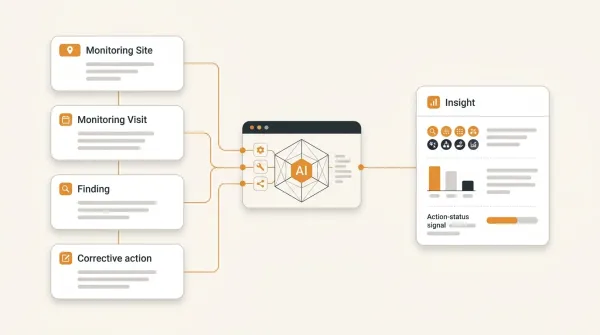
It is an architectural approach that connects operational activities so information captured once can support governance, accountability, enterprise reporting and continuous organisational learning.
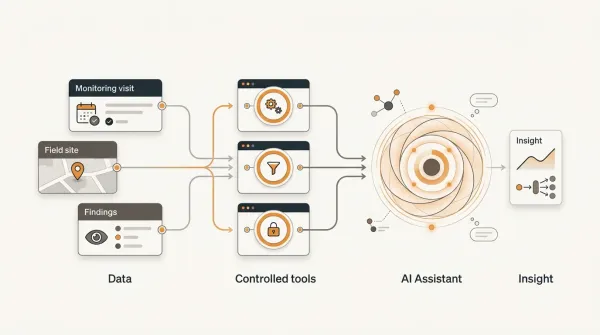
As artificial intelligence, predictive analytics and enterprise reporting continue to mature, organisations with trusted operational data will be significantly better positioned to benefit from these technologies.
Reliable analytics begins with reliable operational processes.
How Modern Operational Intelligence Platforms Solve This
Modern Operational Intelligence platforms address operational challenges by treating field visits as part of an integrated operational ecosystem rather than isolated monitoring events.
Instead of concentrating solely on collecting information, they focus on how operational information moves throughout an organisation.
Several architectural principles distinguish these platforms.
Capture Information Once
Operational information should be collected once and reused wherever it creates value.
The same operational record can support programme monitoring, findings management, corrective actions, executive reporting, donor reporting and enterprise Business Intelligence without requiring repeated data entry.
Connect Operational Workflows
Planning, execution, review, findings, corrective actions and reporting should operate as one continuous lifecycle.
Each operational activity contributes to the next, creating an environment of continuous programme improvement rather than isolated reporting exercises.
Embed Governance Within Operations
Governance should be built into everyday operational processes.
Review workflows, approvals, audit trails and version history strengthen confidence in organisational information without creating unnecessary administrative overhead.
Complement Existing Technology Investments
Few organisations operate using a single platform.
Modern Operational Intelligence platforms therefore complement technologies such as Microsoft Excel, KoboToolbox, ODK Central and enterprise Business Intelligence environments rather than replacing them.
This integration-first approach enables organisations to modernise operational management while protecting previous technology investments.
How FieldOps Applies These Principles
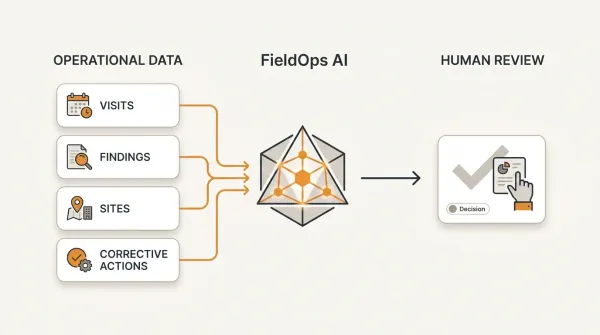
FieldOps was designed as an Operational Intelligence platform for NGOs, governments and development programmes.
Rather than focusing solely on field data collection, FieldOps manages the operational lifecycle that surrounds every monitoring visit, inspection or supervision activity.
FieldOps applies the architectural principles discussed throughout this article in several ways.
- Structured visit lifecycles guide operational records from draft through review and approval.
- Findings become structured operational records rather than narrative observations buried within reports.
- Corrective actions enable organisations to assign ownership, monitor implementation and verify completion.
- Audit trails and version history preserve operational transparency throughout the lifecycle of every visit.
- Operational information can originate from FieldOps, Excel imports, KoboToolbox or ODK Central, enabling organisations to complement existing field technologies.
- Enterprise reporting is supported through structured operational data that integrates with Microsoft Power BI, Tableau and external reporting environments through the BI API.
Rather than replacing successful operational practices, FieldOps helps organisations connect them into a unified Operational Intelligence architecture where information is captured once, governed consistently and reused throughout the organisation.
Evaluation Checklist
When evaluating field visit management software, consider whether the platform supports long-term operational maturity rather than simply replacing paper forms.
| Evaluation Question | Why It Matters |
|---|---|
| Does the platform support the complete visit lifecycle? | Ensures operational processes remain connected. |
| Are findings managed as structured operational records? | Improves visibility and trend analysis. |
| Can corrective actions be tracked through to completion? | Strengthens accountability. |
| Are review and approval workflows supported? | Improves governance and reporting confidence. |
| Are audit trails and version history maintained? | Supports transparency and organisational trust. |
| Does the platform integrate with existing technologies? | Protects previous technology investments. |
| Can operational information support enterprise reporting? | Enables better decision-making. |
| Can the platform scale across multiple programmes and countries? | Supports organisational growth. |
| Does it reduce duplicate reporting effort? | Improves efficiency. |
| Does it help transform operational data into Operational Intelligence? | Maximises the value of every field visit. |
Organisations that evaluate software using these broader criteria are far more likely to invest in platforms that continue delivering value as programmes expand, governance requirements evolve and reporting expectations become increasingly sophisticated.
Final Thoughts
Every field visit represents an investment of time, expertise and organisational resources.
Field teams travel long distances, engage communities, inspect facilities, verify implementation and document observations that influence programme decisions for months or even years.
The value of that investment should not end when a report is submitted.
Organisations that continue treating field visits as isolated reporting activities often accumulate large volumes of information while struggling to answer fundamental operational questions.
Where are the greatest programme risks?
Which recommendations have been implemented?
Which interventions consistently improve outcomes?
How should leadership allocate limited operational resources?
Answering these questions requires more than digital forms.
It requires an operational architecture that connects planning, execution, governance, findings, corrective actions and reporting into a continuous cycle of organisational learning.
This is why the future of field visit management extends far beyond data collection.
It is about transforming operational activities into trusted information that strengthens accountability, accelerates decision-making and continuously improves programme delivery.
For NGOs, governments and development programmes operating in increasingly complex environments, that shift represents more than a technological upgrade.
It represents a new way of managing programmes—one where every field visit contributes to stronger governance, better decisions and better outcomes for the communities they serve.
Operational Intelligence for NGOs, Governments and Development Programmes
Capture once. Use everywhere.
Move beyond data collection
FieldOps helps NGOs manage field visits, monitoring templates, findings, corrective actions, dashboards and donor reporting in one operational intelligence platform.
Learn more about FieldOps