How to Track M&E Findings and Corrective Actions After Monitoring Visits
Learn how NGOs can track monitoring findings, assign corrective actions, monitor deadlines, document evidence and verify whether issues have actually been resolved.
A monitoring visit is supposed to do more than produce a report.
It should help an organization identify problems, assign responsibility, take corrective action and determine whether the situation improves.
Yet this is where many M&E processes break down.
A monitoring team visits a project site.
They identify several issues.
The findings are documented in KoboToolbox, ODK, a Word document, PDF report or Excel spreadsheet.
The report is shared.
A few weeks later, management asks:
What happened to those findings?
The answer may require searching through emails, spreadsheets, reports and previous monitoring forms.
Some actions may have been completed.
Others may still be pending.
Some may have no assigned owner.
Others may have passed their deadlines.
And some may have been marked "closed" without clear evidence that the underlying problem was actually resolved.
This creates a common M&E problem:
Finding a problem is easier than managing what happens next.
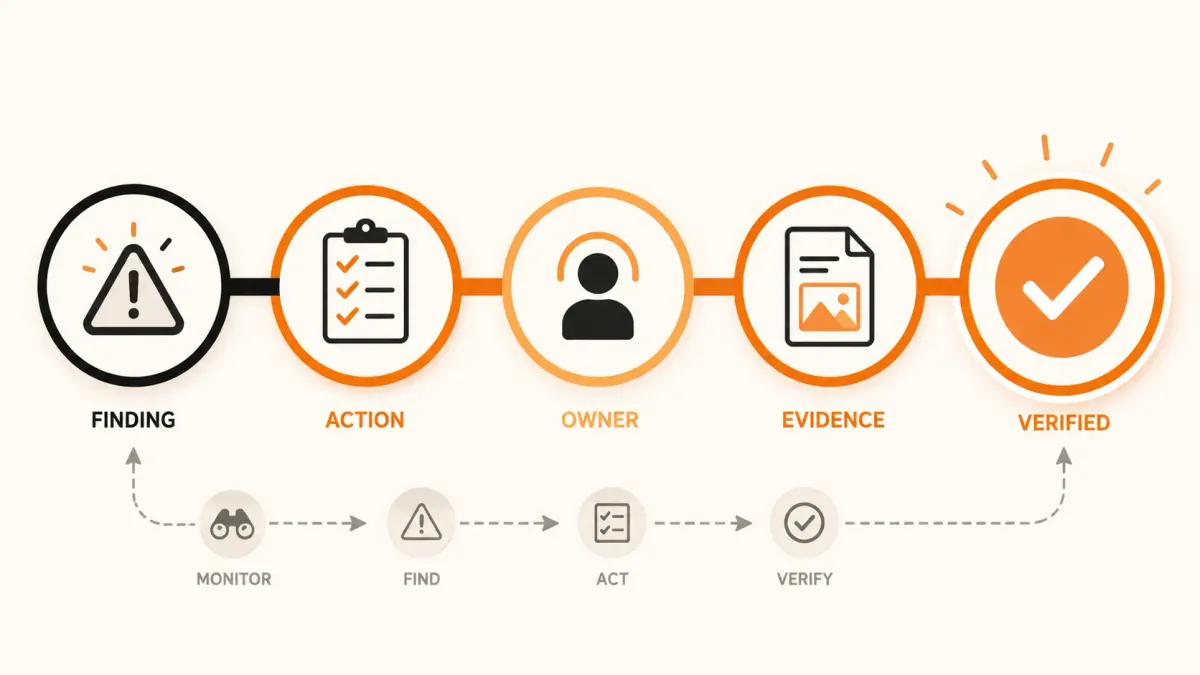
Effective monitoring requires a closed loop:
Finding → Action → Owner → Deadline → Evidence → Verification → Closure
Without that loop, monitoring can become a cycle of repeatedly identifying the same problems.
What is a monitoring finding?
A finding is an issue, observation, gap, strength or condition identified during monitoring.
For example:
The facility does not maintain complete immunization records.
Or:
Three sampled beneficiary files were missing required documentation.
Or:
The project site has not received the required supplies for the past six weeks.
Or:
Monthly reporting was submitted after the required deadline for three consecutive periods.
A finding becomes operationally useful when it is structured well enough to determine what should happen next.
Not every observation should become a corrective action
This distinction is important.
A monitoring visit may identify:
- observations,
- strengths,
- recommendations,
- findings,
- risks,
- non-compliance,
- and corrective actions.
Not every observation requires a formal corrective action.
For example:
Observation
Staff demonstrated good knowledge of the reporting procedure.
No action required.
But:
Finding
Required reporting documentation was incomplete.
This may require:
Corrective action
Complete the missing documentation and introduce a monthly documentation review.
Separating observations from actionable findings helps teams focus their follow-up efforts.
The basic corrective-action workflow
A useful corrective-action process can be represented as:
Finding
↓
Corrective Action
↓
Responsible Person
↓
Due Date
↓
Evidence
↓
Verification
↓
Closed
Each step answers a different question.
Finding
What is wrong?
Corrective action
What needs to change?
Responsible person
Who is accountable?
Due date
When should it be completed?
Evidence
What demonstrates that the action was taken?
Verification
Has the issue actually been resolved?
Closure
Can the organization formally consider the action complete?
This structure creates accountability.
Why recording findings is not enough
Imagine a monitoring visit identifies:
10 findings
The report is uploaded to a shared folder.
The organization has technically documented the problems.
But six months later, management cannot easily determine:
- which findings were addressed,
- who was responsible,
- which deadlines were missed,
- which findings remain open,
- and whether the same issues were identified again.
The organization has information but not workflow.
That distinction is critical.
The Excel corrective-action tracker
A common solution is an Excel spreadsheet.
For example:
| Finding | Site | Owner | Due date | Status |
|---|---|---|---|---|
| Missing records | Site A | Officer 1 | Aug 10 | Open |
| Stock-out | Site B | Officer 2 | Aug 15 | Complete |
| Late reporting | Site C | Officer 3 | Aug 20 | Overdue |
This is a reasonable starting point.
The problem appears when the tracker becomes the central operational system.
As the number of projects, sites and findings increases, the workbook can become difficult to manage.
A single organization may eventually have:
- hundreds of findings,
- dozens of projects,
- hundreds of sites,
- multiple responsible officers,
- different deadlines,
- supporting documents,
- follow-up visits,
- and recurring findings.
The spreadsheet becomes a miniature workflow application.
That is where problems begin.
The biggest problem: ownership
A corrective action without an owner is usually just a recommendation.
Consider:
"The project should improve data quality."
Who is responsible?
The project manager?
M&E officer?
Site manager?
Data clerk?
Program director?
Without explicit ownership, the action can remain unresolved indefinitely.
A structured corrective-action workflow should therefore require:
Responsible person
and, where appropriate:
Responsible team
This changes the conversation from:
Someone should fix this.
to:
This person is responsible for resolving this finding by this date.
Deadlines create accountability
A corrective action should normally have a due date when the issue requires follow-up.
For example:
Finding
Stock records are incomplete.
Action
Reconcile stock records and introduce a weekly stock review.
Owner
Facility Manager.
Due date
August 20.
Now the organization can determine whether the action is:
Open
Due
Overdue
Completed
Verified
This is much more useful than a generic "pending" status.
"Completed" does not always mean "resolved"
This is one of the most important distinctions in corrective-action management.
Suppose a facility reports:
"We have completed the action."
That may mean the responsible person says the action was performed.
But management may still need to verify the result.
For example:
Finding
Patient registers were incomplete.
Corrective action
Train staff and ensure all registers are completed correctly.
Reported status
Completed.
But during the next monitoring visit, the same problem appears.
The action was marked completed.
The problem was not actually resolved.
This is why a mature workflow distinguishes:
Action completed
from:
Issue verified as resolved
Evidence matters
Corrective actions should often have supporting evidence.
Depending on the type of action, evidence might include:
- revised documents,
- photographs,
- attendance records,
- training materials,
- stock records,
- system screenshots,
- signed forms,
- updated registers,
- or follow-up monitoring results.
The evidence should be linked to the action rather than stored somewhere unrelated.
This creates a stronger audit trail.
Verification closes the loop
Verification asks:
Did the corrective action actually address the finding?
For example:
Finding
Required beneficiary documentation was missing.
Action
Complete missing documentation and retrain responsible staff.
Evidence
Updated records and training attendance list.
Verification
M&E officer reviews a sample of beneficiary files.
Result
Documentation is now complete.
Status
Closed.
The organization can now demonstrate not only that someone claimed to complete the action, but that the underlying issue was checked.
Findings should remain connected to the monitoring visit
A finding should not exist in isolation.
It should be traceable to:
Project
Site
Monitoring Visit
Finding
Corrective Action
For example:
Project
Maternal Health Quality Improvement
↓
Site
Facility A
↓
Monitoring Visit
July 15, 2026
↓
Finding
Incomplete immunization documentation
↓
Corrective Action
Complete missing records and implement weekly review
↓
Owner
Facility Manager
↓
Due Date
August 1, 2026
↓
Verification
August 12, 2026
↓
Status
Closed
This creates a complete operational history.
Why site-level history matters
Suppose the same finding appears three times:
January
Incomplete documentation.
April
Incomplete documentation.
July
Incomplete documentation.
If the organization treats each finding as an isolated report, it may simply record three separate issues.
A site-level history reveals something more important:
This is a recurring problem.
Recurring findings deserve a different management response.
The organization may need to investigate:
- whether the corrective action was insufficient,
- whether the responsible person changed,
- whether staff need additional support,
- whether the process itself is flawed,
- or whether the underlying cause has not been addressed.
Recurring findings are a management signal
Consider:
| Site | Finding | Occurrences |
|---|---|---|
| Site A | Incomplete records | 1 |
| Site B | Incomplete records | 2 |
| Site C | Incomplete records | 5 |
Site C deserves additional attention.
The problem is no longer simply:
"There is a finding."
It is:
"The same issue has persisted through five monitoring cycles."
That is valuable management information.
Finding severity matters
Not every finding has the same level of risk.
An organization may classify findings as:
Low
Minor issue with limited operational impact.
Medium
Issue requiring corrective action and monitoring.
High
Significant issue requiring management attention.
Critical
Serious issue requiring immediate escalation.
Severity helps teams prioritize.
For example, an M&E manager may have:
83 open findings
But only:
7 high-severity findings
Those seven may deserve immediate attention.
Status alone is not enough
A list of findings might show:
| Finding | Status |
|---|---|
| Missing records | Open |
| Stock-out | Open |
| Late report | Complete |
| Training gap | Open |
This is useful.
But management may also need:
- severity,
- age,
- owner,
- due date,
- project,
- site,
- previous occurrences,
- and verification status.
A better operational view could identify:
12 high-severity findings are open, including 4 that are overdue by more than 30 days.
That is a much stronger management signal.
Finding aging is important
The age of an unresolved finding matters.
For example:
| Finding | Age |
|---|---|
| Finding A | 4 days |
| Finding B | 18 days |
| Finding C | 46 days |
| Finding D | 103 days |
A 103-day-old unresolved finding should probably receive more attention than one identified four days ago.
Organizations can therefore categorize findings by age:
0–30 days
31–60 days
61–90 days
90+ days
This helps management identify persistent problems.
Overdue actions should be visible
A corrective-action system should make overdue work obvious.
For example:
Open actions: 48
Due soon: 11
Overdue: 9
Verified: 28
Management should be able to drill into the nine overdue actions.
For each action, they may want to see:
- project,
- site,
- finding,
- owner,
- due date,
- severity,
- and last follow-up.
This turns a generic number into a management workflow.
Email reminders can help, but they are not the workflow
Organizations often try to solve corrective-action management by sending reminder emails.
For example:
"Reminder: Please complete the corrective action by Friday."
Reminders are useful.
But email alone does not provide a reliable system of record.
A person may respond:
"Done."
But where is the evidence?
Who verified it?
Was the issue actually resolved?
When did it close?
What happened during the next monitoring visit?
A reminder should support the workflow, not replace it.
Findings should be actionable
Poorly written findings often make corrective actions difficult.
Compare:
Weak finding
Data quality needs improvement.
Better finding
During the review of 30 beneficiary records, 7 records were missing the required eligibility documentation.
The second finding provides:
- the specific problem,
- the evidence,
- and the scale.
The corrective action can therefore be more precise.
For example:
Review the seven incomplete records, correct the missing documentation and introduce a monthly quality check for beneficiary files.
Good findings produce better actions.
Corrective actions should address causes where possible
Another common problem is creating actions that treat symptoms rather than causes.
Suppose the finding is:
Monthly reports are repeatedly submitted late.
A weak corrective action might be:
Submit the next report on time.
A stronger action might investigate:
- who prepares the report,
- whether source data arrives late,
- whether responsibilities are unclear,
- whether the reporting template is unnecessarily complex,
- or whether there is no internal review deadline.
The corrective action might therefore be:
Establish an internal reporting deadline five working days before the external deadline and assign a named reviewer.
This addresses the process rather than only the immediate incident.
One finding can have multiple actions
Some problems require more than one corrective action.
For example:
Finding
Facility staff are not consistently following infection-prevention procedures.
Possible actions:
- Conduct refresher training.
- Update the procedure checklist.
- Assign a supervisor to conduct weekly checks.
- Review compliance during the next monitoring visit.
The finding remains one issue.
The actions represent the steps required to address it.
This is another reason why corrective actions should be structured records rather than simply a text field inside a monitoring form.
Corrective actions should have evidence
Consider:
Action
Train facility staff on infection-prevention procedures.
Evidence:
Training attendance sheet
Training materials
Photographs
Post-training assessment
The organization can then review the evidence during verification.
This creates a stronger chain:
Finding → Action → Evidence → Verification
Follow-up visits can verify previous findings
The next monitoring visit should not start from zero.
The monitoring officer should be able to see relevant previous findings.
For example:
Previous finding
Stock records were incomplete.
Corrective action
Reconcile stock records and implement weekly reviews.
Previous status
Action completed.
During the new visit, the officer can verify:
Are stock records now complete?
If the problem remains, the new visit can record a recurring finding.
This creates continuity across monitoring cycles.
The monitoring process becomes a continuous loop
A mature M&E workflow can therefore look like:
Plan
↓
Monitor
↓
Identify findings
↓
Create corrective actions
↓
Assign responsibility
↓
Set deadlines
↓
Collect evidence
↓
Verify
↓
Close
↓
Monitor again
The next monitoring cycle then provides evidence about whether the corrective actions actually worked.
This is much closer to continuous program improvement than simply producing monitoring reports.
What happens when corrective actions are not tracked?
Without structured follow-up, several problems can occur.
Findings disappear into reports
The report exists, but nobody owns the resolution.
The same findings keep returning
Monitoring teams repeatedly identify the same problems.
Management cannot see the backlog
There is no reliable count of open or overdue actions.
Accountability becomes unclear
People remember discussing issues but cannot establish who was responsible.
Evidence is scattered
Supporting documentation is stored in email threads or shared folders.
Closure becomes subjective
An action is marked complete without verification.
Reporting becomes manual
M&E teams spend hours compiling status updates.
These are operational problems, not simply reporting problems.
A structured findings register
A useful findings register might contain:
| Field | Example |
|---|---|
| Finding ID | F-2026-0142 |
| Project | Maternal Health Project |
| Site | Facility A |
| Visit | July 15, 2026 |
| Finding | Incomplete documentation |
| Severity | High |
| Owner | Facility Manager |
| Due date | August 1, 2026 |
| Status | Overdue |
| Evidence | Not submitted |
| Verification | Pending |
This provides a single operational record.
A structured corrective-action register
Actions can also be tracked separately:
| Action | Finding | Owner | Due date | Status |
|---|---|---|---|---|
| Complete missing records | F-0142 | Facility Manager | Aug 1 | Overdue |
| Staff refresher training | F-0143 | Project Officer | Aug 5 | Open |
| Update reporting checklist | F-0144 | M&E Officer | Aug 10 | Complete |
This makes responsibility explicit.
Management needs summary and detail
Senior management may only need:
Open findings: 64
High severity: 9
Overdue: 17
Overdue >30 days: 6
But an M&E manager may need to drill into those numbers.
For example:
High-severity overdue findings
→ Project A
→ Site 014
→ Finding F-0142
→ Responsible person
→ Due date
→ Evidence
→ Previous monitoring history
A good system should support both levels.
The most important question is not "How many findings?"
The number of findings alone can be misleading.
Suppose:
Project A
100 findings.
Project B
20 findings.
It might appear that Project A has a much bigger problem.
But Project A may have an excellent monitoring system that identifies issues consistently.
Project B may simply have weaker monitoring.
A better set of questions includes:
- How severe are the findings?
- How old are they?
- How many are recurring?
- How quickly are actions completed?
- How many have been verified?
- Which sites generate the most findings?
- Are findings associated with poor performance?
- Are corrective actions improving outcomes?
This moves the organization from counting findings to understanding them.
Link findings to performance
Suppose a project tracks an indicator:
Percentage of facilities meeting quality standards
Target:
90%
A site is at:
62%
The monitoring visit identifies:
- inadequate staff training,
- incomplete records,
- missing supplies.
Corrective actions are created.
Three months later:
Performance = 81%
The organization can now examine whether the operational interventions correspond with improvement.
This does not automatically establish causality.
But it provides an important evidence trail.
Findings can become organizational learning
Over time, an organization may identify patterns across projects.
For example:
Most common finding categories
- Data quality
- Documentation
- Stock management
- Staff capacity
- Reporting timeliness
This can reveal systemic problems.
If documentation findings occur across ten projects, the organization may need an organization-wide intervention rather than ten separate corrective actions.
The M&E system can therefore support learning beyond individual sites.
The difference between monitoring and improvement
Monitoring answers:
What did we find?
Improvement asks:
What are we going to do about it?
A strong M&E process needs both.
The monitoring visit creates evidence.
The finding describes the problem.
The corrective action defines the response.
Verification determines whether the response worked.
That is the operational chain that turns monitoring into improvement.
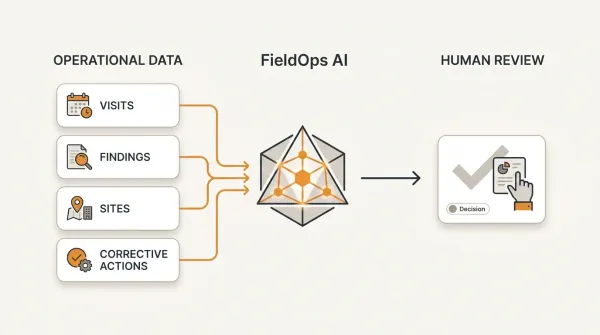
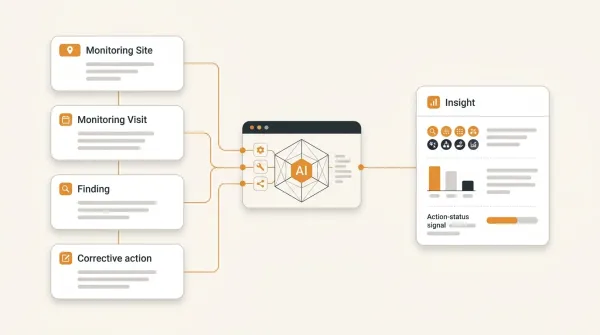
Where FieldOps fits
FieldOps provides a structured operational workflow around monitoring.
A project can have sites.
Sites can have monitoring visits.
Visits can produce findings.
Findings can have corrective actions.
Corrective actions can have owners, deadlines, evidence and statuses.
This creates a connected structure:
Project → Site → Visit → Finding → Action → Evidence → Verification → Closure
The result is that a monitoring visit does not end when the field officer submits the form.
The information can continue through the organization's follow-up workflow.
FieldOps can also preserve monitoring history at the site and project level.
This makes it possible to see not only what was found during the current visit, but what happened previously.
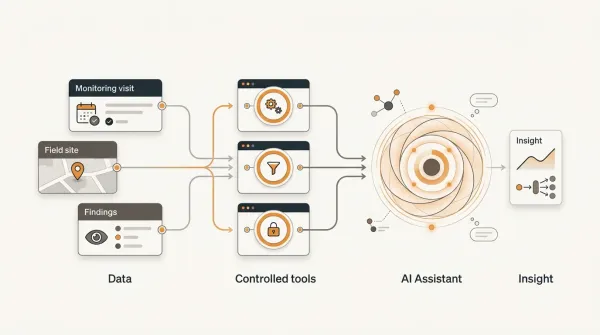
FieldOps does not replace field-data collection
Organizations can continue using their preferred data-collection tools.
For example:
KoboToolbox
for field forms.
ODK
for field forms.
DHIS2
for routine health information.
FieldOps can provide the operational structure around the monitoring process.
The important distinction is:
Data collection
versus:
Operational follow-up
A field form can capture:
"The facility has incomplete records."
The operational workflow needs to answer:
Who will fix it?
By when?
What evidence is required?
Has it been verified?
Is the issue recurring?
Is the action overdue?
That is where structured corrective-action management becomes valuable.
A practical implementation approach
Organizations can improve their corrective-action process without trying to redesign everything at once.
Step 1: Standardize finding fields
Define fields such as:
- finding description,
- category,
- severity,
- project,
- site,
- monitoring visit,
- date identified.
Step 2: Standardize corrective actions
Define:
- action,
- owner,
- due date,
- status,
- evidence,
- verification.
Step 3: Define statuses
Use clear states such as:
Open
In progress
Submitted for verification
Verified
Closed
Overdue
Step 4: Define escalation rules
For example:
High-severity findings may require management escalation.
Actions overdue by more than 30 days may require additional follow-up.
Step 5: Preserve history
Do not overwrite previous monitoring results.
Maintain a historical record of findings and actions.
Step 6: Review recurring findings
Identify issues that repeatedly appear at the same sites.
Step 7: Connect findings to performance
Where relevant, compare operational findings with program indicators.
Step 8: Make the backlog visible
Management should be able to see:
- open findings,
- overdue actions,
- high-severity issues,
- recurring findings,
- and unresolved issues.
Step 9: Verify before closure
Do not treat an action as fully resolved simply because someone reports that it is complete.
Step 10: Use follow-up monitoring
The next visit should confirm whether the underlying issue remains resolved.
A mature corrective-action workflow
The complete process can be summarized as:
Monitoring Visit
↓
Finding Identified
↓
Severity Assessed
↓
Corrective Action Created
↓
Responsible Person Assigned
↓
Due Date Set
↓
Action Implemented
↓
Evidence Submitted
↓
M&E Verification
↓
Finding Closed
↓
Next Monitoring Visit
↓
Effectiveness Checked
This creates accountability across the entire monitoring lifecycle.
Conclusion
The value of monitoring does not end when the monitoring report is submitted.
The real value comes from what happens after the finding is identified.
A strong M&E system should make it possible to answer:
- What was found?
- Where was it found?
- When was it found?
- How serious is it?
- Who is responsible?
- What corrective action is required?
- When is it due?
- Has evidence been submitted?
- Has the action been verified?
- Is the finding still open?
- Has the same problem occurred before?
- Did the situation improve afterward?
Without these connections, organizations can spend considerable resources identifying problems without reliably resolving them.
The operational workflow is therefore:
Monitor → Find → Act → Verify → Learn
That is what turns monitoring from a reporting exercise into a continuous improvement process.
KoboToolbox and ODK can help collect evidence from the field.
DHIS2 can provide important routine performance data.
Excel can support analysis.
But organizations still need a reliable operational process for managing what happens after a problem is discovered.
A finding that is documented but never followed through is information, not improvement.
For organizations managing multiple projects and sites, connecting monitoring visits to findings, corrective actions, evidence and verification can create a much clearer path from field evidence to management action.
Key takeaways
-
A monitoring finding should lead to a defined management response when action is required.
-
Corrective actions should have clear owners and deadlines.
-
"Completed" is not always the same as "verified and resolved."
-
Evidence should be associated with corrective actions where appropriate.
-
Findings should remain connected to the monitoring visit, project and site where they originated.
-
Recurring findings can reveal systemic problems that require more than one corrective action.
-
Finding severity and age help management prioritize limited resources.
-
Overdue corrective actions should be visible rather than buried in spreadsheets or reports.
-
Follow-up monitoring provides an opportunity to verify whether corrective actions actually worked.
-
Connecting findings with performance data can help organizations understand whether operational problems are associated with poor program outcomes.
-
The objective of corrective-action management is not simply to close tasks; it is to resolve the underlying problem.
-
A strong M&E workflow connects monitoring evidence to findings, actions, verification and organizational learning.
Frequently asked questions
What is a corrective action in M&E?
A corrective action is a defined response intended to address a problem identified through monitoring, assessment, audit or another form of program oversight.
How do you track corrective actions from monitoring visits?
Record each actionable finding, assign a responsible person, establish a due date, track the action's status, collect supporting evidence where appropriate, and verify whether the underlying issue has been resolved.
What is the difference between a finding and a corrective action?
A finding describes an identified issue or condition. A corrective action describes what should be done in response to that issue.
Should every monitoring finding have a corrective action?
No. Some observations may not require formal action. Corrective actions are most appropriate when a finding requires a defined response or follow-up.
Why do corrective actions become overdue?
Common causes include unclear ownership, unrealistic deadlines, competing priorities, insufficient resources, weak follow-up processes and actions that do not address the underlying cause of the problem.
Should corrective actions have deadlines?
When an action requires follow-up, a defined deadline generally makes accountability clearer and allows management to identify overdue work.
What evidence should be collected for corrective actions?
Evidence depends on the action. It may include updated records, photographs, training attendance sheets, revised procedures, stock records, reports or results from a follow-up monitoring visit.
What does verification mean in corrective-action management?
Verification is the process of determining whether the corrective action was actually implemented and whether it adequately addressed the original finding.
Why should findings be linked to project sites?
Site-level linkage preserves context and makes it possible to identify recurring problems, compare sites and understand the history of monitoring activity at a specific location.
How can recurring findings be identified?
Maintain historical findings linked to the relevant project and site, then analyze repeated findings by category, site, severity and monitoring period.
Can KoboToolbox track corrective actions?
KoboToolbox can collect information about findings and proposed actions through forms. However, managing a longer-running corrective-action workflow involving ownership, deadlines, evidence, verification, escalation and historical tracking may require an additional operational layer.
Can ODK track corrective actions?
ODK can collect corrective-action information as part of a form workflow. Organizations may still need a separate operational workflow to manage actions across multiple monitoring cycles and ensure that unresolved issues remain visible.
How does FieldOps help with corrective actions?
FieldOps connects projects, sites, monitoring visits, findings and corrective actions in a structured operational workflow. This allows organizations to track responsibility, deadlines, evidence, verification and closure while preserving the history of what was found at each site.
Move beyond data collection
FieldOps helps NGOs manage field visits, monitoring templates, findings, corrective actions, dashboards and donor reporting in one operational intelligence platform.
Learn more about FieldOps