What Happens When AI Looks Across Multiple Monitoring Visits?
A single monitoring visit provides a snapshot. Multiple visits provide a history. When AI can work across connected visits, M&E teams can ask questions about change, persistence and recurring issues without manually comparing records one by one.
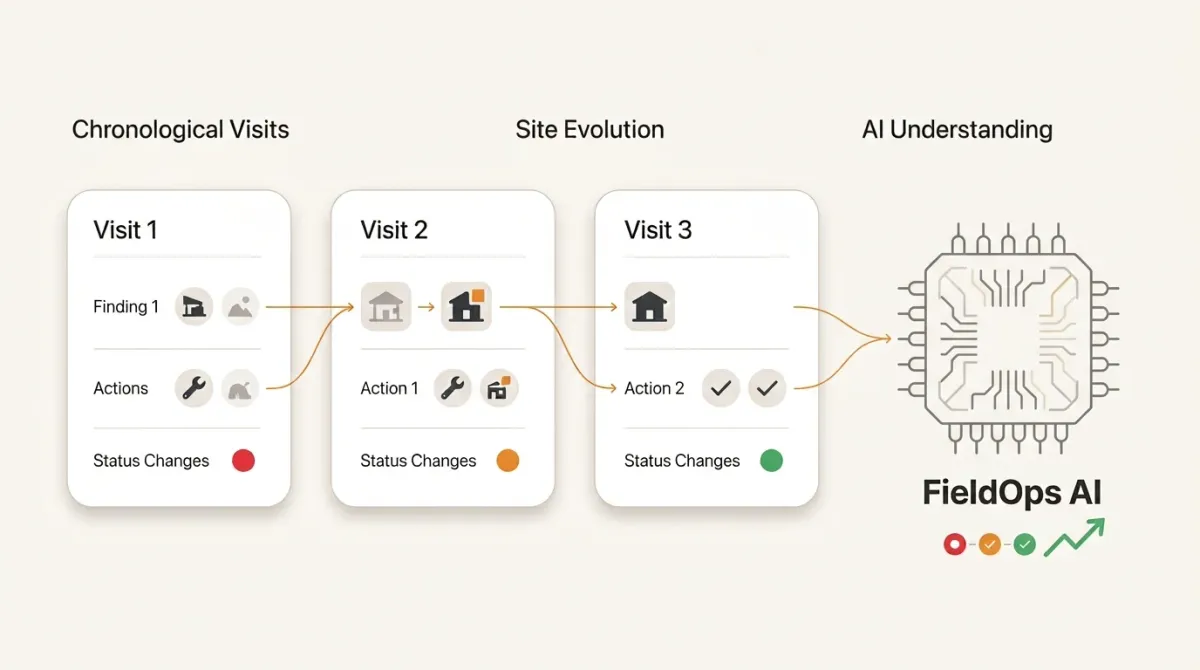
A single monitoring visit provides a snapshot. Multiple visits provide a history.
That difference matters.
When monitoring data is stored as isolated reports, understanding change over time often means opening several records, comparing findings, checking previous actions, and trying to reconstruct what happened.
When monitoring visits are connected, the same information can become much easier to explore.
This is one of the areas where an AI assistant connected to operational monitoring data can become useful: helping M&E teams look across multiple visits and reason about what changed, what persisted, and what still needs attention.
A single visit tells you what happened then
Consider a monitoring visit to a health facility.
The visit might record:
- Stock documentation was incomplete.
- Some required records were not available.
- A corrective action was assigned.
- The action was given a due date.
That information is useful.
But by itself, it does not tell you whether the problem was isolated, persistent, or eventually resolved.
To understand that, you need another visit.
And then another.
The real monitoring story starts to emerge from the relationship between those visits.
Multiple visits create a history
Imagine the same site is monitored three times.
During the first visit, the monitoring team identifies incomplete stock documentation.
During the second visit, documentation has improved, but some records are still missing.
During the third visit, the required documentation is complete.
Looking at the visits individually gives you three separate monitoring records.
Looking at them together gives you a progression:
Finding identified → partial improvement → issue resolved
That progression is much more informative than any individual visit.
It allows an M&E professional to ask questions such as:
- What happened to this finding after the first visit?
- Was the corrective action followed up?
- Did the issue persist?
- Did the situation improve?
- When did the change occur?
- Are similar issues still appearing at other sites?
These are questions about history rather than snapshots.
Why comparing visits manually takes time
M&E teams already perform this kind of analysis.
The challenge is often the amount of work involved.
A user may need to:
- Find the site.
- Open the most recent visit.
- Review its findings.
- Find the previous visit.
- Compare the findings.
- Check corrective actions.
- Review their status.
- Repeat the process for earlier visits.
- Determine whether the same issue appears elsewhere.
This becomes increasingly difficult when a programme has many sites and repeated monitoring cycles.
The information may exist in the system, but the path from the question to the answer can still be long.
This is where a conversational interface can change how users interact with the monitoring system.
Instead of manually reconstructing the history, a user could ask:
"What changed at this site across the last three monitoring visits?"
The assistant can retrieve the relevant records and organize the information around that question.
The underlying data has not changed.
The way the user explores it has.
AI can connect the visits
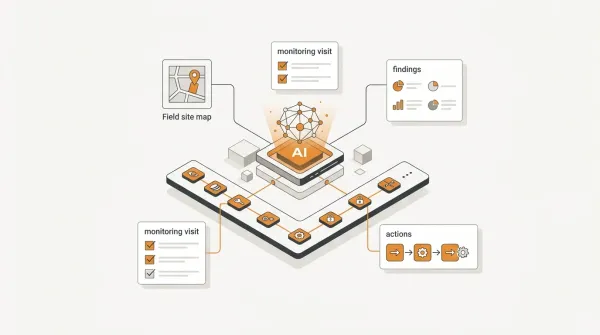
For an AI assistant to reason across multiple visits, the visits need to be connected to the operational context around them.
A monitoring history might look conceptually like this:
Program → Project → Site → Visit 1 → Findings → Actions
Program → Project → Site → Visit 2 → Findings → Actions
Program → Project → Site → Visit 3 → Findings → Actions
The assistant can then examine those records together rather than treating each visit as an unrelated document.
This allows questions about:
- persistence
- improvement
- deterioration
- recurring findings
- completed corrective actions
- unresolved corrective actions
- changes between monitoring periods
- differences between sites
The important point is that the AI is not creating the history.
The monitoring system already contains it.
The AI provides another way to explore it.
Finding persistence is different from finding recurrence
These concepts can sound similar, but they answer different questions.
Suppose a site has a finding about incomplete documentation during three consecutive visits.
That may indicate persistence at the same site.
Now imagine the same type of finding appears at ten different sites during the same quarter.
That is a different pattern.
The first question is:
"Why has this issue remained unresolved at this site?"
The second might be:
"How widespread is this issue across the project?"
Both require looking across multiple records, but they require different types of analysis.
An AI assistant can help users move between these questions without requiring them to manually reconstruct the underlying records each time.
AI can help identify change over time
Change is often more useful than a static status.
Consider a simplified monitoring history:
| Visit | Finding | Corrective action | Status |
|---|---|---|---|
| Visit 1 | Stock records incomplete | Update documentation process | Open |
| Visit 2 | Some records still incomplete | Refresher support provided | In progress |
| Visit 3 | Required records available | Previous action followed up | Resolved |
A dashboard might show that the current finding is resolved.
But the sequence tells a richer story.
The issue was identified, followed up, partially improved, and eventually resolved.
An AI assistant can help summarize that sequence when a user asks about the site's monitoring history.
For example:
"Summarize how the stock documentation issue changed across the last three visits."
The useful answer is not simply the latest status.
It is the progression.
The same approach can reveal unresolved patterns
The opposite can also happen.
Suppose the history looks like this:
Visit 1: Missing stock records
Visit 2: Missing stock records
Visit 3: Missing stock records
Now the important question is no longer simply what was found.
It is:
"Why does this finding keep appearing?"
The assistant can help surface the repeated evidence across visits.
It can also help identify related corrective actions and whether they were recorded as completed.
This does not mean the AI should invent a reason for the persistence.
If the monitoring data does not contain evidence explaining why the issue continued, the assistant should say so.
There is an important difference between:
"The finding persisted across three visits."
and:
"The finding persisted because staff were not trained."
The first statement can be supported by the monitoring records.
The second requires additional evidence.
An AI assistant should not turn an observed pattern into an unsupported explanation.
New findings and recurring findings are different
Multiple visits also help distinguish between problems that are continuing and problems that are appearing for the first time.
Imagine a site with three visits.
The first identifies incomplete documentation.
The second identifies incomplete documentation again and also identifies a new issue with equipment maintenance.
The third shows the documentation issue resolved but the equipment issue still open.
Now there are several different stories happening at the same site.
The documentation finding is recurring and eventually resolved.
The equipment finding is newer and remains unresolved.
Looking only at the latest visit could hide that distinction.
Looking across the history makes it visible.
Multiple visits can also provide programme-level context
The same reasoning can move beyond a single site.
An M&E professional might ask:
"Which sites have had similar findings across multiple monitoring visits?"
Or:
"Which findings have remained unresolved across more than one monitoring cycle?"
Or:
"Show me sites where corrective actions were recorded but the related finding appeared again in a later visit."
These questions require relationships between records.
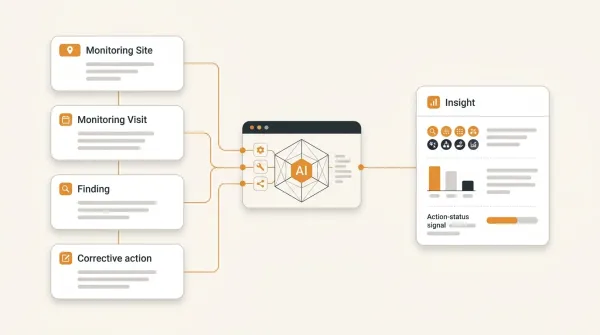
The assistant needs to understand which visit belongs to which site, which finding belongs to which visit, and which corrective action relates to which finding.
Without those relationships, the AI is left trying to reconstruct context from disconnected text.
With them, it can reason over the operational history.
This is why structured monitoring data matters
AI does not make disconnected records connected.
The underlying system has to preserve those relationships.
In FieldOps, monitoring data is structured around the operational context of the organization.
Programs contain projects.
Projects contain sites.
Sites have monitoring visits.
Visits contain findings.
Findings can have corrective actions.
That structure gives an AI assistant something much more useful than a collection of documents.
It provides an operational history.
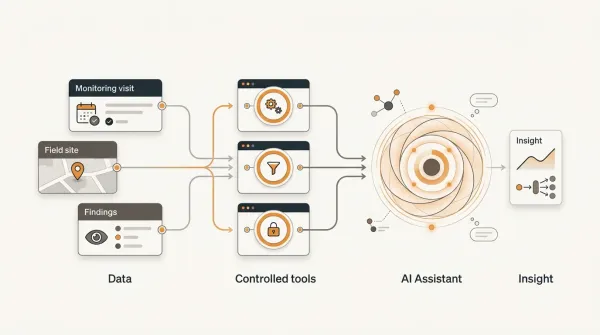
The assistant can then retrieve the records it needs through controlled tools and reason over the information returned.
The question can become conversational
Once the assistant understands the monitoring history, users do not have to formulate every question perfectly from the beginning.
A conversation might start with:
"What changed at this site across the last three visits?"
Then the user could ask:
"Which findings were still unresolved?"
Then:
"Were those findings also present in the previous visit?"
And then:
"Which corrective actions were associated with them?"
Each question builds on the previous context.
This makes the AI interaction less like generating a one-off answer and more like investigating the monitoring record.
The system remains the source of truth.
The conversation becomes an additional interface for exploring it.
Change does not automatically mean causation
There is an important limitation here.
If monitoring data shows that a finding improved between two visits, that does not automatically prove why it improved.
For example:
Visit 1: Documentation incomplete.
Visit 2: Documentation complete.
The records show a change.
They do not necessarily prove that a particular training session, management intervention, or corrective action caused that change.
An AI assistant can report the documented sequence.
It should be much more cautious about explaining causation unless the available evidence supports it.
This distinction matters particularly in development programmes, where monitoring data may be used to inform management decisions and programme learning.
AI should help users see what the evidence says.
It should not manufacture explanations that the evidence does not contain.
Historical completeness matters
There is another practical challenge.
An AI assistant can only reason over the monitoring history available to it.
If a site has five years of monitoring activity but only the last two visits are available in the system, the assistant cannot reliably describe the complete five-year history.
Similarly, if older visits were recorded but findings or corrective actions were not consistently captured, the resulting history may be incomplete.
This is why AI readiness is closely connected to data quality and historical continuity.
The more consistently an organization captures monitoring information, the more useful questions it can eventually ask of that information.
Why FieldOps AI is read-only
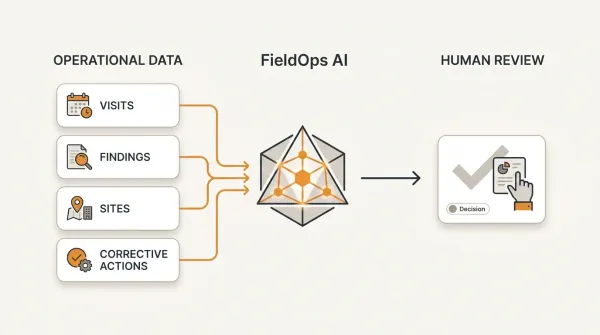
FieldOps AI is designed as a read-only assistant.
That means it can retrieve operational information, connect related records, identify patterns, and explain what the available data shows.
It does not independently modify the underlying visits, findings, or corrective actions.
That distinction is important when analyzing historical monitoring data.
The monitoring records remain the source of record.
The AI is an analysis and interaction layer on top of them.
This also means that when an M&E professional asks about change across multiple visits, the assistant is working with existing evidence rather than silently changing the evidence it is analyzing.
The human remains responsible for deciding what the observed pattern means and what action should follow.
From snapshots to operational history
A single monitoring visit answers:
"What did we find?"
Multiple visits allow a much broader set of questions:
"Did this issue continue?"
"What changed?"
"Was the corrective action followed up?"
"Did the same issue appear again?"
"Which sites are experiencing similar patterns?"
"What remains unresolved?"
Those questions become possible because the monitoring system contains connected records across time.
AI does not replace that underlying structure.
It makes the structure easier to explore.
This is one of the ideas behind FieldOps AI.
The goal is not simply to give M&E teams another chatbot.
It is to give them a natural-language way to investigate the operational information they have already captured.
A monitoring visit is a snapshot.
A series of connected visits becomes a history.
And when AI can reason across that history, M&E teams can spend less time reconstructing what happened and more time understanding what the monitoring data is showing.
Capture once. Use everywhere.
Move beyond data collection
FieldOps helps NGOs manage field visits, monitoring templates, findings, corrective actions, dashboards and donor reporting in one operational intelligence platform.
Learn more about FieldOps